
Astrid & Veronika
Linda Olsson, 2007
Viking Penguin
259 pp.
ISBN-13: 9780143038078
Summary
With extraordinary emotional power, Linda Olsson's stunningly well-crafted debut novel recounts the unusual and unexpected friendship that develops between two women. Veronika, a young writer, rents a house in a small Swedish village as she tries to come to terms with a recent tragedy while also finishing a novel.
Her arrival is silently observed by Astrid, an older, reclusive neighbor who slowly becomes a presence in Veronika's life, offering comfort in the form of companionship and lovingly prepared home-cooked meals.
Set against a haunting Swedish landscape, Astrid & Veronika is a lyrical and meditative novel of love and loss, and a story that will remain with readers long after the characters' secrets are revealed. (From the publisher.)
Author Bio
• Birth—1948
• Where—Stockholm, Sweden
• Education—J.D., University of Stockholm; University of Wellington
• Currently—lives in Auckland, New Zealand
Linda Olsson is a Swedish-born novelist who lives in Auckland, New Zealand. Published in 2003, her first novel, Astrid and Veronika, became an international best seller and was translated into 15 languages. She writes all of her novels in both English and Swedish.
Born and raised in Stockholm, Olsson attended the University of Stockholm. After graduating with a law degree, she worked in banking and finance, eventually getting married and giving birth to three boys.
In 1986, her family left Sweden for Africa where Olsson initially intended to take up a post in Kenya. But she traveled on to Singapore, Britain, and Japan, finally settling in New Zealand with her family in 1990. She continued her studies at the University of Wellington, graduating in English and German literature.
During her time in London, Olsson signed up for a course in creative writing and was encouraged to begin writing short stories. In 2003, after arriving in New Zealand, she won a short story competition run by the Sunday Star Times. She then enrolled in a postgraduate course, "Writing the Novel," and was inspired to try her hand at long-form fiction.
Olsson's first novel was completed in 2005. Astrid and Veronika (originally titled "Let Me Sing You Gentle Songs") became a Swedish bestseller. Subsequent novels include Sonata for Miriam (2009), The Memory of Love (2011—The Kindness of Your Nature in New Zealand ), The Blackbird Sings at Dusk (2016—not available in the U.S.), and A Sister in My House (2016, 2018 in the U.S.).
Under the pen name Adam Sarafis, OLsson has also collaborated with Thomas Sainsbury on the thriller Something is Rotten (2015). (Adapted from Wikipedia. Retrieved 11/6/2018.)
Book Reviews
Unlike the voice of the novel’s omniscient narrator, [the voices of the two women] are natural and vivid, utterly convincing. And unlike the novel’s flatly depicted present, the physical world of the past, in which their stories take place, generously opens to admit us. By the halfway mark, it’s the characters’ voices that are keeping Olsson’s readers going, not her irritating attempt to create suspense. And when the crucial revelations arrive, they’re disappointing. Neither Veronika’s tragedy nor Astrid’s truly illuminates the character of the woman who suffers it. Yet Astrid & Veronika survives this potential derailment because the braiding together of the two women’s voices is simply so beguiling.
Linda Harleman - New York Times
Linda Olsson evokes, with great beauty and precision, the landscape of a friendship between two very different women, each caught in a tragic moment from the past. Their connec-tion, initially as tentative and fragile as the first filaments of ice, gradually strengthens, allowing each woman to give voice to her stories, and in doing so to reclaim "a heart for beauty." Subtle, penetrating, and beautifully written, Astrid and Veronika affirms the power of narrative to transform.
Kim Edwards (author of The Time Traveler's Wife)
In Swedish novelist Olsson's somber debut, Veronika Bergman returns to Sweden after a childhood following her diplomat father around the world (her mother abandoned the family), and after publishing her first novel titled Single, One Way, No Luggage. She rents a small house in a rural town to work on her second, but in solitude finds herself seized by feverish dreams and paralyzed by the "stillness" of the landscape and the memories of her recently dead fiance. Reclusive septuagenarian Astrid Mattson, thought by the village to be a witch, takes an interest in Veronika, and the two strike up a friendship based on loss. Against the backdrop of the changing seasons and their small, plangent houses, the two women slowly tell each other their most closely guarded secrets (which concern their mothers and lovers), and venture, tentatively, out of the safety of their routines. Olsson has a clear feel for the emotional wellsprings of both characters, but can't convert her terse lyricism into a fully realized story.
Publishers Weekly
This is the first novel for Olsson, a native of Stockholm who now lives in New Zealand. Though the pace of her narrative lags at times, readers of Anne Tyler and Jodi Picoult will appreciate the lyrical prose and expert rendering of the themes of heartbreak and loss. —Allison Block
Booklist
Two women, four decades apart in age, share their emotional scars while living next door to each other in a small Swedish town. Olsson's restrained debut has the hallmarks of an Ingmar Bergman film: a leisurely pace, a chilly Scandinavian setting leavened by rich observations of nature and characters whose prim, polite facades eventually disappear, exposing years of anger and hurt. Veronika, a 30-year-old writer, arrives in a tiny village looking for a solitary place where she can work on the follow-up to her successful first novel. The house next to the one she rents is owned by Astrid, a septuagenarian shut-in whose husband is slowly dying in a nursing home miles away. Veronika is sad and embittered, Astrid is so closed-off she has a reputation as the village witch, but as their routines increasingly intersect, their relationship thaws, and they become close friends. Over dinners, hikes and trips into town, they discuss the things that prompted them to seclude themselves. By and large, those things are men: Astrid was cruelly rejected by her grandfather as a child, her true love died when she was a teen, and she spent years in a loveless marriage to a domineering man; Veronika left her boyfriend in Stockholm to live with another man in New Zealand, but that relationship had a tragic ending. It's a story with lots of potential to become overwrought, three-hanky fare, but Olsson refuses to give in to that temptation. Her prose is empathetic while remaining steely and unadorned, never overselling the amount of psychic damage that either character has sustained or glossing over the women's flaws. While the plot demands that the conclusion offer some familiar statements about our capacity toheal, Olsson's observations about breakups and dysfunctional families are carefully thought out and free of cliche. The slow pace is sometimes maddening, but it places the women's personal dramas in strong relief. An appealing, if oddly stoic, meditation on friendship.
Kirkus Reviews
Discussion Questions
1. Astrid has been solitary for so long. Why, then, do you think she is drawn to Veronika, essentially a stranger, and then later allows herself to open up to her so freely?
2. The houses in the novel serve almost as characters. The author describes Astrid’s house as “dark and warm . . . It was an organic part of her and its shapes were ingrained in her body” (p. 9). Discuss how the author uses the houses in the novel. What is the importance of a home in our lives? How does our house/living space define us? What do you think your house/living space says about you?
3. Astrid’s mother committed suicide when Astrid was six-years-old; Veronika’s mother left when Veronika was a child. Talk about the theme of the “absent mother” and how it influences these characters’ lives.
4. What did you think of Astrid’s confession regarding the death of her child? Were you able to understand her actions? Did knowing this about her past affect the way you felt about her? What do you think Astrid expected Veronika’s reaction would be to her story? Was Astrid taking a risk in telling her? Why do you think Veronika reacts in the way she does?
5. Veronika feels very guilty about the death of her fiancé and agonizes over what she could have done differently that day to prevent his death. Why do you think she feels so guilty?
6. When Astrid tries on the floral swimsuit during Veronika’s birthday “outing,” the women burst out into laughter. (p. 85). Why do the women find this moment so hysterically funny? How does this day, Veronika’s birthday, serve as a turning point in the novel?
7. After her husband dies, Astrid says to Veronika , “There was nothing more to be afraid of. . . . It was never about him. It was about me” (p.167). What does she mean?
8. Veronika visits her father after her fiancé’s death, and when she is leaving her father begins to say, “I wish . . .” but doesn’t complete the sentence (p. 200). What do you think he was going to say? How would you describe Veronika’s relationship with him?
9. Great literary novels skillfully incorporate sometimes elaborate symbolism. In Astrid & Veronika, Ollson makes repeated and significant references to water. Discuss the symbolic function of water in the novel and consider how water may be connected with Olsson’s major themes.
10. Discuss how the seasons shape the novel. How do the seasons influence the characters? Discuss the ways that the seasons affect you throughout the year? Are your memories connected to the seasons in which they took place?
11. In her letter to Veronika, Astrid mentions “a great love” (p. 241). Whom do you think she is talking about?
(Questions issued by publisher.)
top of page (summary)


Assemetry
Lisa Halliday, 2018
Simon & Schuster
288 pp.
ISBN-13: 9781501166761
Summary
A singularly inventive and unforgettable debut novel about love, luck, and the inextricability of life and art, from 2017 Whiting Award winner Lisa Halliday.
Told in three distinct and uniquely compelling sections, Asymmetry explores the imbalances that spark and sustain many of our most dramatic human relations: inequities in age, power, talent, wealth, fame, geography, and justice.
The first section, "Folly," tells the story of Alice, a young American editor, and her relationship with the famous and much older writer Ezra Blazer. A tender and exquisite account of an unexpected romance that takes place in New York during the early years of the Iraq War, "Folly" also suggests an aspiring novelist’s coming-of-age.
By contrast, "Madness" is narrated by Amar, an Iraqi-American man who, on his way to visit his brother in Kurdistan, is detained by immigration officers and spends the last weekend of 2008 in a holding room in Heathrow.
These two seemingly disparate stories gain resonance as their perspectives interact and overlap, with yet new implications for their relationship revealed in an unexpected coda.
A stunning debut from a rising literary star, Asymmetry is an urgent, important, and truly original work that will captivate any reader while also posing arresting questions about the very nature of fiction itself. (From the publisher.)
Author Bio
• Birth—ca. 1976
• Raised—Medfield, Massachusetts, USA
• Education—Harvard University
• Awards—Whiting Award
• Currently—lives in Milan, Italy
Lisa Halliday has worked as a freelance editor and translator in Milan, where she lives with her husband. Her short story "Stump Louie" appeared in The Paris Review in 2005, and she received a Whiting Award for Fiction in 2017. Asymmetry is her first novel. (From the pubisher.)
Book Reviews
Asymmetry is extraordinary, and the timing of its publication seems almost like a feat of civics.… Halliday’s prose is so strange and startingly smart that its mere existence seems like commentary on the state of fiction.… It’s a first novel that reads like the work of an author who has published many books over many years.… Halliday has written, somehow all at once, a transgressive roman a clef, a novel of ideas, and a politically engaged work of metafiction.
Alice Gregory - New York Times Book Review
A scorchingly intelligent first novel …a clever comedy of manners set in Manhattan as well as a slowly unspooling tragedy about an Iraqi-American family, which poses deep questions about free will, fate and freedom, the all-powerful accident of one’s birth and how life is alchemized into fiction.… [Asymmetry] will make you a better reader, a more active noticer. It hones your senses.
Parul Segha - New York Times
A brilliant and complex examination of power dynamics in love and war.
Sam Sacks - Wall Street Journal
It’s hard to deny, by the novel’s end, that Alice/Halliday has pulled off this stunt of transcendence. As with a gymnast who’s just stuck a perfect routine, your impulse is to ask her, what’s next?
Christian Lorentzen - New York Magazine
Lisa Halliday’s debut novel, Asymmetry, begins with a lopsided affair—a perfect vehicle for a story of inexperience and advantage.… Alice and Amar may be naive, but Halliday is knowing–about isolation, dissatisfaction and the pain of being human.
Time
Asymmetry is a debut burnished to a maximum shine by technical prowess, but it offers readers more than just a clever structure: a familiar world gone familiarly mad.
New Republic
(Starred review.) [A] stellar and inventive debut, a puzzle of seemingly incongruous pieces that, in the end, fit together perfectly.… Any reader who values innovative fiction should treasure this.
Publishers Weekly
(Starred review.) While the first story may have readers wondering about the characters' motivations…, the second builds a picture of life as a dual national, the eventual need to pick a side.… [T]hought-provoking…evocative. —Joanna Burkhardt, Univ. of Rhode Island Libs., Providence
Library Journal
(Starred review.) [A] beautiful debut…. Halliday deftly and subtly intersects the two disparate stories, resulting in a deep rumination on the relation of art to life and death. — Cortney Ophoff
Booklist
(Starred review.) Two seemingly unrelated novellas form one delicately joined whole in this observant debut.… A singularly conceived graft of one narrative upon another; what grows out of these conjoined stories is a beautiful reflection of life and art.
Kirkus Reviews
Discussion Questions
1. Why do you think Halliday chose to title her novel Asymmetry? Discuss the central relationships within the book. In what ways are they unequal? Are there other things that are asymmetrical within the book in addition to the interpersonal relationships? Discuss them with your book club.
2. Alice tells Ezra, "I guess you could say … that I’m a good old-fashioned girl" (p. 17). Describe the context of this statement. How did you interpret the statement? How would you describe Alice? Did your perception of her change throughout the novel? In what ways?
3. Discuss the structure of the novel. Did the titles of each section frame your understanding of the narrative that follows? If so, how? Who or what do you think "Folly" and "Madness" refer to?
4. Amar recounts how at a dinner with Maddie and one of Maddie’s high school friends, the conversation turned to religion. Were you surprised to learn that Amar was religious, given that he identifies as an empiricist? How does he reconcile the two belief systems that are seemingly at odds? Explain his argument in favor of religion.
5. Amar says that his mother has told him, "You would be happier …if you were more like your brother. Sami lives in the moment, like a dog," and then notes with irony that Sami’s name means "high, lofty, or elevated—not traits you’d readily associate with [a dog]" (p. 149). Did you find yourself making certain assumptions about the characters based on their names? If so, what were they? Ezra’s name isn’t revealed immediately when he starts spending time with Alice. What’s the effect?
6. Amar "once heard a filmmaker say that in order to be truly creative a person must be in possession of four things: irony, melancholy, a sense of competition, and boredom" (p. 152). Do you agree? What do you think leads to creativity? As a well-respected author, Ezra is viewed by many as "truly creative." Do you think he possesses all the characteristics enumerated in the statement? Share some examples.
7. When they are discussing a homeless man in their neighborhood, Ezra chastises Alice, telling her, "Don’t sentimentalize him" (p. 38). Explain this statement. Why does Ezra object to the way that Alice is speaking about the man? Are any of the other characters guilty of sentimentalizing others within the narrative? What are the dangers in doing so?
8. Ezra asks Alice, "Do you ever think this isn’t good for you?" (p. 49) of their relationship. Why might it be detrimental to Alice? What do you think of their relationship? Did your feelings about it change as you got to know Ezra and Alice as a couple? Why or why not? What do you think they see in each other?
9. Amar muses, "Sometimes I wonder whether we hide lovers from others because it makes it easier to hide ourselves from ourselves" (p. 179). What are the reasons that Alice and Ezra give each other for keeping their relationship hidden? Do you think they’re being truthful about the rationale behind their actions? Explain your answer.
10. When Amar is speaking with Hassan, Hassan tells him to "think about the future." Upon reflection, Amar says, "If I were to articulate the prevailing impression of the… weeks I spent in Iraq …it would be to venture that the future meant something very different there from what it means in, say, America" (p. 222). Based on Amar’s descriptions of his visit in Iraq, do you agree? Why is it so hard for Zahra’s family to understand the concept of making New Year’s resolutions? Compare his world view to that of Zahra’s family. Do Ezra and Alice also experience different perceptions of what "the future" means? Explain your answer.
11. Amar tells Sami that the more time he spent in the Middle East, the more he understood why Alastair said "the more time a foreign journalist spends in the Middle East, the more difficult it becomes for him to write about it" (p. 226). Explain the sentiment that Alastair expresses. What causes Amar’s view to evolve? Why does Sami disagree? What does Sami think the role of art should be? What do you think?
12. Passages from several books are interspersed within the text of Asymmetry. What books do these excerpts come from? Why do you think that Halliday has included these passages? Did the excerpts affect your reading? If so, how?
13. Both Amar and Alice make unexpected disclosures to strangers—to the doctor in the airport and to the judge during jury duty respectively. What are the disclosures that each of the characters share? Why are they able to make these assertions in front of virtual strangers? Were you surprised by their pronouncements?
14. Consider the parallels between Asymmetry and Alice in Wonderland, beginning with the first sentence and including all the foods and beverages (and pills) Alice and Ezra eat and drink, the description of Alice's first ride up Ezra's elevator, Amar's reflection on rabbit holes, and Ezra's reference on page 261 to penetrating the looking-glass. Discuss these and any other similarities between the two books. What might this connection be trying to say?
15. Chad Harbach praised Asymmetry, saying, "Halliday’s debut novel starts like a story you’ve heard, only to become a book unlike any you’ve read. The initial mystery is how its pieces fit together; the lasting one is how she pulled the whole thing off." Were you able to solve the "mystery" of how the seemingly disparate stories related to each other? Talk about it with your book club. Did you find the stories more powerful by reading them in tandem?
(Questions issued by the publishers.)
At First Sight
Nicholas Sparks, 2005
Grand Central Publishing
288 pp.
ISBN-13: 9780759514409
Summary
Nicholas Sparks brings back two characters from his beloved bestseller, True Believer, in this continuing saga of extraordinary love.
There are few things Jeremy Marsh was sure he'd never do: he'd never leave New York City; never give his heart away again after barely surviving one failed marriage; and most of all, never become a parent. Now, Jeremy is living in the tiny town of Boone Creek, North Carolina, married to Lexie Darnell, the love of his life, and anticipating the birth of their daughter.
But, just as his life seems to be settling into a blissful pattern, an unsettling and mysterious message reopens old wounds and sets off a chain of events that will forever change the course of this young couple's marriage. (From the publisher.)
Author Bio
• Birth—December 31. 1965
• Where—Omaha, Nebraska, USA
• Education—B.A., University of Notre Dame
• Currently—lives in New Bern, North Carolina
Nicholas Charles Sparks is an American novelist, screenwriter and producer. He has published some 20 novels, plus one non-fiction. Ten have been adapted to films, including Message in a Bottle, A Walk to Remember, The Notebook, Nights in Rodanthe, Dear John, The Last Song, The Lucky One, and most recently The Longest Ride.
Background
Sparks was born to Patrick Michael Sparks, a professor of business, and Jill Emma Marie Sparks (nee Thoene), a homemaker and an optometrist's assistant. He was the middle of three children, with an older brother and a younger sister, "Dana", who died at the age of 33 from a brain tumor. Sparks said that she is the inspiration for the main character in his novel A Walk to Remember.
His father was pursuing graduate studies at University of Minnesota and University of Southern California, and the family moved a great deal, so by the time Sparks was eight, he had lived in Watertown, Minnesota, Inglewood, California, Playa del Rey, California, and Grand Island, Nebraska, which was his mother's hometown during his parents' one year separation.
In 1974 his father became a professor of business at California State University, Sacramento teaching behavioral theory and management. His family settled in Fair Oaks, California, and remained there through Nicholas's high school days. He graduated in 1984 as valedictorian from Bella Vista High School, then enrolled at the University of Notre Dame under a full track and field scholarship. In his freshman year, his team set a record for the 4 x 800 relay.
Sparks majored in business finance and graduated from Notre Dame with honors in 1988. He also met his future wife that year, Cathy Cote from New Hampshire, while they were both on spring break. They married in 1989 and moved to New Bern, North Carolina.
Writing career
While still in school in 1985, Sparks penned his first (never published) novel, The Passing, while home for the summer between freshman and sophomore years at Notre Dame. He wrote another novel in 1989, also unpublished, The Royal Murders.
After college, Sparks sought work with publishers or to attend law school, but was rejected in both attempts. He then spent the next three years trying other careers, including real estate appraisal, waiting tables, selling dental products by phone and starting his own manufacturing business.
In 1990, Sparks co-wrote with Billy Mills Wokini: A Lakota Journey to Happiness and Self-Understanding. The book was published by Random House sold 50,000 copies in its first year.
In 1992, Sparks began selling pharmaceuticals and in 1993 was transferred to Washington, DC. It was there that he wrote another novel in his spare time, The Notebook. Two years later, he was discovered by literary agent Theresa Park, who picked The Notebook out of her agency's slush pile, liked it, and offered to represent him. In October 1995, Park secured a $1 million advance for The Notebook from Time Warner Book Group. The novel was published in 1996 and made the New York Times best-seller list in its first week of release.
With the success of his first novel, he and Cathy moved to New Bern, NC. After his first publishing success, he began writing his string of international bestsellers.
Personal life and philanthropy
Sparks continues to reside in North Carolina with his wife Cathy, their three sons, and twin daughters. A Roman Catholic since birth, he and his wife are raising their children in the Catholic faith.
In 2008, Entertainment Weekly reported that Sparks and his wife had donated "close to $10 million" to start a private Christian college-prep school, The Epiphany School of Global Studies, which emphasizes travel and lifelong learning.
Sparks also donated $900,000 for a new all-weather tartan track to New Bern High School. He also donates his time to help coach the New Bern High School track team and a local club track team as a volunteer head coach.
In addition to track, he funds scholarships, internships and annual fellowship to the Creative Writing Program (MFA) at the University of Notre Dame. (Adapted from Wikipedia.)
Book Reviews
When we last left 37-year-old Jeremy Marsh (in Sparks's True Believer), the science columnist had traveled from his New York base to Boone Creek, N.C., to get a story—and ended up falling in love with Lexie Darnell, the 30-year-old town librarian. Now Lexie's pregnant—but it's true love (and a portable job) that's allowing divorce Jeremy to move down so they can marry and build a life together. The book centers on the tension-filled runup to the wedding. Sparks pulls out all the smalltown stops—psychic grandmother, meddling mayor, sullen townie ex, jealous best friends—and offers Mars/Venus commentary on what makes his characters tick. Jeremy's writer's block, instead of heightening the will-they-or-won't-they tension, is as enervating for readers as it is for him. More compelling are the mysterious e-mails Jeremy receives that suggest Lexie may not be telling the truth (about who the father is, for one thing), and the character of Lexie's psychic grandmother, Doris, who has correctly predicted the sex of every child born in the town. As the wedding gets closer (and house renovations suck more and more money from Jeremy's dwindling savings), Jeremy and Lexie have some serious talking to do, and Sparks throws in a substantial zinger at the end. It's majorly manipulative and totally effective. Have plenty of tissues on hand.
Publishers Weekly
With his trademark sensitivity, Sparks delves into the nitty-gritty of relationships, and considers the sacrifices that each partner has to make in order to have a successful marriage. And readers beware: this is multiple-hankie romance. —Patty Engelmann.
Booklist
Discussion Questions
1. This novel picks up a few weeks after True Believer left off, where we learn that Jeremy and Lexie are engaged. By this point, Jeremy and Lexie have known each other less than a month. How did Lexie and Jeremy know so quickly? What role, if any, did her pregnancy play into the decision? Do you know any couples personally who got engaged so quickly? How long did it take you to realize that you wanted to marry your spouse? In his biography, Nicholas says that he told Cathy that they would get married one day, within 24 hours of meeting her. She laughed, but they've been married since 1989. Did this factor into the author's decision to open the novel in this manner?
2. Alvin thinks Jeremy is making a mistake and feels free to tell him so. If you were Jeremy's friend, what would you have said? Lexie is nervous about meeting Jeremy's family, and though they were referenced quite a bit in both True Believer and At First Sight, they are minor characters, in that the reader never even learns the names of Jeremy's parents. Why did the author do this? Should the characters have been developed further? Why or why not?
3. The story largely takes place during the forty week period while Lexie is pregnant, which always changes a relationship. Yet, during this time, Jeremy and Lexie are still getting to know each other. How does the pregnancy affect the development of the relationship? Are the developments more positive or negative? At the same time, Jeremy and Lexie are remodeling a house, and Jeremy struggles with writer's block. It seems, to Jeremy anyway, that when it rains it pours. Describe how these challenges affect Jeremy? How do they affect Lexie?
4. Mayor Gherkin plays a lesser role in this novel than in True Believer. The town, too, plays a lesser role. Doris, Jed, Rachel and Alvin, on the other hand, play more prominent roles in At First Sight. Who was the most important of the minor characters? Who was the least important? Why did the author choose to "switch" the prominence of the characters in the sequel?
5. Describe the symbolism of the mysterious lights in the cemetery. In what ways does this symbolism portrayed in the relationship between Lexie and Jeremy?
6. Working late one night, Jeremy receives an e-mail that calls into question whether the child is actually his. At first he dismisses it; later, however, he begins to wonder how well he really knows Lexie. Should Jeremy have told Lexie about the e-mail right away? Would he have believed her? How might the relationship have played out differently had Jeremy been less secretive? In what ways was Lexie secretive? Who was more at fault when the problems in their relationship began to arise?
7 After Jeremy and Lexie are married, Jeremy takes a walk on the beach, where he spies some wild horses grazing on the dunes. This paragraph is one of the author's favorite passages in the novel. Were there any passages that you found particularly insightful, well-written or interesting?
8. Doris tells Lexie that a happy marriage means meeting your spouse's needs, while they do the same for you. If your spouse could meet only one of your needs, what would it be? What would your spouse's be? (The Ten Needs, from the book, His Needs, Her Needs, are: Communication, Affection, Honesty, Family commitment, Financial Support, Sex, Recreational companionship, domestic support, physical attractiveness, and admiration)
9. Toward the end of the novel, just as Lexie and Jeremy are settling into life as a married couple, new tension is suddenly added to the relationship. How would you react had this happened in your marriage?
10. This is the first of Nicholas's novels in which life after the characters fell in love is described in detail. It's also the first novel in which the characters were in love when the book began. In what other ways was this novel different than the author's previous work? Can this novel still be described as a love story? Why or why not?
(Questions from the author's website.)
top of page (summary)


At Last (Patrick Melrose Series, 5)
Edward St. Aubyn, 2012
Picador : Macmillan
272 pp.
ISBN-13: 9781250023902
Summary
Here, from the writer described by The Guardian as “our purest living prose stylist” and whom Alan Hollinghurst has called “the most brilliant English novelist of his generation,” is a work of glittering social comedy, profound emotional truth, and acute verbal wit. At Last is also the stunning culmination of one of the great fiction enterprises of the past two decades in the life of the English novel.
As readers of Edward St. Aubyn's extraordinary earlier works—Never Mind, Bad News, Some Hope, and the Man Booker Prize finalist Mother's Milk—are well aware, for Patrick Melrose, “family” has always been a double-edged sword. At Last begins as friends, relatives, and foes trickle in to pay final respects to his mother, Eleanor. An Americam heiress, Eleanor married into the British aristocracy, giving up the grandeur of her upbringing for “good works” freely bestowed on everyone but her own son, who finds himself questioning whether his transition to a life without parents will indeed be the liberation he had so long imagined.
The service ends, and family and friends gather for a final party. Amid the social niceties and social horrors, Patrick begins to sense the prospect of release from the extremes of his childhood, and at the end of the day, alone in his room, the promise some form of safety...at last. (From the publisher.)
The four previous novels in the series—Never Mind, Bad News, Some Hope, and Mother's Milk—have been collected in a single volume in the U.S., titled The Patrick Melrose Novels.
Author Bio
• Birth—January 14, 1960
• Where—London, England, UK
• Education—Oxford University
• Awards—Betty Trask Award; Prix Femina
Etranger; South Bank Show Award;
• Currently—lives in London, England
Edward St Aubyn was born in London in 1960. He was educated at Westminster school and Keble college, Oxford University. He is the author of seven novels of which Mother’s Milk was shortlisted for the 2006 Man Booker Prize, won the 2007 Prix Femina Etranger and won the 2007 South Bank Show award on literature.
His first novel, Never Mind (1992) won the Betty Trask award. This novel, along with Bad News (1992), Some Hope (1994), and Mother's Milk (2005) have been collectively published under the title The Patrick Melrose Novels. The series is semi-autobiographical.
His other fiction consists of On the Edge (1998), which was shortlisted for the Guardian Fiction Prize, and A Clue to the Exit (2000).
The Patrick Melrose series
The series begins with Never Mind (1992) in Patrick’s fifth year in a mansion in the South of France. It paints a picture of his father as a monstrous member of the fading English nobility who believes in suave public school (elite English boarding school) cruelty and that a truly noble man is languid. It is revealed that Patrick was the product of rape and that at this mansion his father raped him, not for any sexual pleasure but out of mere insatiable cruelty.
In the second book, Bad News (1992), Patrick is in his early 20s, reveling in a heroin addiction, and in New York to collect his father’s ashes. The novel portrays Patrick’s searches and highs and avoidance of the significance of his father’s death and the vague pleasure he gets from it.
In Some Hope (1994), Patrick is recovering from his addiction, finally admits to a friend about his father’s actions towards him in his childhood and goes to a party which is also attended by Princess Margaret where St Aubyn gets to sketch an absurd upper class.
In Mother’s Milk (2005) Patrick has a family and children. His mother, who in his childhood victimized him through inaction, now actively victimizes him through having an insatiable need to be charitable and effectively disinheriting Patrick by giving away the family home he grew up in to a new age religion foundation. He descends to a lower class than that of his ancestors and works as a lawyer.
If Mother’s Milk is about the wonders of birth and early childhood, At Last (2012) is a meditation on death. In the final instalment of the series his midlife crisis has caused his wife to leave him and his horrible mother has died. He finally deals with and accepts his history.
In 2012 Mother's Milk was made into a feature film, opening in the UK to some excellent reviews in publications such as the Guardian, Sight & Sound and the Observer. The screenplay was written by St Aubyn and director Gerald Fox. It stars Jack Davenport, Adrian Dunbar, Diana Quick and Margaret Tyzack in her last performance. (Author bio adapted from the publisher and Wikipedia.)
Book Reviews
The thing that everyone loves about this man...is that his prose has an easy charm that masks a ferocious, searching intellect. As a sketcher of character, his wit—whether turned against pointless members of the aristocracy or hopeless crack dealers—is ticklingly wicked. As an analyser of broken minds and tired hearts he is as energetic, careful and creative as the perfect shrink. And when it comes to spinning a good yarn, whether over the grand scale of three volumes or within a single page of anecdote, he has a natural talent for keeping you on the edge of your seat.... [An] amazing book.
Melissa Katsoulis - London Times
St. Aubyn’s technique is to crystallise emotional intensity into sentences of arctic beauty, which can be caustically witty or brutal. His novels are uncommonly well controlled, and thus their impact is all the more powerful…. In At Last this crystallisation and control are on glittering display…. We have reached the pinnacle of a series that has plunged into darkness and risen towards light. At Last is both resounding end and hopeful beginning.
Philip Womack - Telegraph (UK)
For fans of the Melrose cycle, At Last provides some of the exultation and relief of watching [a] sailor, so often nearly drowned, bob, gasping, to the surface…if this is, as St. Aubyn's publisher claims, the "culmination" of the Melrose cycle, we can only wish Patrick well and be thankful that his travails have furnished the material for some of the most perceptive, elegantly written and hilarious novels of our era.
Francine Prose - New York Times Book Review
[T]he final installment of a remarkable cycle of novels…which chronicle the life of Mr. St. Aubyn's alter ego, Patrick, while creating a glittering (and scathing) portrait of the upper-class British world his family inhabits. The books are written with an utterly idiosyncratic combination of emotional precision, crystalline observation and black humor, as if one of Evelyn Waugh's wicked satires about British aristos had been mashed up with a searing memoir of abuse and addiction, and injected with Proustian meditations on the workings of memory and time…the Melrose books underscore [St. Aubyn's] gift for lassoing the extremes of human experience in coolly chiseled language; for using irony and exactitude to reconfigure the raw, painful facts of life into an art that somehow manages to be affecting, alarming and, yes, amusing, all at the same time.
Michiko Kakutani - New York Times
St. Aubyn writes with exquisite control and a brilliant comic touch.... An intelligent and surprisingly hopeful novel, a fitting conclusion to one of the best fictional cycles in contemporary fiction.
Anthony Domestico - Boston Globe
[O]ne of the most amazing reading experiences I've had in a decade. After all the suffering and torment and despair that Patrick Melrose has been through over the years, [St. Aubyn] leaves him in a very interesting place, and he does it all with his incredible examination of the sweep of time and the way our understanding of people changes over decades. All of that is done with this incredible, biting, witty, hilarious prose style, the elegant, classic English sentences that he writes and these amazing put-downs, and he's great at dissecting an entire social world with a really wicked scalpel.
Michael Chabon - Los Angeles Times
St. Aubyn’s skill with characterization, his dissection of how a personality warps, settles, or improves over time, is nowhere more evident than in his aging of Patrick, whose mood and mental state are a gauge for the tone of each novel.... At Last is far less dramatic than any previous Melrose book, although the humor and perfectly observed dialogue remain. Its calm is entirely suited to the wisdom Patrick Melrose has painfully, finally earned.
Victoria Beale - New Republic
It's tough competition for the most-underrated writer in the English language—there's plenty of neglect to go around—but if you put a Colt Commander to my head, I might well say it's St. Aubyn, the chronically under-published chronicler of abuse, dysfunction, alcoholism and worse in the English upper classes. At Last is the final novel, one thinks, in his series about his alter ego, the neurotic Patrick Melrose. It's pretty much a lock to be one of the funniest, saddest, most beautiful books of the year.
Lev Grossman - Time
In this fifth and final book in St. Aubyn's "Patrick Melrose" series, ...Patrick attends the funeral of his mother, who died after a lingering illness.... As his story ends, we find him reexamining his life. Can he connect with his sons? He would never hurt them as his father hurt him, but he is hurting them just the same by being so remote. Verdict: This well-written work has dark undertones and subtle, cutting humor, like an Augusten Burroughs novel with less zaniness and more cruelty. For those willing to tackle an emotionally difficult, unflinching narrative. —Shaunna Hunter, Hampden-Sydney Coll. Lib., VA
Library Journal
With this title, St. Aubyn caps his five-volume cycle of Melrose novels. ...[E]vents in At Last take place over the course of a single day; in this case, the day of Patrick’s mother’s funeral. Despite his loss and his reduced circumstances...Patrick has “at last” found a measure of peace. With lacerating humor and razor-sharp imagery, St. Aubyn continues to work out his themes: the follies of the British upper class, “the psychological impact of inherited wealth,” the complex dynamics between parent and child. —Mary Ellen Quinn
Booklist
A London funeral stirs up a lot of memories but few epiphanies in this British author's latest, which concludes [the Patrick Melrose] trilogy.... Now, after two mute years in a wheelchair, his mother Eleanor has died, making Patrick a 45-year-old orphan. The action, such as it is, covers the crematorium funeral and subsequent reception; mixed in are family memories.... Patrick, more forgiving now, sees his "supposed persecutors," his parents, as "unhappy children" themselves. It's a curious conclusion. St. Aubyn tries for a Muriel Spark kind of black comedy but lacks her finesse.
Kirkus Reviews
Discussion Questions
1. Edward St. Aubyn describes Patrick as being torn between the lure of consolation and the lure of disappointment. Why does he find those options alluring? What aspects of a powerful, albeit masochistic, bond are captured in the fact that he mourns not the loss of his mother but the loss of longing for closeness to her?
2. Why does Nicholas derive pleasure from being snarky? In the book's opening scenes, was it fun or annoying to see him creating tension, on what should have been a somber occasion? At the end of the novel, do people react to his closing chapter with phoniness or candor?
3. Discuss Eleanor's marriage to David and what we learn about it in this novel. Why was she unable to choose between being his collaborator and his antagonist when it came to raising Patrick?
4. Patrick contemplates Eleanor's emotional legacy throughout her funeral. What legacies will he leave for Robert and Thomas? How is he able to break the cycle of his family's cruelty?
5. Discuss Annette's observations about Eleanor's spiritual side, delivered in a fairly lengthy eulogy. How does Annette's depiction compare to other impressions of Eleanor? What would Eleanor have thought of these spiritual philosophies, and those that Erasmus continues to ponder throughout the service?
6. What does Nancy's spending say about her memories of Jean, her stepfather? Why can't Nancy simply accept the reality of her situation? Why is the myth of endless wealth important for her to uphold?
7. St. Aubyn has spoken candidly with interviewers about the horrific incidents from his own life that inspired aspects of Patrick's story, including being brutalized by his father and recovering from drug addiction. How does it affect your reading to know that the plot is partially autobiographical?
8. What makes St. Aubyn a master of the art of gallows humor? Why are morbid subjects and despicable people often the best material for comedy?
9. On page 262, the author describes Patrick as getting comfortable with Keatsian mysteries, finally open to questions that can't necessarily be answered. What questions in your life and legacy can't really be answered? How could you make peace with this uncertainty?
10. Discuss the author's notion that those who appear to deserve the most blame actually deserve the most help. When is this true in the novel, and in your own life?
11. Why was it easy for Eleanor to give charitably to strangers but not to her own family and staff? What does her generosity say about her personality? What were some of the most striking differences between her public and private personae?
12. How does the transatlantic connection enhance At Last? What is Patrick's perspective on America, and how is his identity shaped by knowing about Eleanor's grandfather Jonson? Why was Southern culture meaningful to Eleanor? Did her image of it extend very far beyond the stereotypes of Porgy and Bess?
13. In At Last, how do Patrick's interactions with Mary, his wife, compare to his interactions with Julia, his former girlfriend? Is his attitude toward women different now that his mother is gone?
14. Discuss the transformations that Patrick has experienced in the Melrose novels you have read previously. He has evolved from anger and addiction to middle-age crises; what has he become in this final portrait?
(Questions issued by publisher.)
At Swim, Two Boys
Jamie O'Neill, 2001
Simon & Schuster
576 pp.
ISBN-13: 9780743222952
Summary
Set during the year preceding the Easter Uprising of 1916—Ireland's brave but fractured revolt against British rule—At Swim, Two Boys is a tender, tragic love story and a brilliant depiction of people caught in the tide of history. Powerful and artful, and ten years in the writing, it is a masterwork from Jamie O'Neill.
Jim Mack is a naïve young scholar and the son of a foolish, aspiring shopkeeper. Doyler Doyle is the rough-diamond son—revolutionary and blasphemous—of Mr. Mack's old army pal. Out at the Forty Foot, that great jut of rock where gentlemen bathe in the nude, the two boys make a pact: Doyler will teach Jim to swim, and in a year, on Easter of 1916, they will swim to the distant beacon of Muglins Rock and claim that island for themselves.
All the while Mr. Mack, who has grand plans for a corner shop empire, remains unaware of the depth of the boys' burgeoning friendship and of the changing landscape of a nation. (From the publisher.)
Author Bio
• Birth—1962
• Where—south of Dublin, Ireland, UK
• Education—Presentation College, Glasthule, County Dublin
• Currently—lives in County Galway, Ireland
Jamie O'Neill is an Irish author, who lived and worked in England for two decades; he now lives in Gortachalla, in County Galway, Ireland. His critically-acclaimed novel, At Swim, Two Boys (2001) earned him the highest advance ever paid for an Irish novel and frequent claims that he was the natural successor to James Joyce, Flann O'Brien and Samuel Beckett.
O'Neill was born in Dún Laoghaire in 1962 and was educated at Presentation College, Glasthule, County Dublin, run by the Presentation Brothers, and (in his words) "the city streets of London, the beaches of Greece." He was raised in a home without books, and first discovered that books "could be fun" when he read Ivanhoe by Sir Walter Scott. O'Neill was unhappy at home; he had a very difficult relationship with his father and ran away from home at age 17.
O’Neill met Russell Harty in 1982, during a two-week holiday in London. They became a couple and lived together in London and at Rose Cottage, Harty's home in Giggleswick, Yorkshire. Harty encouraged O'Neill's writing and read his manuscripts; he even mailed manuscripts of early novels to publishers without O'Neill's consent or knowledge, and a book deal was agreed with Weidenfeld. Soon after that, in 1988, Russell Harty died of Hepatitis. Hounded by the tabloid press, O'Neill's nude photograph was splashed across the front of the Sunday Mirror; the picture was taken shortly after his arrival in London when he earned some money as a model. He turned down offers of up to £50,000 for interviews about his private life with Russell Harty.
This newspaper coverage was how O'Neill's parents in Ireland discovered that their son was gay. This event would have been traumatising enough; his distress was deepened when members of the Harty family threw him out of the cottage, burned his clothes and left him homeless. They did, however, allow him to take the couple's pet dog, Paddy; even though they did want it.
After Russell Harty's death, O'Neill sought therapeutic help. The following year, O'Neill's first novel, Disturbance, was published; Kilbrack followed in 1990. Both novels had been mostly finished while Harty was alive. But then, grieving for Harty and alone in London, O'Neill struggled to write, parted company with both his agent and publisher, and took the job as a night porter at the Cassell Hospital, a psychiatric institution in Surrey from 1990 up to 2000.
Two years after Russell Harty's death, Paddy was to accidentally introduce O'Neill to his future partner. O'Neill was in a London pub when he noticed the dog was missing. Paddy had been found by a ballet dancer named Julien Joly. They began a relationship and Joly was instrumental in helping O'Neill put his life back together. During the ten years that followed, O'Neill wrote At Swim, Two Boys, which was published in 2001. Its official launch at Somerset House in London was abandoned on the day—it was September 11, 2001. (From Wikipedia.)
Extras
From a 2003 Barnes & Noble interview:
• I was reading in Toronto last year, in the big library there (I should say now that At Swim, Two Boys culminates in the Easter Rising in Dublin in 1916). Well, there was a big crowd, appreciative audience, curious, listening. We had a great Q & A afterwards, with intelligent, searching questions. After an hour and a half of this, I began to think we had my book nicely wrapped up. Then, just at the end, this hesitant hand pokes up at the back. "I was just wondering," says its owner, ‘what is this Rising thing anyway?' And everyone turns and says, ‘Yeah, I was wondering about that too.' And you realize how small, how insignificant is your tiny country's big history.
• But my most favoured memory is of a reading at Concordia University in Montreal. I stood on the podium and looked out on the faces. Generations of Irish faces, the high complexion of the men, that particular kink of the women's hair (those are some genes, I tell you). In the front row sat a priest, suited and collared. On his left, a lesbian couple. On his right, two gay men growing old together. Students, teachers; the university GLBT society. And I thought to myself, what a privilege to have brought such unlikely people together. What a very great privilege it is."
• When asked what book tht most influenced his life, this is what he answered:
Ivanhoe, by Sir Walter Scott. I come from a home that had no books. Shelves we had, wide sweeps of shelves, with capidamonte roses, holiday china, objets not so much d'art as d'artifice. But no books. And the only reading was the local evening newspaper, read out loud at tea-table, religiously, column after column of the classified ads. Even at school I never read, leastways I never finished, the books on the English syllabus. I took my exams, even, without reading them. I don't know why, but those books were chosen specifically to dampen teenage spirits. It wasn't that life was too interesting. Life was already dull enough without being further wearied by dried-up withered prose.
It came to my final exams and, the way schoolboys do, I thought to cram 13 years of idled study into the last two weeks of term. I cleared all distractions from my room—music, games, everything. The last thing on my shelf was an old crusty copy of Ivanhoe. It had been given me by a mean-minded aunt (as I had thought) some years before, and had been gathering dust on my shelf ever since. There's no point throwing that out, I thought—I'm never going to be reading that. Well, of course, it's all I did those two weeks, read Ivanhoe. Read it two, three times. It was a revelation to me. Books can be fun, they can be entertaining, you can learn things out of books—a book can be interesting. Ivanhoe, by Sir Walter Scott. Whoever would have thought? (Interview from Barnes & Noble.com.)
Book Reviews
Jamie O'Neill's wonderful novel At Swim, Two Boys is built on such risks—on the hazards of love, heroism, history and tenderness.... Such elements could easily be drawn together into an excess of the worst sort of stage Irishness, not to mention a sexual politics that could seem anachronistic—and that's before you begin to consider the ticklish business of celebrating under-age lovers and a grown man's entanglement with them both. But O'Neill's writing has such authority and life that you consider these questions only afterward; none of it matters as you're tugged along on the tides of the book.... A dangerous, glorious book: the kind that is likely to make absolutely anyone cry and laugh in public places.
New York Times
In exquisitely sculpted prose, Jamie O'Neill...achieves a kind of richness of scope and ambition that makes one reluctant to come to its tragic and inevitable close.
Robin Hemley - Chicago Tribune
Dublin burned, British troops and Irish separatists exchanged gunfire and artillery shells, and about two hundred and thirty civilians were killed during Easter week in Ireland in 1916. As Tim Pat Coogan writes in 1916: The Easter Rising, the rebel leader James Connolly, injured and confined to the Irish Volunteer headquarters after a few days of bloody fighting, passed the time reading a detective novel. During a rare quiet moment, Connolly dryly remarked, "A book like this, plenty of rest and an insurrection—all at the same time. This certainly is revolution de luxe." Out in the streets, his militia battled to take the city, fighting with a bravery that has been repeatedly eulogized since. Within a week, the group was forced to surrender, and, like most of the leaders of the rebellion, Connolly himself was executed. Into this turbulent landscape Jamie O'Neill casts the heroes of his historical novel, At Swim, Two Boys, whose title is a play on the title of Flann O'Brien's landmark Irish comic novel At Swim-Two-Birds. This story takes place in the year leading up to the Easter Rising and investigates the complicated weave of alliances in Ireland; the two Dublin boys struggle not only with their political affiliations but with their religious and sexual identities. W. B. Yeats spoke to Ireland's scars of strife, famously noting in "Easter, 1916" that, after the Rising, "All changed, changed utterly: / A terrible beauty is born."
Lauren Porcaro - The New Yorker
(Starred review.) This powerful debut novel, which took Irishman O'Neill 10 years to write, has a truly exhilarating style as the author rhythmically bends language that is, at times, of his own making.... Over the many pages of his novel, O'Neill creates a stunningly vivid world ("a strange land of rainshine and sunpour") in a language all his own. —Joanne Wilkinson
Booklist
Published... in Great Britain, this novel has been compared to works by James Joyce (or Flann O'Brien, whose At Swim-Two-Birds the title plays on), but it has more in common with the film Chariots of Fire in its painterly depiction of male athleticism and relationships. The sheltered son of a pro-British shopkeeper, 16-year-old Jim develops a doting and eventually homosexual relationship with Doyler, a bright boy from an impoverished family, as the two train for an ambitious swim across Dublin Bay on Easter 1916, a date that happens to coincide with a planned Republican uprising. Both become entangled with McMurrough, scion of wealthy Irish gentry, who is back in Dublin following imprisonment in England for indecent behavior. Jim is too naive and Doyler too politically sophisticated for their years, while McMurrough is typecast as an Oscar Wilde figure. Still, these are rich characterizations, and together with the playfully rendered Irish dialect they outweigh the book's imperfections. O'Neill also offers gorgeous descriptions of the Dublin environs and remarkable details of the period. Recommended for most fiction collections. —Reba Leiding, James Madison Univ. Lib., Harrisonburg, VA.
Library Journal
The hunger for liberation—political, emotional, and sexual— gnaws at the big heart of this young Irish writer's engrossing, often very moving debut. The title, of course, alludes to "Flann O'Brien's" subversive comic masterpiece At Swim-Two-Birds. But O'Neill's real influences appear to be James Joyce's Ulysses and James Plunkett's Strumpet City, a romantic-epic portrayal of Dublin beset by the Troubles. O'Neill focuses initially on Arthur Mack, a widowed Dublin shopkeeper and Boer War veteran whose stubborn loyalty to Britain conflicts with the swirling energies of incipient rebellion against "foreign" rule that capture his neighbors. If Mack is a dreamy, distracted Leopold Bloom, his 16-year-old son James, a model youth seemingly destined for the priesthood or a teaching career, is a kind of Stephen Dedalus—a passive, well-meaning boy whose life changes under the charismatic influence of his pal Doyler Doyle, a rebel with several causes who draws James into a plan to swim to a nearby island and plant a green flag (symbolizing Ireland's independence). The rapidly growing love the boys share is interrupted when Doyler is imprisoned for "sedition," then absorbed in his duties as a Volunteer soldier—and is consummated, with bitter irony, when the Dublin streets become a blood-soaked "nighttown." O'Neill's replete characterizations of the aforementioned are deepened by the complex relationships each forms with such other figures as Jim's stoical, quietly perceptive Aunt Sawney, aristocratic Irish nationalist Eveline MacMurrough, and the latter's adult nephew Anthony, a sardonic homosexual (formerly convicted of "indecency") whose imaginary "conversations" with his deceased cellmate explore both Anthony's reluctant involvement with the Volunteers and his conflicted (and, really, rather contrived) dealings with both Doyler and James. Excess and overstatement do crop up, but O'Neill's warm empathy with his characters, stinging dialogue, and authentic tragic vision more than compensate: altogether, his first the best literary news out of Ireland since the maturity of Roddy Doyle.
Kirkus Reviews
Discussion Questions
1. The Irish have long been a storytelling people, and Jamie O'Neill is certainly no exception. He brings to life the Irish struggle for independence with an intensity and an honesty that is staggering. In what ways do you find O'Neill's writing to be reminiscent of that of other great Irish authors, both contemporary and classic? What techniques may O'Neill have borrowed from authors such as James Joyce, Flann O'Brien, Oscar Wilde, and even Frank McCourt?
2. Language, both in the narrative and, especially, in the dialogue between characters, makes this a rich and sometimes challenging read, but it also pulls us into the world of Ireland in a way that nothing else could. Why is language so significant in this novel? Discuss the ways that O'Neill wields words to shed light on individual characters and to illuminate the underlying forces that shape the tumultuous Ireland of the early 1900s.
3. Focusing on Aunt Eva, Aunt Sawney, Nancy, and even MacMurrough's Nanny Tremble, look at the different things women stand for in this novel. In what ways do their representational roles—as church, as Ireland, as universal mother—clash? Do they ever exist outside of these compart-mentalized spheres? Also, does the novel suggest that women are above the weakness of the flesh, or that they are saintly beings? Is the author toying with the ideal of the Christian woman (holy and untawdried)?
4. Passion, lust, and love manifest themselves in very interesting ways in this story. While Jim and Doyler share a free and beautiful passion for one another, Brother Polycarp and MacMurrough are at times like sexual predators; one could almost say that they fall perfectly into the stereotypical homosexual deviant role that society perpetuates. To what extent do you think MacMurrough's predatorial behavior is a fulfillment of the expectations that society has for him as a gay man? Discuss the ways in which his love and desire for other men become subverted into lust and carnal desire though the lens of society's eye.
5. MacMurrough compartmentalizes his desires, his intellect, and his feelings of sympathy, empathy, and love in the voices of Dick, Scrotes, and Nanny, respectively. Are we to believe that he is literally schizophrenic? Or do these voices (and the way that they seem to meld into one voice by the end) point to larger themes?
6. Similarly, what instigates the transformation that MacMurrough undergoes throughout the course of the novel? Why does he seem, at least by the end, somehow freed from his self-hatred and ready to experience love again in the most selfless form? How much of this change can be attributed to Jim, who has a great capacity for love?
7. Symbols play a role of great importance in this story, and whether it is a flag, a stripe, a medal, or a religious emblem, the sacredness of these objects divides and unites the characters time and time again. What is it about the nature of symbols that makes them so powerful to these people—and to all people, for that matter? Why, for instance, does Doyler's red badge mean so much to him? Do you think symbol worship in this novel verges on idolatry? Is it dangerous?
8. By the end of the novel, Jim seems set on more fighting. How do you feel about his choice to continue the fight? Are you left with a feeling of disillusionment? Do you think the author is making an overarching statement about war?
9. This novel, like some other covertly or overtly gay novels written in the twentieth century (The Well of Loneliness, Maurice, Giovanni's Room), ends in tragedy. Is this simply the plight of the gay character in modern literature? Is the reunion between Jim and Doyler in the last pages of the novel enough of a happy ending to make At Swim, Two Boys a novel of triumph rather than tragedy?
10. We watch as the characters in this novel struggle with their feelings of desire in a society that will not even recognize it. (Think back to the scene in which Jim tries to confess to the priest.) Discuss the ways in which Jim, Doyler, and MacMurrough try to rediscover a hidden history through the stories they tell one another about the Spartans. Why is having this history so significant to them? How does the notion of queer sexuality recycle, revise, and challenge traditional perceptions of gender in this novel?
(Questions issued by publisher.)
top of page (summary)


At the Water's Edge
Sara Gruen, 2015
Random House
368 pp.
ISBN-13: 9780385523233
Summary
A gripping and poignant love story about a privileged young woman’s awakening as she experiences the devastation of World War II in a tiny village in the Scottish Highlands.
After disgracing themselves at a high society New Year’s Eve party in Philadelphia in 1944, Madeline Hyde and her husband, Ellis, are cut off financially by his father, a former army colonel who is already ashamed of his son’s inability to serve in the war.
When Ellis and his best friend, Hank, decide that the only way to regain the Colonel’s favor is to succeed where the Colonel very publicly failed—by hunting down the famous Loch Ness monster—Maddie reluctantly follows them across the Atlantic, leaving her sheltered world behind.
The trio find themselves in a remote village in the Scottish Highlands, where the locals have nothing but contempt for the privileged interlopers. Maddie is left on her own at the isolated inn, where food is rationed, fuel is scarce, and a knock from the postman can bring tragic news. Yet she finds herself falling in love with the stark beauty and subtle magic of the Scottish countryside.
Gradually she comes to know the villagers, and the friendships she forms with two young women open her up to a larger world than she knew existed. Maddie begins to see that nothing is as it first appears: the values she holds dear prove unsustainable, and monsters lurk where they are least expected.
As she embraces a fuller sense of who she might be, Maddie becomes aware not only of the dark forces around her, but of life’s beauty and surprising possibilities. (From the publisher.)
Author Bio
• Birth—N/A
• Where—Vancouver, Canada
• Raised—London, Ontario
• Education—Carleton University (Ottawa)
• Currently—lives in western North Carolina
Sara Gruen is the author of the New York Times bestseller Water for Elephants and Riding Lessons. She lives in western North Carolina with her husband, three sons, and a menagerie of rescued animals. (From the publisher.)
More
Sara Gruen is a Canadian-born author, whose books deal greatly with animals; she is a supporter of numerous charitable organizations that support animals and wildlife.
Gruen moved to the U.S. from Canada in 1999 for a technical writing job. When she was laid off two years later, she decided to try her hand at writing fiction. A devoted animal lover, her first novel, Riding Lessons (2004), explored the intimate and often healing spaces between people and animals and was a USA Today bestseller. She wrote a second novel, Flying Changes (2005), also about horses.
Although her first two novels sold several hundred thousands of copies—and Riding Lessons was a best seller—her third release, Water for Elephants, was initially turned down by her publisher at the time, forcing Gruen to find another publisher. That book, of course, went on to become one of the top-selling novels of our time. Readers fell in love with its story of Jacob, the young man tossed by fate onto a rickety circus train that was home to Rosie, the untrainable elephant. This #1 New York Times bestseller has been printed in 44 languages and the movie version (2011) stars Reese Witherspoon, Christoph Waltz, and Robert Pattinson.
Gruen sold her fourth novel, Ape House (2010), on the basis of a 12-page summary to Random House, which won that and another of her novels in a bidding war with 8 other publishers. Ape House features the amazing Bonobo ape. When a number of apes are kidnapped from a language laboratory, their mysterious appearance on a reality TV show calls into question our assumptions about these animals who share 99.4% of our DNA.
Gruen has had a life-long fascination with human-ape discourse, with a particular interest in Bonobo apes. She has studied linguistics and a system of lexigrams in order to communicate with apes, and is one of the few visitors who has been allowed access to the Great Ape Trust in Des Moines, Iowa, where the apes have come to love her. In bringing her experience and research to bear on her fourth novel, she opens the animal world to us as few novelists have done.
Sara Gruen’s awards include the 2007 Book Sense Book of the Year Award, the Cosmo Fun Fearless Fiction Award, the Bookbrowse Diamond Award for Most Popular Book, the Friends of American Literature Adult Fiction Award and the ALA/Alex Award 2007. (From Wikipedia.)
Book Reviews
A gripping, compelling story...wholly diverting and well written. I read it in one sitting.... At the Water’s Edge will likely fly off bookstore shelves.
Emily Rapp Black - Boston Globe
Powerfully evocative.
USA Today
A page-turner of a novel that rollicks along with crisp historical detail, waves of deep emotions and a dash of Scottish mystical mythology.
Fort Worth Star-Telegram
Bestselling author Sara Gruen returns with the breathtaking tale of a young Philadelphia socialite who reluctantly follows her husband to a remote town in Scotland in search of the Loch Ness Monster. At the same time another monster, Hitler, threatens to tear their world apart. At the Water’s Edge is a daring story of adventure, friendship, and love in the shadow of WWII.
Harper’s Bazaar
[R]iveting.... A slow start gives way to mystery upon mystery, building to a gripping climax. Though some aspects, particularly an ambiguous brush with the supernatural, are a little pedestrian, Gruen’s beautiful setting and deeply sympathetic characters ensure a memorable read for new and returning fans alike.
Publishers Weekly
Gruen skillfully weaves in historical reference points, making Maddie’s story seem larger than that individual focus.... At the Water’s Edge captivates with its drama, intrigue and glimpses of both the dark and light of humanity.... For all her faults, Maddie’s tragic history and her courage in the face of her present predicament will win readers to her side (A Top Pick).
BookPage
Gruen...is not likely to replicate the success of the best-selling Water for Elephants (2006) with this silly novel.... [Her] handling of air raids, food rations, sad telegrams and reports from the front makes the thinness of the story's premise all the more awkward. At heart, this is an unlikely romance novel. A little too unlikely.
Kirkus Reviews
Discussion Questions
Use our LitLovers Book Club Resources; they can help with discussions for any book:
• How to Discuss a Book (helpful discussion tips)
• Generic Discussion Questions—Fiction and Nonfiction
• Read-Think-Talk (a guided reading chart)
(We'll add specific questions if and when they're made available by the publisher.)
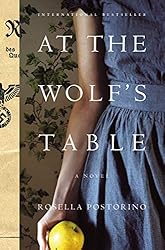
At the Wolf's Table
Rosella Postorino, 2019 (2018 in Italy; as The Tasters)
Flatiron Books
288 pp.
ISBN-13: 9781250179142
Summary
The international bestseller based on a haunting true story that raises provocative questions about complicity, guilt, and survival.
They called it the Wolfsschanze, the Wolf’s Lair. "Wolf" was his nickname. As hapless as Little Red Riding Hood, I had ended up in his belly. A legion of hunters was out looking for him, and to get him in their grips they would gladly slay me as well.
Germany, 1943: Twenty-six-year-old Rosa Sauer’s parents are gone, and her husband Gregor is far away, fighting on the front lines of World War II.
Impoverished and alone, she makes the fateful decision to leave war-torn Berlin to live with her in-laws in the countryside, thinking she’ll find refuge there.
But one morning, the SS come to tell her she has been conscripted to be one of Hitler’s tasters: three times a day, she and nine other women go to his secret headquarters, the Wolf’s Lair, to eat his meals before he does.
Forced to eat what might kill them, the tasters begin to divide into The Fanatics, those loyal to Hitler, and the women like Rosa who insist they aren’t Nazis, even as they risk their lives every day for Hitler’s.
As secrets and resentments grow, this unlikely sisterhood reaches its own dramatic climax, as everyone begins to wonder if they are on the wrong side of history. (From the publisher.)
Author Bio
• Birth—1978
• Where—Reggio Calabria, Italy
• Raised—San Lorenzo al Mare, Ligura
• Education—N/A
• Awards—Campiello Prize, Pozzale Luigi Russo Award, Rapallo Prize, and others
• Currently—lives in Rome, Italy
Rosella Postorino is a bestselling Italian author and an editor. She was born in Reggion Calabria, the toe of Italy, at the narrow strait separating the mainland from Sicily. She grew up farther north, however, in Liguria, the region known as the Italian Riveria.
Postorino speaks fluent English, Italian, French, and German. Her novels have garnered numerous Italian literary awards. At the Wolf’s Table is her first to be translated into English.
Novels
2007 - The room above
2009 - The summer that we lost God
2013 - The docile body
2018 - The tasters (At the Wolf's Table, 2019 in the U.S.)
(Author bio adapted from online sources. Retrieved 2/25/2019.)
Book Reviews
[E]ngrossing.… [Postorino's] ability to beautifully convey feelings of guilt, shame, love and remorse in a single gesture is a sign that we will be hearing more from her.
Susan Ellingwood - New York Times Book Review
Postorino reconstructs a truly unusual everyday existence in which the rules have changed and there is no room for accommodations…. With literary skill she weaves together historical facts and fiction.
Corriere della Sera (Italy)
Hailed as the new The Reader… the wording is rich, precise. At every twist and turn, the masterfully developed narration avoids predictability and comforting outcomes, up to the surprise ending.
La Repubblica (Italy)
This book―which speaks of love, hunger, survival and remorse―will end up engraved on your heart.
Marie Claire (Italy)
Unsettling and compelling.… At the Wolf’s Table stays with you, and for a long time.
La Repubblica (Italy)
Masterful…A unique story in which every reader will see themselves reflected.
L’Unione Sarda (Italy)
You’ll fly into this novel with your heart in your throat and a constant feeling of identification all the way through to the final, magnificent chapter.
Io Donna (Italy)
Compelling and truly well written.
Huffington Post (Italy)
A necessary book of great power that brings to mind Primo Levi’s The Drowned and the Saved and the finest Italian fiction.
La Riviera (France)
As engaging as a great film.
Vanity Fair (Italy)
Discussion Questions
1. Though she risks her life every day for Hitler, Rosa claims not to be a Nazi. Do you agree? How is her involvement in the war similar to or different from her husband Gregor’s, who enlisted to fight?
2. Rosa imagines her father telling her
You’re responsible for any regime you tolerate.… Each person’s existence is granted by the system of the state in which she lives,even that of a hermit, can’t you understand that? You’re not free from political guilt, Rosa.
Do you agree? How does this novel address the idea of collective guilt in Germany? Are any of the characters innocent?
3. Rosa never meets Hitler, but his presence hangs over the entire novel. What role does he play in the story? Discuss the different ways in which the characters view him.
4. Rosa compares herself to Little Red Riding Hood, and Hitler to the wolf: "I had ended up in his belly. A legion of hunters was out looking for him, and to get him in their grips they would gladly slay me as well." Do you think the comparison holds up? Are there other fairy-tale elements to Rosa’s story?
5. Rosa describes her love with Gregor as either "a mouth that doesn’t bite, or the opportunity to unexpectedly attack the other, like a dog that turns against its master." What does she mean? How do we see that duality—safety and danger—in her relationships throughout the novel?
6. Rosa keeps secrets from her loved ones from a very early age. She says of her childhood relationship with her mother:
My pain at the wrong I had done to her was so great that the only way to bear it was to love my mother less, to say nothing, to keep it a secret. The only way to survive my love for my mother was to betray that love.
Discuss that apparent paradox. How else do secrets shape Rosa’s life and relationships?
7. Rosa tells us: "The ability to adapt is human beings’ greatest resource, but the more I adapted, the less human I felt." What do you think she means? How does this novel address sacrifice and survival?
8. Rosa never asks Albert directly about his experiences at the concentration camps: "I was afraid and couldn’t speak and didn’t want to know." What do you make of their relationship? What draws them together and keeps them apart? Do you consider Albert a villain in this story? Does Rosa’s romantic involvement with him make her guilty or culpable in some way?
9. Rosa argues, "There’s no such thing as universal compassion—only being moved to compassion before the fate of a single human being." Do you think there’s any truth to that? How does the novel either bear out or contradict that statement?
10. Much of this novel is about female friendship. What is the nature of Rosa’s relationships with the other tasters? How does her outsider status, as a Berliner rather than a villager, play a role? How does this novel address issues of class and status, particularly through Rosa’s friendship with the Baroness?
11. Among the tasters, Rosa is closest to Elfriede, another outsider with secrets. How are the two women similar and different, and why do they develop such an intense friendship?
12. Why do you think Elfriede risks everything to help Heike get an abortion and, later,tell the SS guards that Leni was raped? When Elfriede is found out and deported,Rosa tells Albert, "It’s our fault." Do you agree? Why or why not?
13. Rosa and Gregor’s marriage doesn’t last after the war, in part because they were too careful with one another:
If only we had shared our memories, I told myself at times. We couldn’t. To us it would have seemed like squandering our miracle. Instead we tried to protect it, to protect one another. For the rest of those years we were trying so hard to protect one another that we ended up with nothing but that: barricades.
Rosa never tells Gregor about her experiences as a taster and never tries to track down anyone from her past. Why does she make those decisions?
14. Discuss Rosa’s views on loss:
When you lose someone, the pain you feel is for yourself, the pain that you’ll never see them again, never hear their voice again, that without them, you think, you’ll never make it. Pain is selfish.
Would you describe Rosa’s choices in this novel as selfish? Is survival inherently selfish?
15. At the Wolf’s Table is based on the true story of the women who served as Hitler’s food tasters. Were you aware of that piece of history? Did you come away from this novel with a different understanding of World War II and the Holocaust? Do you sympathize with Rosa and the other tasters?
(Questions issued by the publisher.)
top of page (summary)


Atlanta's Most Eligible Bachelor (Southern Men Don't Fall in Love, I)
Mia Mae Lynne, Chronicles of Fate, 2010
Book & Spirit, LLC
254 pp.
ISBN-13: 9781943651023
Summary
Douglas Arthur Bader
“Atlanta’s Most Eligible Bachelor” has it all. His career was on the rise at Whitman Stacks Law firm located on the perimeter of Atlanta. His cell phone rang constantly of women who wanted to possess the man with deep blue eyes and sandy blonde hair. Women of all ages fell for his boyishly handsome good looks and his impeccable manners. He was elusive to any type of commitment. “Three date max” was his motto until crossing paths with Lisa Dunbar.
Lisa Dunbar
After a moderately successful career as a traveling professional soccer player, Lisa has finally come home to settle down and start her career as a newly licensed CPA in Atlanta. She is hired at Grant & Co. CPA’s by Mona Grant. Staunchly independent, Lisa takes life’s challenges as they come. She’s satisfied with her single status as an African American woman and has no time to look for love. Her chance meeting with a man that she only knows as a commitment phobic bachelor alters her plans for her future.
The meeting, explosive. The romance intense. This first book in the “Southern Men don’t fall in Love” series explores how fate can set the time and place for a romance to begin. Doug and Lisa embark on a journey of self discovery as they learn that they are deeply connected beneath the skin.
Author Bio
• Birth—March 4, 1966
• Where—Cleveland, Ohio, USA
• Education—B.S., University of Akron; M.S., American Graduate University
• Currently—Twinsburg, Ohio
Mia Mae Lynne lived in Cleveland Heights, Ohio. Her mom was a part-time nurse in a private nursing home and her dad was a local truck driver for Chase Brass & Copper Company. She has two sisters.
In her early life, she participated in several activities including ballet, acrobatics, roller skating, and ice skating. Realizing that her talents were classroom oriented, she focused more on academics. She completed high school in the East Cleveland School system. She was also an active member of the INROADS program.
Mia attended and graduated from the University of Akron with a B.S. in Accounting. She pledged Alpha Kappa Alpha sorority in her freshman year and spent many hours studying and partying with friends.
In September, 1989 Mia was married in Cleveland, Ohio. She and her husband moved to Louisville, KY where their first son, Carlos, was born. In 1992 the family moved to Rome, Georgia where their second son, Marcus, was born. With two beautiful boys to light up her life, Mia dedicated herself to her family. She worked full time in the aerospace industry during the day and was a soccer mom evenings and weekends. In 2008, with Christmas fast approaching, the first novel in her series, "The Chronicles of Fate," was born. Following "Tempting Fate" seven more books were written.
In 2009, Mia lost her father. In the heartbreak that followed, her marriage dissolved, she lost her job, and moved to Cleveland to be closer to her mother.
Even with all the tragedies, Mia never lost faith in her work and in 2010 Mia began the process of editing and copyrighting her series.
In April, 2015, she opened her self-publishing company, Book & Spirit, LLC. She renamed her series from "The Chronicles of Fate" to "Southern Men Don't Fall in Love". Several contributors came forward to assist with the project including her son, Carlos, who volunteered to translate the series into Spanish. He hired two of his college friends to edit the books into Spanish of the America's and European Spanish.
The first book of the renamed series was Atlanta's Most Eligible Bachelor. It was released November 4, 2015 in English, Spanish (ES and SA), large print, and standard editions in honor of her son, Carlos', birthday. She plans to release her next book, Atlanta's Most Eligible Bachelor II, on April 26, 2016 in honor of her son Marcus. She plans to release books twice a year to commemorate the two most important men in her life.
Now between writing and editing her books, her new career in the aerospace industry and watching her sons' college and professional soccer careers, Mia spends her time as a student of spiritualism. She received training from the Fellowship of the Spirit. She looks forward to visiting Lily Dale, New York, again in her future.
Trivia & Facts
♦ She is naturally left-handed.
♦ She has a Master's degree in Contract Management from American Graduate University.
♦ She is a Certified Public Accountant in the state of Georgia.
♦ In the span of nine months, she wrote eight books that were published seven years later.
♦ She does tarot readings for friends and family.
♦ She reads books on Astrology, Tarot, Numerology and related books in the metaphysical genre. (From the author.)
Visit the author's website.
Follow Mia Mae on Facebook and here for her books.
Book Reviews
If you love sweet romances about destiny deciding your soul mate, you will love this book. It was a good clean read. It really cute how Lisa and Doug's paths continued to cross. The more they ran into each other the more they realized how much they had in common.
Amazon Customer Review (Kindle)
This book was wonderful. First let me say that I usually do not like straight romance novels, however this one totally captured my interest. Such intrigue and suspense to see if they are true soul mates and meant to be together. I was actually sad to see this end. Can't wait for the next book in the series.
Amazon Customer Review - LAS
Oh my goodness, this is the most enjoyable read of 2016 for me already and I HAVE NOT EVEN FINISHED THE BOOK YET!!!! I look forward to other books from this author. I will be sad when I finish the book. I'm trying to drag it out as long as possible until the next one.
Amazon Customer Review
Good book! It's the second time in 2 days I've read that an author has included the family in the story line. Thank you for realizing that we would love reading about these kind of lovers. Can't wait for your next book
Amazon Customer Review
Riveting story. Can't wait for the next volume sometimes southern men do fall in love after all loved hearing the family background. A
Amazon Customer Review - laohio
Discussion Questions
1. Do you think Doug and Lisa were destined to be together or did they just experience Groundhog Day?
2. Did Doug really enjoy his bachelor lifestyle before meeting Lisa? Was he completely happy with his life?
3. Are there any social stereotypes portrayed throughout the novel?
4. What does Lisa find charming about Doug's arrogance, if anything?
5. Who does the author more closely relate to in the series? Doug or Lisa? How can we tell this throughout the novel?
6. Will Doug and Lisa stay together as a couple or do you think their future will be as crazy as their courtship?
(Questions courtesy of the author.)
Atlas Shrugged
Ayn Rand, 1957
Penguin Group USA
1088 pp.
ISBN-13: 9780451191144
Summary
Atlas Shrugged (1957) is a mystery story, Ayn Rand once commented, "not about the murder of man’s body, but about the murder—and rebirth—of man’s spirit."
It is the story of a man—the novel’s hero—who says that he will stop the motor of the world, and does. The deterioration of the U.S. accelerates as the story progresses. Factories, farms, shops shut down or go bankrupt in ever larger numbers. Riots break out as food supplies become scarce. Is he, then, a destroyer or the greatest of liberators? Why does he have to fight his battle, not against his enemies but against those who need him most, including the woman, Dagny Taggart, a top railroad executive, whom he passionately loves? What is the world’s motor—and the motive power of every man?
Peopled by larger-than-life heroes and villains, and charged with awesome questions of good and evil, Atlas Shrugged is a novel of tremendous scope. It presents an astounding panorama of human life—from the productive genius who becomes a worthless playboy (Francisco d’Anconia)—to the great steel industrialist who does not know that he is working for his own destruction (Hank Rearden)—to the philosopher who becomes a pirate (Ragnar Danneskjold)—to the composer who gives up his career on the night of his triumph (Richard Halley).
Dramatizing Ayn Rand’s complete philosophy, Atlas Shrugged is an intellectual revolution told in the form of an action thriller of violent events—and with a ruthlessly brilliant plot and irresistible suspense.
We do not want to spoil the plot by giving away its secret or its deeper meaning, so as a hint only we will quote here one brief exchange from the novel:
If you saw Atlas, the giant who holds the world on his shoulders, if you saw that he stood, blood running down his chest, his knees buckling, his arms trembling but still trying to hold the world aloft with the last of his strength, and the greater the effort the heavier the world bore down upon his shoulders—what would you tell him to do?
I…don’t know. What…could he do? What would you tell him?
To shrug. (From the publisher.)
Author Bio
• Also known as—Alice Rosenbaum
• Birth—February 2, 1905
• Where—St. Petersburg, Russia
• Died—March 6, 1982
• Where—New York, New York, USA
• Education—University of Petrograd
Ayn Rand was born in St. Petersburg, Russia, on February 2, 1905. At age six she taught herself to read and two years later discovered her first fictional hero in a French magazine for children, thus capturing the heroic vision that sustained her throughout her life. At the age of nine she decided to make fiction writing her career. Thoroughly opposed to the mysticism and collectivism of Russian culture, she thought of herself as a European writer, especially after encountering authors such as Walter Scott and—in 1918—Victor Hugo, the writer she most admired.
During her high school years, she was eyewitness to both the Kerensky Revolution, which she supported, and—in 1917—the Bolshevik Revolution, which she denounced from the outset. In order to escape the fighting, her family went to the Crimea, where she finished high school. The final Communist victory brought the confiscation of her father's pharmacy and periods of near-starvation. When introduced to American history in her last year of high school, she immediately took America as her model of what a nation of free men could be.
When her family returned from the Crimea, she entered the University of Petrograd to study philosophy and history. Graduating in 1924, she experienced the disintegration of free inquiry and the takeover of the university by communist thugs. Amidst the increasingly gray life, her one great pleasure was Western films and plays. Long a movie fan, she entered the State Institute for Cinema Arts in 1924 to study screen writing.
In late 1925 she obtained permission to leave Soviet Russia for a visit to relatives in the United States. Although she told Soviet authorities that her visit would be short, she was determined never to return to Russia. She arrived in New York City in February 1926. She spent the next six months with her relatives in Chicago, obtained an extension to her visa, and then left for Hollywood to pursue a career as a screenwriter.
On Ayn Rand's second day in Hollywood, Cecil B. DeMille saw her standing at the gate of his studio, offered her a ride to the set of his movie The King of Kings, and gave her a job, first as an extra, then as a script reader. During the next week at the studio, she met an actor, Frank O'Connor, whom she married in 1929; they were married until his death fifty years later.
After struggling for several years at various nonwriting jobs, including one in the wardrobe department at the RKO Corporation, she sold her first screenplay, Red Pawn to Universal Studios in 1932 and saw her first stage play, Night of January 16th, produced in Hollywood and then on Broadway. Her first novel, We the Living, was completed in 1933 but was rejected by publishers for years, until The Macmillan Company in the United States and Cassells and Company in England published the book in 1936. The most autobiographical of her novels—it was based on her years under Soviet tyranny—We the Living was not well-received by American intellectuals and reviewers. Ayn Rand was up against the pro-communism dominating the culture during "the Red Decade."
She began writing The Fountainhead in 1935. In the character of the architect Howard Roark, she presented for the first time the kind of hero whose depiction was the chief goal of her writing: the ideal man, man as "he could be and ought to be." The Fountainhead was rejected by twelve publishers but finally accepted by the Bobbs-Merrill Company. When published in 1943, it made history by becoming a best seller through word-of-mouth two years later, and gained for its author lasting recognition as a champion of individualism.
Ayn Rand returned to Hollywood in late 1943 to write the screenplay for The Fountainhead, but wartime restrictions delayed production until 1948. Working part time as a screenwriter for Hal Wallis Productions, she began her major novel, Atlas Shrugged, in 1946. In 1951 she moved back to New York City and devoted herself full time to the completion of Atlas Shrugged.
Published in 1957, Atlas Shrugged was her greatest achievement and last work of fiction. In this novel she dramatized her unique philosophy in an intellectual mystery story that integrated ethics, metaphysics, epistemology, politics, economics and sex. Although she considered herself primarily a fiction writer, she realized that in order to create heroic fictional characters, she had to identify the philosophic principles that make such individuals possible. She needed to formulate "a philosophy for living on earth."
Thereafter, Ayn Rand wrote and lectured on her philosophy— Objectivism. She published and edited her own periodicals from 1962 to 1976, her essays providing much of the material for nine books on Objectivism and its application to the culture. Ayn Rand died on March 6, 1982, in her New York City apartment.
Every book by Ayn Rand published in her lifetime is still in print, and hundreds of thousands of copies are sold each year, so far totaling more than twenty million. Several new volumes have been published posthumously. Her vision of man and her philosophy for living on earth have changed the lives of thousands of readers and launched a philosophic movement with a growing impact on American culture. (Author biography from Barnes & Noble, courtesy of The Ayn Rand Institute.)
Book Reviews
This gargantuan book comes among us as a demonstrative act rather than as a literary work.... It is an earnest one, belligerent and unremitting in its earnestness. What is important is the spirit in which the book is written. Like The Fountainhead, Atlas Shrugged is a defense of and a tribute to the superior individual...superior in every way—in body as well as mind and especially in his cpacity for life. Its spirit, regard-less of the specific doctrines it preaches, is calculated to appeal to those who feel that life could and should have more meaning than they have experienced.
Granville Hicks - New York Times (11/13/1957)
Atlas Shrugged by Ayn Rand is a celebration of life and happiness. Justice is unrelenting. Creative individuals and undeviating purpose and rationality achieve joy and fulfillment. Parasites who persistently avoid either purpose or reason perish as they should.
Alan Greenspan (former Chairman, U.S. Fed. Reserve)
(Audio version.) The problem with Rand is easily detectable... by careful listeners of this production: a good essayist with a flair for the dramatic turn of phrase, she wasted her obvious writing skills in an effort to support outlandish personal opinions cloaked in the guise of logic. An absolutist thinker, she devotes one whole essay to an effort to persuade us that we really should see things as black and white, with no shades of gray. Born in Soviet Russia, Rand so despised socialism and collectivist thinking that she leapt to the furthest extreme possible to become the champion of unbridled capitalism, the rights of the individual at the expense of the community, and the diminution of all regulation by the state, with the exception of a judicial system and the control of crime. Among the sadly dated ideas she conveys are the attitude that homosexuals are mutant symptoms of a sick society and the belief that anyone with an interest in internationalism is a "one world" proponent. To use one of her own favored words, Rand's political and social philosophy is critically "muddled." C.M. Herbert's voice is efficient and cold, making it a perfect choice for the narration of this author's work. Recommended only as documentation of an anomaly in the history of ideas. —Mark Pumphrey, Polk Cty. P.L., Columbus, NC.
Library Journal
Discussion Questions
1. What and where is the "utopia of greed"?
2. Why does Dagny Taggart, a woman of ruthless logic who passionately loves life, chase a mysterious stranger’s plane in her own plane when she knows it will lead to her virtually certain death?
3. Why do Dagny Taggart and Lillian Rearden—both highly affluent women—fight over a cheap metallic bracelet? Who gets to keep the bracelet, and at what cost? What is Lillian’s real motive in trapping her husband Hank in infidelity?
4. Why does Francisco d’Anconia, heir to the greatest fortune in the world and a productive genius with boundless ambition, seek ever more outrageous ways to destroy his own business empire? Why does he turn into a playboy who forsakes the woman he loves and instead seduces prominent women who are of no interest to him?
5. When an entire country tells them that their railroad bridge, constructed from a new ultralight metal, won’t stand under the onrush of a speeding train, why are Dagny Taggart and Hank Rearden so confident that it will? Were you convinced by the arguments offered against them by their opponents? Whom did you side with? Why?
6. According to Atlas Shrugged, selfishness is both moral and practical. What does Ayn Rand mean by "selfishness"? Compare the actions and character of James Taggart, Hank Rearden, Orren Boyle, and Francisco d’Anconia: Who is selfish and who is not? Can you present arguments for or against Ayn Rand’s view of selfishness? Contrast Ayn Rand’s approach with that of the ethics of Christianity.
7. What basic motive unites people who brag about their sexual promiscuity and people who demand economic handouts from the government?
8. Explain the meaning and wider significance of the following quote from Atlas Shrugged: "The words ‘to make money’ hold the essence of human morality." Explain what ideas underlie the maxim that "money is the root of all good."
9. Capitalism is often defended by appeal to the "public good"; that is, solely because its economic efficiency benefits society. Contrast this with Ayn Rand’s defense of capitalism, as dramatized in Atlas Shrugged.
(Questions issued by publisher.)
top of page (summary)

The Atomic Weight of Love
Elizabeth J. Church, 2016
Algonquin Books
320 pp.
ISBN-13: 9781616204846
Summary
In her sweeping debut novel, Elizabeth J. Church takes us from the World War II years in Chicago to the vast sun-parched canyons of New Mexico in the 1970s as we follow the journey of a driven, spirited young woman, Meridian Wallace, whose scientific ambitions are subverted by the expectations of her era.
In 1941, at seventeen years old, Meridian begins her ornithology studies at the University of Chicago. She is soon drawn to Alden Whetstone, a brilliant, complicated physics professor who opens her eyes to the fundamentals and poetry of his field, the beauty of motion, space and time, the delicate balance of force and energy that allows a bird to fly.
Entranced and in love, Meridian defers her own career path and follows Alden west to Los Alamos, where he is engaged in a secret government project (later known to be the atomic bomb). In married life, though, she feels lost and left behind. She channels her academic ambitions into studying a particular family of crows, whose free life and companionship are the very things that seem beyond her reach.
There in her canyons, years later at the dawn of the 1970s, with counterculture youth filling the streets and protests against the war rupturing college campuses across the country, Meridian meets Clay, a young geologist and veteran of the Vietnam War, and together they seek ways to mend what the world has broken.
Exquisitely capturing the claustrophobic eras of 1940s and 1950s America, The Atomic Weight of Love also examines the changing roles of women during the decades that followed. And in Meridian Wallace we find an unforgettable heroine whose metamorphosis shows how the women’s movement opened up the world for a whole generation. (From the publisher.)
Author Bio
• Birth—ca. 1956 (?)
• Where—Los Alamos, New Mexico, USA
• Education—B.A., University of New Mexico; J.D.,University of New Mexico
• Currently—lives in Los Alamos, New Mexico
Elizabeth J. Church was born in Los Alamos, New Mexico. Her father, a research chemist, was drafted out of Carnegie Mellon University, where he was pursuing his graduate studies, and was sent to join other scientists working in secret on the Manhattan Project. Church’s mother, a biologist, eventually joined her husband in Los Alamos.
While The Atomic Weight of Love is not their story, it is the story of many of the women who sacrificed their careers so that their husbands could pursue unique opportunities in scientific research. Along with other Los Alamos children, Church grew up in an environment that gave her ready access both to nature and to female teachers who had advanced degrees in mathematics, chemistry, physics, biology, and other disciplines.
Church practiced law for over thirty years, focusing on mental health and constitutional law issues. After circumstances taught her the brevity of life, she walked away from the law to pursue her original dream of writing.
She has written extensively for legal publications and scientific journals. Her short story "Skin Deep" won first prize in Literal Latté’s 2001 fiction contest, and "Lying with Dogs" was published in Natural Bridge in 2002. This is her first novel. (From the publishers.)
Book Reviews
As characters go, Meri is a little too passive, Alden too one-dimensional a domestic tyrant, and Clay too good to be true. Nonetheless, readers will enjoy following Meri’s long, vivid journey, which concludes in her 80s.
Publishers Weekly
Church’s debut will likely strike a chord, especially with women who find that not much has changed in our patriarchal society since Meri’s time, and that Meri’s story might well be their own. —Poornima Apte
Booklist
Church's debut novel explores the relationship between sacrifice and love. Set during World War II and the decades leading up to the Vietnam War, the novel follows Meridian Wallace as she transforms from a bright ornithologist-to-be studying at the University of Chicago into an unhappy housewife.... An elegant glimpse into the evolution of love and womanhood.
Kirkus Reviews
Discussion Questions
Use our LitLovers Book Club Resources; they can help with discussions for any book:
• How to Discuss a Book (helpful discussion tips)
• Generic Discussion Questions—Fiction and Nonfiction
• Read-Think-Talk (a guided reading chart)
(We'll add specific questions if and when they're made available by the publisher.)

Atonement
Ian McEwan, 2002
Random House
480 pp.
ISBN-13: 9780307387158
Summary
Winner, 2001 National Book Critics' Circle Award
Ian McEwan’s symphonic novel of love and war, childhood and class, guilt and forgiveness provides all the satisfaction of a brilliant narrative and the provocation we have come to expect from this master of English prose.
On a hot summer day in 1935, thirteen-year-old Briony Tallis witnesses a moment’s flirtation between her older sister, Cecilia, and Robbie Turner, the son of a servant and Cecilia’s childhood friend. But Briony’s incomplete grasp of adult motives–together with her precocious literary gifts—brings about a crime that will change all their lives.
As it follows that crime’s repercussions through the chaos and carnage of World War II and into the close of the twentieth century, Atonement engages the reader on every conceivable level, with an ease and authority that mark it as a genuine masterpiece. (From the publisher.)
Author Bio
• Birth—June 21, 1948
• Where—Aldershot, England, UK
• Education—B.A., University of Sussex; M.A. University of East Anglia
• Awards—(see blow)
• Currently—lives in Oxford, England
Ian Russell McEwan is an English novelist. He was born in Aldershot, Hampshire, the son of David McEwan and Rose Lilian Violet (nee Moore). His father was a working class Scotsman who had worked his way up through the army to the rank of major. As a result, McEwan spent much of his childhood in East Asia (including Singapore), Germany and North Africa (including Libya), where his father was posted. His family returned to England when he was twelve.
McEwan was educated at Woolverstone Hall School; the University of Sussex, receiving his degree in English literature in 1970; and the University of East Anglia, where he was one of the first graduates of Malcolm Bradbury and Angus Wilson's pioneering creative writing course.
Career
McEwan's first published work was a collection of short stories, First Love, Last Rites (1975), which won the Somerset Maugham Award in 1976. He achieved notoriety in 1979 when the BBC suspended production of his play Solid Geometry because of its alleged obscenity. His second collection of short stories, In Between the Sheets, was published in 1978.
The Cement Garden (1978) and The Comfort of Strangers (1981) were his two earliest novels, both of which were adapted into films. The nature of these works caused him to be nicknamed "Ian Macabre." These were followed by The Child in Time (1987), winner of the 1987 Whitbread Novel Award; The Innocent (1990); and Black Dogs (1992). McEwan has also written two children's books, Rose Blanche (1985) and The Daydreamer (1994). His 1997 novel, Enduring Love, about the relationship between a science writer and a stalker, was popular with critics and adapted into a film in 2004.
In 1998, he won the Man Booker Prize for Amsterdam. His next novel, Atonement (2001), received considerable acclaim; Time magazine named it the best novel of 2002, and it was shortlisted for the Booker Prize. In 2007, the critically acclaimed movie Atonement, directed by Joe Wright and starring Keira Knightley and James McAvoy, was released in cinemas worldwide. His next work, Saturday (2005), follows an especially eventful day in the life of a successful neurosurgeon. Saturday won the James Tait Black Memorial Prize for 2005, and his novel On Chesil Beach (2007) was shortlisted for the 2007 Booker Prize.
McEwan has also written a number of produced screenplays, a stage play, children's fiction, an oratorio and a libretto titled For You with music composed by Michael Berkeley.
In 2008 at the Hay Festival, McEwan gave a surprise reading of his then novel-in-progress, eventually published as Solar (2010). The novel includes a scientist hoping to save the planet from the threat of climate change and got its inspiration from a 2005 Cape Farewell expedition. McEwan along with fellow artists and scientists spent several weeks aboard a ship near the north pole.
McEwan's twelfth novel, Sweet Tooth (2012), is historical in nature and set in the 1970. In an interview with the Scotsman newspaper, McEwan revealed that the impetus for writing the novel was a way for him to write a "disguised autobiography." McEwan's 13th novel, The Children Act (2014), is about a high court judge.
Controversy
In 2006 McEwan was accused of plagiarism, specifically a passage in Atonement that closely echoed one from a 2012 memoir, No Time for Romance, by Lucilla Andrews. McEwan acknowledged using the book as a source for his work; in fact, he had included a brief note at the end of the book referring to Andrews's autobiography, among several other works. Writing in the Guardian in November 2006, a month after Andrews' death, McEwan professed innocence of plagiarism while acknowledging his debt to the author.
The incident recalled critical controversy over his debut novel The Cement Garden, key plot elements that closely mirrored some of those in Our Mother's House, a 1963 novel by Julian Gloag, which had also been made into a film. McEwan denied charges of plagiarism, claiming he was unaware of the earlier work.
In 2011 McEwan caused controversy when he accepted the Jerusalem Prize for the Freedom of the Individual in Society. In the face of pressure from groups and individuals opposed to the Israeli government, specifically British Writers in Support of Palestine (BWISP), McEwan wrote a letter to the Guardian in which he said...
There are ways in which art can have a longer reach than politics, and for me the emblem in this respect is Daniel Barenboim's West-Eastern Divan Orchestra—surely a beam of hope in a dark landscape, though denigrated by the Israeli religious right and Hamas. If BWISP is against this particular project, then clearly we have nothing more to say to each other.
He announced that he would donate the ten thousand dollar prize money to Combatants for Peace, an organization that brings together Israeli ex-soldiers and Palestinian ex-fighters.
Recognition
McEwan has been nominated for the Man Booker prize six times to date, winning the Prize for Amsterdam in 1998. His other nominations were for The Comfort of Strangers (1981, Shortlisted), Black Dogs (1992, Shortlisted), Atonement (2001, Shortlisted), Saturday (2005, Longlisted), and On Chesil Beach (2007, Shortlisted). McEwan also received nominations for the Man Booker International Prize in 2005 and 2007.
He is a Fellow of the Royal Society of Literature, a Fellow of the Royal Society of Arts, and a Fellow of the American Academy of Arts and Sciences. He was awarded the Shakespeare Prize by the Alfred Toepfer Foundation, Hamburg, in 1999. He is also a Distinguished Supporter of the British Humanist Association. He was awarded a CBE in 2000. In 2005, he was the first recipient of Dickinson College's Harold and Ethel L. Stellfox Visiting Scholar and Writers Program Award, in Carlisle, Pennsylvania, U.S. In 2008, McEwan received an honorary degree of Doctor of Literature by University College, London, where he used to teach English literature. In 2008, The Times (of London) featured him on their list of "The 50 greatest British writers since 1945".
Personal
McEwan has been married twice. His 13-year marriage to spiritual healer and therapist Penny Allen ended in 1995 and was followed by a bitter custody battle over their two sons. His second wife, Annalena McAfee, was formerly the editor of the Guardian's Review section.
In 2002, McEwan discovered that he had a brother who had been given up for adoption during World War II when his mother was married to a different man. After her first husband was killed in combat, McEwan's mother married her lover, and Ian was born a few years later. The brothers are in regular contact, and McEwan has written a foreword to Sharp's memoir. (Excerpted and adapted from Wikipedia. Retrieved 9/4/2014.)
Book Reviews
His fellow Brits once dubbed him "Ian Macabre" due to his string of dazzling yet morbid novels. But this time around, Ian McEwan has written a gorgeous, lush book, taking on the genteel shades of Jane Austen, in particular her Northanger Abbey and its young heroine with the over-active imagination that lands her in so much trouble. But McEwan moves beyond Austen's staid world ... Read more.
A LitLovers LitPick (Jan. '07)
This haunting novel, which just failed to win the Booker this year, is at once McEwan at his most closely observed and psychologically penetrating, and his most sweeping and expansive.... With each book McEwan ranges wider, and his powers have never been more fully in evidence than here.
Publishers Weekly
Moving deftly between styles, this is a compelling exploration of guilt and the struggle for forgiveness. Recommended for most public libraries. —Lawrence Rungren, Merrimack Valley Lib. Consortium, Andover, MA.
Library Journal
Every lustrously rendered, commanding scene is charged with both despair and diabolical wit, and McEwan's Jamesian prose covers the emotional spectrum from searing eroticism to toxic guilt. In sum, he excels brilliantly at depicting moral dilemmas and stressed minds in action without losing a keen sense of the body's terrible fragility, the touching absurdity of desire, and time's obstinacy. —Donna Seaman
Booklist
The story is compelling, the characters well drawn and engaging, and the outcome is almost always in doubt. The descriptions of the retreat and the subsequent hospitalization of the soldiers are grim and realistic. Readers are spared little, yet the journey is worth the observed pain and distress. Well-read teens will find much to think about in this novel. —Susan H. Woodcock, Chantilly Regional Library, VA.
School Library Journal
McEwan's latest, both powerful and equisite, considers the making of a writer, the dangers and rewards of imagination, and the juncture between innocence and awareness, all set against the late afternoon of an England soon to disappear.
Kirkus Reviews
Discussion Questions
1. What sort of social and cultural setting does the Tallis house create for the novel? What is the mood of the house, as described in chapter 12? What emotions and impulses are being acted upon or repressed by its inhabitants? How does the careful attention to detail affect the pace of Part One, and what is the effect of the acceleration of plot events as it nears its end?
2. A passion for order, a lively imagination, and a desire for attention seem to be Briony’s strongest traits. In what ways is she still a child? Is her narcissism—her inability to see things from any point of view but her own—unusual in a thirteen-year-old? Why does the scene she witnesses at the fountain change her whole perspective on writing? What is the significance of the passage in which she realizes she needs to work from the idea that—other people are as real as you. And only in a story could you enter these different minds and show how they had an equal value? Do her actions bear this out?
3. What kind of a person is Emily Tallis? Why does McEwan decide not to have Jack Tallis make an appearance in the story? Who, if anyone, is the moral authority in this family? What is the parents’ relationship to Robbie Turner, and why does Emily pursue his conviction with such single-mindedness?
4. What happens between Robbie and Cecilia at the fountain? What symbolic role does Uncle Clem’s precious vase play in the novel? Is it significant that the vase is glued together by Cecilia, and broken finally during the war by Betty as she readies the house to accept evacuees?
5. Having read Robbie’s note to Cecilia, Briony thinks about its implications for her new idea of herself as a writer: No more princesses! . . . With the letter, something elemental, brutal, perhaps even criminal had been introduced, some principle of darkness, and even in her excitement over the possibilities, she did not doubt that her sister was in some way threatened and would need her help. Why is Robbie’s uncensored letter so offensive within the social context in which it is read? Why is Cecilia not offended by it?
6. The scene in the library is one of the most provocative and moving descriptions of sex in recent fiction. How does the fact that it is narrated from Robbie’s point of view affect how the reader feels about what happens to him shortly afterwards? Is it understandable that Briony, looking on, perceives this act of love as an act of violence?
7. Why does Briony stick to her story with such unwavering commitment? Does she act entirely in error in a situation she is not old enough to understand, or does she act, in part, on an impulse of malice, revenge, or self-importance? At what point does she develop the empathy to realize what she has done to Cecilia and Robbie?
8. How does Leon, with his life of agreeable nullity, compare with Robbie in terms of honor, intelligence, and ambition? What are the qualities that make Robbie such an effective romantic hero? What are the ironies inherent in the comparative situations of the three young men present Leon, Paul Marshall, and Robbie?
9. Lola has a critical role in the story’s plot. What are her motivations? Why does she tell Briony that her brothers caused the marks on her wrists and arms? Why does she allow Briony to take over her story when she is attacked later in the evening? Why does Briony decide not to confront Lola and Paul Marshall at their wedding five years later?
10. The novel’s epigraph is taken from Jane Austen’s Northanger Abbey, in which a naïve young woman, caught up in fantasies from the Gothic fiction she loves to read, imagines that her host in an English country house is a villain. In Austen’s novel Catherine Norland’s mistakes are comical and have no serious outcome, while in Atonement, Briony’s fantasies have tragic effects upon those around her. What is McEwan implying about the power of the imagination, and its potential for harm when unleashed into the social world? Is he suggesting, by extension, that Hitler’s pathological imagination was a driving force behind World War II?
11. In McEwan’s earlier novel Black Dogs, one of the main characters comes to a realization about World War II. He thinks about the recently concluded war not as a historical, geopolitical fact but as a multiplicity, a near-infinity of private sorrows, as a boundless grief minutely subdivided without diminishment among individuals who covered the continent like dust, like spores whose separate identities would remain unknown, and whose totality showed more sadness than anyone could ever begin to comprehend. Does McEwan intend his readers to experience the war similarly in Atonement? What aspects of Atonement make it so powerful as a war novel? What details heighten the emotional impact in the scenes of the Dunkirk retreat and Briony’s experience at the military hospital?
12. When Robbie, Mace, and Nettle reach the beach at Dunkirk, they intervene in an attack on an RAF man who has become a scapegoat for the soldiers’ sense of betrayal and rage. As in many of his previous novels, McEwan is interested in aggressive human impulses that spin out of control. How does this act of group violence relate to the moral problems that war creates for soldiers, and the events Robbie feels guilty about as he falls asleep at Bray Dunes?
13. About changing the fates of Robbie and Cecilia in her final version of the book, Briony says, "Who would want to believe that the young lovers never met again, never fulfilled their love? Who would want to believe that, except in the service of the bleakest realism?" McEwan’s Atonement has two endings —one in which the fantasy of love is fulfilled, and one in which that fantasy is stripped away. What is the emotional effect of this double ending? Is Briony right in thinking that it isn’t weakness or evasion, but a final act of kindness, a stand against oblivion and despair, to let my lovers live and to unite them at the end?
14. Why does McEwan return to the novel’s opening with the long-delayed performance of The Trials of Arabella, Briony’s youthful contribution to the optimistic genre of Shakespearean comedy? What sort of closure is this in the context of Briony’s career? What is the significance of the fact that Briony is suffering from vascular dementia, which will result in the loss of her memory, and the loss of her identity?
15. In her letters to Robbie, Cecilia quotes from W. H. Auden’s 1939 poem, "In Memory of W. B. Yeats," which includes the line, "Poetry makes nothing happen." In part, the novel explores the question of whether the writing of fiction is not much more than the construction of elaborate entertainments—an indulgence in imaginative play—or whether fiction can bear witness to life and to history, telling its own serious truths. Is Briony’s novel effective, in her own conscience, as an act of atonement? Does the completed novel compel the reader to forgive her?
(Questions issued by publisher.)
top of page (summary)
The Attack
Yasmina Khadra, 2005 (Trans., by John Collin, 2006)
Knopf Doubleday
272 pp.
ISBN-13: 9780307275707
Summary
Dr. Amin Jaafari, an Arab-Israeli citizen, is a surgeon at a hospital in Tel Aviv. Dedicated to his work, respected and admired by his colleagues and community, he represents integration at its most successful.
He has learned to live with the violence and chaos that plague his city, and on the night of a deadly bombing in a local restaurant, he works tirelessly to help the shocked and shattered patients brought to the emergency room. But this night of turmoil and death takes a horrifyingly personal turn. His wife’s body is found among the dead, with massive injuries, the police coldly announce, typical of those found on the bodies of fundamentalist suicide bombers.
As evidence mounts that his wife, Sihem, was responsible for the catastrophic bombing, Dr. Jaafari is torn between cherished memories of their years together and the inescapable realization that the beautiful, intelligent, thoroughly modern woman he loved had a life far removed from the comfortable, assimilated existence they shared.
From the graphic, beautifully rendered description of the bombing that opens the novel to the searing conclusion, The Attack portrays the reality of terrorism and its incalculable spiritual costs. Intense and humane, devoid of political bias, hatred, and polemics, it probes deep inside the Muslim world and gives readers a profound understanding of what seems impossible to understand. (From the publisher.)
Author Bio
• Aka—Mohammed Moulessehoul
• Birth—January 10, 1955
• Where—Kenadsa, Sahara, Algeria
• Education—Officer in Algerian Army
• Currently—Aix-en-Provence, France
Yasmina Khadra is the nom de plume of the Algerian army officer Mohammed Moulessehoul, who is the author of four other books published in English: Double Blanc, Morituri, In the Name of God and Wolf Dreams. He took the feminine pseudonym to avoid submitting his manuscripts for approval by military censors while he was still in the army. He lives in France. (From the publisher.)
Extras
From an interview with Barnes & Noble:
When asked about his favorite books, here is what he said:
•The Stranger by Albert Camus—for the calm power of its simplicity in translating the absurdity of the human condition.
•The Grapes of Wrath by John Steinbeck—for its realism and the extraordinary handling of its characters. John Steinbeck is my favorite author.
•Crime and Punishment by Fyodor Dostoevsky—for its talent at revealing the pettiness of humans and their awful stupidity.
•The Days by Taha Hossein—for the lucidity of its story and for the beauty of its language.
•Sophie's Choice by William Styron—for the crudeness of its humanism and its implacable concern with reconstructing horror in its absolute cruelty, human cruelty.
•Regain by Jean Giono—for his poetry and the sobriety of his talent.
•The Quai of Flowers Doesn't Answer by Malek Haddad —for its beauty.
•Anna Karenina by Leo Tolstoy—for his genius.
•The Trial by Franz Kafka—for many reasons.
•The Swallows of Kabul—because I wrote it.
Book Reviews
By the end of The Attack, Israel's heavy firepower appears to have marginally eclipsed Palestinian suicide bombing in the ugly-weapon stakes for Khadra, but his achievement in this novel is neither his take on the local politics nor his moral finessing. Instead, it is the way that he limns, quite brilliantly, the character of a man torn to pieces by extremism and extreme social distress, neither of which has been of his own making.
Jonathan Wilson - Washington Post
Khadra, the pseudonym of Mohammed Moulessehoul, an exiled Algerian writer celebrated for his politically themed fiction (The Swallows of Kabul), turns his attention to the Israeli-Palestinian conflict in this moving novel unlikely to satisfy partisans on either side of the issue. Dr. Amin Jaafari is a man caught between two worlds; he's a Bedouin Arab surgeon struggling to integrate himself into Israeli society. The balancing act becomes impossible when the terrorist responsible for a suicide bombing that claims 20 lives, including many children, is identified as Jaafari's wife by the Israeli police. Jaafari's disbelief that his secular, loving spouse committed the atrocity is overcome when he receives a letter from her posthumously. In an effort to make sense of her decision, Jaafari plunges into the Palestinian territories to discover the forces that recruited her. Khadra, who nicely captures his hero's turmoil in trying to come to terms with the endless violence, closes on an appropriately grim note.
Publishers Weekly
Khadra (The Swallows of Kabul) has the ability to convey that damning sense of unrelenting anxiety that may indeed be the object of terrorism. His latest novel concerns Dr. Amin Jaafari, an esteemed surgeon of Arab-Bedouin descent who has worked against the odds to become a relatively well-appointed citizen of Tel Aviv. In an instant, the doctor's life is turned inside-out by a suicide-bomb attack near the hospital where he practices. The very worst of it comes when he learns that his beloved wife, who perished in the attack, is believed to have been the one who actually carried out the bombing. Incensed by this accusation, Amin rejects the idea that their idyllic marriage may not have been all that it seemed. His relentless search for the truth leads him back to a place from his past, and the story comes full circle. This could prove to be a book of some importance owing to its fine technique and relevance to current world affairs. Yasmina Khadra is a pseudonym for Mohammed Moulessehoul, a former officer in the Algerian army who lives in France. Recommended for all fiction collections. —Susanne Wells, P.L. of Cincinnati and Hamilton Cty.
Library Journal
Within relatively few pages, The Attack tells us so much about the complex realities of life in modern Israel. The narrator is a much-honored surgeon in Tel Aviv, Dr. Amin Jaafari, an Arab-Israeli. As Amin works on the victims of a suicide attack, saving lives, his friend, a Jewish policeman, tells him his wife was also in the attack. Amin is horrified by his wife's death, and stunned to learn the police believe it was she who was the suicide bomber. What unfolds is Amin's determination to find out if indeed his wife was the bomber, and then to learn why she did this outrageous act. Amin had believed their marriage was happy, that their comfortable life in Israel, their assimilation in Israeli society, was a success. What follows is a tense few weeks as Amin follows every tiny lead that might bring him to the truth. He is doing this as he is lost in grief and irrational rage. His once-friendly neighbors have trashed his home and threatened him, since he is the husband of a terrorist. So, with his life completely upturned, he uses his intelligence and family ties to discover the truth about his wife, about her decision, about the condition of the Palestinian community, including Amin's own relatives. You may recognize the author because of his book The Swallows of Kabul. He is a former Algerian army officer, now living in France, and seems to be an ideal interpreter of the life of an Arab living an assimilated life in a Western country. The Attack is suspenseful and insightful. —Claire Rosser
KLIATT
"How could she?" That's the question haunting an eminent Arab Israeli surgeon, whose wife has become the latest suicide bomber. Khadra (pseudonym of a retired Algerian army officer) moves from Algeria (Wolf Dreams, 2003) and Afghanistan (The Swallows of Kabul, 2004) to Israel/Palestine. A huge explosion kills 19 people, 11 of them schoolchildren, in a fast-food restaurant in Tel Aviv. Amin Jaafari operates on the injured before returning to his beautiful home, under the illusion that his wife Sihem is visiting her grandmother's farm. Then he gets a call to identify her body in the morgue and is interrogated by the cops for three days before being cleared. Amin is still in denial; after all, they were a close, loving couple, they were not practicing Muslims, and most of their friends were Jews. Only when he finds a note from her implying her guilt does he accept the truth. He is attacked by a mob outside his home and is given shelter by a fellow doctor and old flame, Kim Yehuda. Desperately confused and angry, Amin drives to Bethlehem; that is where Sihem had mailed her note. He exposes himself to danger by forcing a meeting with the radical imam, but gets nowhere; Kim sympathetically points out that he needs a shrink more than a sheikh. But Amin feels betrayed, doubly so when he suspects, on flimsy evidence, that Sihem was having an affair with his nephew Adel, whom he tracks down in Jenin after scary encounters with Intifada leaders. Yes, says Adel, Sihem had been part of an Intifada cell; no, they were never lovers. Khadra keeps the story moving at a good clip, but there's a flaw at its center; how could Amin's intimate marriage have contained such a devastating secret? Sihem is a shadowy figure, and her freelance self-destruction, opposed by her cell, is unconvincing. Amin's question is never satisfyingly answered. The action is always convincing, the relationships less so.
Kirkus Reviews
Discussion Questions
1. What was your reaction to the novel’s powerful opening scene? How did your perception of this scene shift as the narrator’s life later unfolded for you?
2. What were your initial perceptions of Amin and Sihem’s marriage? Whom did you trust during the interrogation in chapter four?
3. Why does Kim remain so supportive of Amin? In what way is her friendship different from Navid’s? Why are they more patient with him than most of their colleagues are?
4. Discuss the very concept of an attack, which forms the novel’s title. What is the nature of the attacks that take place in the book, including not only the terrorist explosions but also the beating Amin receives when he tries to return to home. What emotional and psychological attacks take place? What motivates the novel’s numerous attackers?
5. How were you affected by the structure of the novel, including the author’s use of present tense, the first-person narration, and the way the timeline unfolds? What makes fiction itself a useful form in examining horrific realities?
6. Revisit the passages that emphasize two of the novel’s elderly characters: Kim’s grandfather, Old Yehuda, who in chapter six recalls Hitler’s rise; and in chapter sixteen, Omr, Amin’s great-uncle, who recalls the destruction of family orchards to make way for an Israeli colony. What do Yehuda and Omr reveal about the history of violence, not only in the Middle East but throughout humanity?
7. At the end of chapter seven, Amin tells Kim he has no idea why he did not tell Navid about the letter. In your opinion, why did he keep the receipt of Sihem’s letter asecret?
8. In the novel’s latter chapters, Amin believes his wife was having a romantic affair with Adel. What parallels exist between her actual liaisons with him and the infidelities usually associated with adultery? Was Sihem seduced?
9. In chapter nine, Amin’s taxi driver lauds a militant imam and plays one of his recordings. What elements of persuasion did you detect in the imam’s diatribe? What similar tactics are used by religious and political leaders in other circumstances around the world?
10. In chapter eleven, the imam at the Grand Mosque tells Amin, “The margin between assimilation and disintegration is quite narrow. There’s not much room for maneuver.” Do you agree? Is assimilation a dangerous goal? Knowing what you do about Amin’s upbringing, is it surprising that he was an advocate for assimilation? Does assimilation require a secular society?
11. What is Amin’s goal in investigating the truth about Sihem himself, and confronting those who assisted her, rather than letting the Israeli authorities handle it? In the end, has he achieved his quest?
12. Adel and the militants Amin encounters emphasize their anger about being humiliated, saying emotional and cultural destruction are just as devastating as physical destruction. What do these observations imply about solutions for peace? What did you learn from the novel—not only about daily life in the Middle East but also about the prospects for peace?
13. The author is a retired army officer from Algeria, a former French colony. After he won a small French literary prize for a collection of short stories, his writing came to the attention of Algerian army officials and he was forced to submit future works to army censors. Thus, he created a female pseudonym to avoid censorship. He now lives in France and has since revealed his true name, Mohammed Moulessehoul. In what way did his life prepare him to write The Attack? Would your impressions of the novel have been different had you thought the author was female?
14. Compare The Attack to the author’s previous novel, The Swallows of Kabul, which is set in Afghanistan during the Taliban’s rule. In what ways do these novels complement each other? How do the dynamics of marriage play out in each of these books?
(Questions issued by publisher.)
top of page (summary)
August Heat (Inspector Montalbano series #10)
Andrea Camilleri, 2006 (trans., 2009)
Penguin Group USA
272 pp.
ISBN-13: 9780143114055
Summary
When a colleague extends his summer vacation, Inspector Salvo Montalbano is forced to stay in Vigàta and endure the August heat. Montalbano's long-suffering girlfriend, Livia, joins him with a friend-husband and young son in tow-to keep her company during these dog days of summer.
But when the boy suddenly disappears into a narrow shaft hidden under the family's beach rental, Montalbano, in pursuit of the child, uncovers something terribly sinister. As the inspector spends the summer trying to solve this perplexing case, Livia refuses to answer his calls-and Montalbano is left to take a plunge that will affect the rest of his life.
Fans of the Sicilian inspector as well as readers new to this increasingly popular series will enjoy following the melancholy but unflinchingly moral Montalbano as he undertakes one of the most shocking investigations of his career. (From the publisher.)
Author Bio
• Birth—September 6, 1925
• Where—Porto Empedocle, Sicily, Italy
• Education—Faculty of Literature (no degree);
Accademia Nazionale d'Arte Drammatica
• Awards— Nino Martoglio International Book Award
• Currently—lives in Rome, Italy
Andrea Camilleri is an Italian writer. Originally from Porto Empedocle, Sicily, Camilleri, began studies at the Faculty of Literature in 1944, without concluding them, meanwhile publishing poems and short stories.
From 1948 to 1950 Camilleri studied stage and film direction at the Silvio D'Amico Academy of Dramatic Arts (Accademia Nazionale d'Arte Drammatica) and began to take on work as a director and screenwriter, directing especially plays by Pirandello and Beckett. As a matter of fact, his parents knew Pirandello and were even distant friends, as he tells in his essay on Pirandello "Biography of the changed son". His most famous works, the Montalbano series show many pirandellian elements: for example, the wild olive tree that helps Montalbano think is on stage in his late work "The giants of the mountain."
With RAI, Camilleri worked on several TV productions, such as Inspector Maigret with Gino Cervi. In 1977 he returned to the Academy of Dramatic Arts, holding the chair of Movie Direction and occupying it for 20 years.
In 1978 Camilleri wrote his first novel Il Corso Delle Cose (The Way Things Go). This was followed by Un Filo di Fumo (A Thread of Smoke) in 1980. Neither of these works enjoyed any significant amount of popularity.
In 1992, after a long pause of 12 years, Camilleri once more took up novel-writing. A new book, La Stagione della Caccia (The Hunting Season) turned out to be a best-seller.
In 1994 Camilleri published the first in a long series of novels: La forma dell'Acqua (The Shape of Water) featured the character of Inspector Montalbano, a fractious Sicilian detective in the police force of Vigàta, an imaginary Sicilian town. The series is written in Italian but with a substantial sprinkling of Sicilian phrases and grammar. The name Montalbano is an homage to the Spanish writer Manuel Vázquez Montalbán; the similarities between Montalban's Pepe Carvalho and Camilleri's fictional detective are remarkable. Both writers make great play of their protagonists' gastronomic preferences.
This feature provides an interesting quirk which has become something of a fad among his readership even in mainland Italy. The TV adaptation of Montalbano's adventures, starring the perfectly-cast Luca Zingaretti, further increased Camilleri's popularity to such a point that in 2003 Camilleri's home town, Porto Empedocle—on which Vigàta is modelled—took the extraordinary step of changing its official name to that of Porto Empedocle Vigàta, no doubt with an eye to capitalising on the tourism possibilities thrown up by the author's work.
On his website, Camilleri refers to the engaging and multi-faceted character of Montalbano as a “serial killer of characters." meaning that he has developed a life of his own and demands great attention from his author, to the demise of other potential books and different personages. Camilleri added that he writes a Montalbano novel every so often just so that the character will be appeased and allow him to work on other stories.
In 1998 Camilleri won the Nino Martoglio International Book Award.
Camilleri now lives in Rome where he works as a TV and theatre director. About 10 million copies of his novels have been sold to date and are becoming increasingly popular in the UK and North America.
In addition to the degree of popularity brought him by the novels, in recent months Andrea Camilleri has become even more of a media icon thanks to the parodies aired on an RAI radio show, where popular comedian, TV-host and impression artist Fiorello presents him as a raspy voiced, caustic character, madly in love with cigarettes and smoking (Camilleri is well-known for his love of tobacco).
He received an honorary degree from University of Pisa in 2005. (From Wikipedia.)
Book Reviews
With his eye for beautiful women, his taste for fine literature and a tendency to stop in his tracks to indulge in a meal, the idiosyncratic Montalbano is totally endearing.
Marilyn Stasio - New York Times Book Review
The joys of August Heat arise less from the central plot than from its margins: Montalbano's never-flagging fondness for food, his ruminations on aging and his commentaries on Italian society.... Often, the investigation serves as a kind of scaffolding from which to hang skit-length romps.... But the occasional absurdity doesn't detract from the novel's myriad pleasures.
Washington Post
Camilleri's 10th mystery to feature Sicilian Insp. Salvo Montalbano (after 2008's Paper Moon) cleverly balances a compelling story line with engaging characters. Urged by his girlfriend, Livia, to find a summer rental for a friend of hers in Vigàta, Montalbano ends up selecting a house with a tainted past. The man who built the house died in a fall soon after its construction, and his 20-year-old stepson, Ralf Gudrun, vanished. After the young son of Livia's friend disappears, Montalbano finds the missing boy, essentially unharmed, but in the process stumbles upon a corpse, later identified as that of an attractive 16-year-old girl who disappeared six years earlier. Suspects include a real estate developer with unhealthy sexual appetites as well as the missing Gudrun. While the solution is less complicated than, say, those Peter Lovesey provides for his similar series sleuth, Peter Diamond, the humor and humanity of Montalbano make him an equally winning lead character.
Publishers Weekly
Montalbano’s various weaknesses lead directly to the troubling finale, leaving him forced to, yes, strip off his clothes one more time and dive into the sea, hoping to swim away his regrets. Combine the movies Body Heat and The Seven-Year Itch, blending the noir of the former with the farce of the latter, and you have something like this beguiling tragicomedy. —Bill Ott
Booklist
The victim in Inspector Salvo Montalbano's tenth case (The Paper Moon, 2008, etc.) has been waiting six years in a chest in an illegally constructed apartment. It's not easy to find a Sicilian beach house for rent during August. So when his girlfriend Livia, denied a vacation with the inspector by his colleague's change of summer plans, insists that he find a rental for her friend Laura, Montalbano's proud of his discovery, until the plagues begin: cockroaches, mice, spiders, floods. Finally Laura's toddler disappears-into a pit, it turns out, that leads to a secret ground-floor apartment constructed and buried in defiance of the building code. It's the exact duplicate of Laura's apartment, except for the corpse in the chest. The victim, 16-year-old Caterina Morreale, was obviously assaulted and killed by someone who had access to the apartment on the day it was hidden from view to await a government amnesty on illegal construction. Was the killer well-connected contractor Michele Spitaleri, who liked his girls young? Foreman Angelino Dipasquale? Mason Gaspare Micciche? Watchman Filiberto Attanasio, a habitual offender? Or Ralf Speciale, late stepson of the German businessman for whom the apartment was built? With help from a most unusual young woman, Montalbano battles the usual corruption, incompetence and indifference, compounded this time by heat that repeatedly moves him to strip to his underwear. He comes up with a solution as satisfying as it is unsurprising. Despite its noirish undertones, the perfect beach read for those lucky enough to have found suitable accommodations.
Kirkus Reviews
Discussion Questions
Use our LitLovers Book Club Resources; they can help with discussions for any book:
• How to Discuss a Book (helpful discussion tips)
• Generic Discussion Questions—Fiction and Nonfiction
• Read-Think-Talk (a guided reading chart)
Also consider these LitLovers talking points to help get a discussion started for August Heat:
1. How would you describe the character of Inspector Salvo Montalbano?
2. How does Livia strike you? Is she justified in her anger at Salvo over the rental and how he dealt with the body found in the basement?
3. What is it about the developer Michele Spitaleri that makes Montalbano dislike him and want to prosecute him?
4. After Montalbano and Fazio's nighttime visit to Spitaleri's construction site to extract information from the watchman, Montalbano feels remorse for his actions. Why? Should he feel remorseful?
5. What was your reaction to the attraction between Salvo and Adriana?
6. What does the Inspector come to understand about attempting to prosecute Spitaleri for the death of the Arab workman? What is the reason given by his colleague, Inspector Lozupone of the neighboring precinct, for not following through on an investigation of the accident?
7. Author Andrea Camilleri drops several red-herrings, false leads, along the way toward the final solution. Did any of them trip you up? In other words, whom did you initially suspect?
8. Were you surprised by the ending? If not, what led you to the murderer?
9. What does Salvo realize by the end, when he dives into the Mediterranean?
10. Does this dectective story deliver in terms of intrigue, mystery, characters? Is it a compelling read? If you're a fan of other detective series, how does this one compare, particularly the character of Inspector Montablano? Similar...different? As good as...?
(Questions by LitLovers. Please feel free to use them, online or off, with attribution. Thanks.)
top of page (summary)

Auntie Poldi and the Sicilan Lions (Auntie Poldi Adventures, 1)
Mario Giordono, 2018
Houghton Mifflin
352 pp.
ISBN-13: 9781328863577
Summary
On her sixtieth birthday, Auntie Poldi retires to Sicily, intending to while away the rest of her days with good wine, a view of the sea, and few visitors.
But Sicily isn’t quite the tranquil island she thought it would be, and something always seems to get in the way of her relaxation. When her handsome young handyman goes missing—and is discovered murdered—she can’t help but ask questions.
Soon there’s an investigation, a smoldering police inspector, a romantic entanglement, one false lead after another, a rooftop showdown, and finally, of course, Poldi herself, slightly tousled but still perfectly poised.
This "masterly treat" (Times Literary Supplement) will transport you to the rocky shores of Torre Archirafi, to a Sicily full of quirky characters, scorching days, and velvety nights, alongside a protagonist who’s as fiery as the Sicilian sun. (From the publisher.)
Author Bio
Mario Giordano, the son of Italian immigrants, was born in Munich. He is the author of 1,000 Feelings for Which There Are No Names; he has also written thrillers, books for children, and screenplays. Auntie Poldi and the Sicilian Lions is his first novel translated into English. He lives in Berlin. (From the publisher.)
Book Reviews
A lively, humorous portrait of Sicilian society and gastronomy.
Times (UK)
Funny, smart and, above all, atmospheric.
Toronto Globe and Mail
To the ranks of amateur sleuths from Miss Marple to Jessica Fletcher, welcome Auntie Poldi—a 60-year-old German widow who has bought a villa on Sicily to drink wine and enjoy the sea view. Then her young handyman, Valentino, is found murdered, and she has a case on her hands.
Long Island Newsday
[W]inning.… Despite some clunky moments, such as the recurring appearance of the figure of Death, Poldi’s pursuit of Valentino’s killers is done with breezy good humor. Wry, appreciative observations of Sicilian food, people, and history herald a series worth tracking.
Publishers Weekly
Poldi is flamboyant, earthy, and always forthright.… The mystery is well-plotted and red herrings abound, [but] the true draw of the book is the Sicilian setting and the eccentric Auntie Poldi. Fans of quirky stories such as Alan Bradley's "Flavia de Luce" series may enjoy this amusing romp
Library Journal
(Starred review) The category of lusty Bavarian widow has been woefully underrepresented—until now.… Fans of international mysteries or just those who fantasize about good wine and languorous meals on the Italian coast will devour this mystery debut.
Booklist
(Starred reivew) Poldi is an irresistible newcomer with a mature voice and a vision of who she is and who she never will be, not afraid to take chances, and willing to fail.… Giordano’s wit and his formidable heroine's wisdom combine to make this debut a smash.
Kirkus Reviews
absolutely enchanting, combining whimsy, mystery, sorrow and Sicilian hot blood, with a lusty, tart heroine who "[knows] a thing or two about good places, friendship and things that sustain us."
Shelf Awareness
Discussion Questions
We'll add publisher questions if and when they're available; in the meantime, use our LitLovers Mystery Questions to help start a discussion for AUNTIE POLDI AND THE SICILIAN LIONS … then take off on your own.
GENERIC DISCUSSION QUESTIONS
Mystery / Crime / Suspense Thrillers
1. Talk about the characters, both good and bad. Describe their personalities and motivations. Are they fully developed and emotionally complex? Or are they flat, one-dimensional heroes and villains?
2. What do you know...and when do you know it? At what point in the book do you begin to piece together what happened?
3. Good crime writers embed hidden clues in plain sight, slipping them in casually, almost in passing. Did you pick them out, or were you...clueless? Once you've finished the book, go back to locate the clues hidden in plain sight. How skillful was the author in burying them?
4. Good crime writers also tease us with red-herrings—false clues—to purposely lead readers astray? Does your author try to throw you off track? If so, were you tripped up?
5. Talk about the twists & turns—those surprising plot developments that throw everything you think you've figured out into disarray.
- Do they enhance the story, add complexity, and build suspense?
- Are they plausible or implausible?
- Do they feel forced and gratuitous—inserted merely to extend the story?
6. Does the author ratchet up the suspense? Did you find yourself anxious—quickly turning pages to learn what happened? A what point does the suspense start to build? Where does it climax...then perhaps start rising again?
7. A good ending is essential in any mystery or crime thriller: it should ease up on tension, answer questions, and tidy up loose ends. Does the ending accomplish those goals?
- Is the conclusion probable or believable?
- Is it organic, growing out of clues previously laid out by the author (see Question 3)?
- Or does the ending come out of the blue, feeling forced or tacked-on?
- Perhaps it's too predictable.
- Can you envision a different or better ending?
8. Are there certain passages in the book—ideas, descriptions, or dialogue—that you found interesting or revealing...or that somehow struck you? What lines, if any, made you stop and think?
9. Overall, does the book satisfy? Does it live up to the standards of a good crime story or suspense thriller? Why or why not?
(Generic Mystery Questions by LitLovers. Please feel free to use them, online or off, with attribution. Thanks.)


Austenland
Shannon Hale, 2007
Bloomsbury USA
208 pp.
ISBN-13: 9781620404867
Summary
Jane is a young New York woman who can never seem to find the right man—perhaps because of her secret obsession with Mr. Darcy, as played by Colin Firth in the BBC adaptation of Pride and Predjudice.
When a wealthy relative bequeaths her a trip to an English resort catering to Austen-obsessed women, however, Jane's fantasies of meeting the perfect Regency era gentleman suddenly become more real than she ever could have imagined.
Is this total immersion in a fake Austenland enough to make Jane kick the Austen obsession for good, or could all her dreams actually culminate in a Mr. Darcy of her own? (From the publisher.)
Author Bio
• Birth—January 26, 1974
• Where—Salt Lake City, Utah, USA
• Education—B.A., University of Utah; M.A., Universityof Montana
• Awards—Newbery Honor
• Currently—lives in Salt Lake City, Utah
Shannon Hale is an American author of young adult fantasy and adult fiction, including the Newbery Honor book Princess Academy, the Books of Bayern series, two adult novels, and two graphic novels that she co-wrote with her husband. Her comic adult novel, Austenland, was adapted to film in 2013.
Early life
Shannon Bryner was born in Salt Lake City, where she began writing at the age of 10. She attended West High School. After high school, she pursued acting in television, stage, and improvisational comedy. She also studied studying in Mexico and the United Kingdom. She spent a year and a half as an unpaid missionary in Paraguay, then returned to the United States to earn her bachelor's degree in English from the University of Utah and a master's in creative writing from the University of Montana. Hale also worked as an instructional designer, developing web-based training for Avaltus and Allen Communication before becoming a full-time writer.
Published works
Her first published book, The Goose Girl, met with numerous rejections until it was finally published in 2003. In 2004 her second novel, Enna Burning, which follows a minor character from The Goose Girl, was published. The third installment in the Bayern series, River Secrets, was released in September 2006. By then Hale had earned numerous awards for her 2005 release, Princess Academy, including the prestigious Newbery Honor. A sequel to Princess Academy came out in 2012, called Palace of Stone.
She has published three adult novels, Austenland, The Actor and the Housewife, and Midnight in Austenland (a sequel to Austenland). She and her husband Dean Hale have also published a graphic novel, Rapunzel's Revenge. A sequel, entitled Calamity Jack, was published in 2010.
A young adult fantasy novel and the fourth book in the Books of Bayern series, Forest Born, came out in 2009.
Personal life
Shannon has four children with husband Dean Hale. The family resides in South Jordan, Utah, where Sharon is a member of The Church of Jesus Christ of Latter-day Saints. (From Wikipedia. Retrieved 1/24/2014.)
Book Reviews
Cheeky irreverence…. For all her breezily amused tone, Hale treats Jane and her fellow park "clients" with affection, and she shows that the Janes of today are as likely as the Darcys to shy from commitment.
Los Angeles Times
An homage to Austen and Fielding….Austenland offers hope that after years of fruitless searching for a companion, just when you're ready to give up on love, it will find you all on its own.
Houston Chronicle
he Austen-themed resort called Pembrook Park exists so far only in Austenland, a just-published chick-lit novel by Shannon Hale, whose author's note describes her as "an avid Austen fan and admirer of men in britches." Hale's heroine is a "Sex and the City" career gal who can't keep a boyfriend and who has a crush on Mr. Darcy. Oh, not the "real" one—the one played by Colin Firth in the BBC Pride and Prejudice.
Newsweek
Jane [Hayes] is forced to confront her Austen obsession when her wealthy great-aunt Carolyn dies and leaves her an all-expenses-paid vacation to Pembrook Park, a British resort where guests live like the characters in Jane's beloved Austen novels.... Nods to Austen are abundant in contemporary women's fiction, and an intriguing setup and abundant wit are not enough to make this one stand out.
Publishers Weekly
In her first novel for adults, Newbery Honor Medalist Hale (Princess Academy) puts an intriguing twist on Austenmania by writing about a Jane Austen fantasy camp tailor.... The hijinks that follow are entertaining if predictable. An amusing trifle likely to please chick-lit readers and Austen aficionados who enjoy modern twists on the author's classic tales. —Nanette Donohue
Library Journal
Jane, called Miss Erstwhile for the duration of her stay, tries to get used to corsets and other Regency amusements while sorting out whether the attentions of a Darcyesque Mr. Nobley, not to mention a good-looking gardener, are sincere or part of the show. A clever confection for fans of contemporary Austen knockoffs. —Mary Ellen Quinn
Booklist
The novel is clever in its depiction of the many ways in which romance can fall away, and Jane is no fool as she attempts to sort out the real from the make-believe.... But ultimately this is a romance novel in which lovers who are meant to be together overcome miscues and misunderstandings before the final clinch. Mindless froth that Austen addicts will love.
Kirkus Reviews
Discussion Questions
1. Austenland opens, “It is a truth universally acknowledged that a thirtysomething woman in possession of a satisfying career and fabulous hairdo must be in want of very little, and Jane Hayes, pretty enough and clever enough, was certainly thought to have little to distress her” (1). How does this sentence set the stage for the novel? Compare it to the famous first sentence of Pride and Prejudice: “It is a truth universally acknowledged, that a single man in possession of a good fortune, must be in want of a wife.” Which of these universal “truths” is actually true, if either?
2. Austenland, besides chronicling Jane’s stay at Pembrook Park, lists all thirteen “boyfriends” she’s had in her lifetime. How well does the reader get to know Jane’s past? How much has she changed from her first relationship at age twelve to the one that is now just beginning?
3. Jane observes of the BBC’s Pride and Prejudice: “Stripped of Austen’s funny, insightful, biting narrator, the movie became a pure romance” (2). What would Austenland be like without Jane’s own funny, insightful, biting narration?
4. Looking at the gallery of portraits in Pembrook Park, Jane feels “an itch inside her hand” to paint a portrait, “but she scratched the desire away. She hadn’t picked up a paintbrush since college” (36). How is Jane’s artistic itch intensified during her stay at Pembrook Park? How does she come to the realization that “she wanted to love someone the way she felt when painting—fearless, messy, vivid” (125)? In the end, has she found that type of artistic love?
5. In Pride and Prejudice, Elizabeth’s mother, Mrs. Bennet, is known for her determination to marry off her daughters and for her frequent social blunders. How does Miss Charming, Jane’s fellow visitor to Pembrook Park, resemble Mrs. Bennet? What are some of Charming’s funny faux pas and verbal blunders?
6. Jane realizes, “Wait a minute, why was she always so worried about the Austen gentlemen, anyway? What about the Austen heroine?” (105) Is the heroine given short shrift by many Austen fans today? Why or why not?
7. Jane calls herself and Mr. Nobley “Impertinence and Inflexibility” (133). How do these nicknames originate? How do these traits compare to the pride and prejudice of Darcy and Elizabeth in Austen’s novel?
8. Jane’s great-aunt Carolyn set the whole Pembrook Park adventure into motion. What do you think Carolyn’s intentions were in sending Jane to this Austenland? Do you think Jane fulfilled those expectations?
9. Jane comes to wonder what kind of fantasy world Jane Austen might have created for herself: “Did Austen herself feel this way? Was she hopeful? Jane wondered if the unmarried writer had lived inside Austenland with close to Jane’s own sensibility—amused, horrified, but in very real danger of being swept away” (123). Is it possible to guess at Austen’s attitude toward romance by reading her work? Why or why not?
10. Looking at Henry Jenkins, Jane realizes that “just then she herself was more Darcy than Erstwhile, sitting there admiring his fine eyes, feeling dangerously close to falling in love against her will” (190). Are there other occasions in which Jane is more Darcy than Erstwhile? Is it possible that today’s single, thirtysomething woman is more a Darcy than a so-called spinster?
11. Jane walks away from Nobley and Martin at the airport with the parting words, “Tell Mrs. Wattlesbrook I said tallyho” (186). Why does Jane enjoy her last line so much? What does she mean by “tallyho”?
12. What might Jane Austen think of Austenland, if she were alive today? Could she have possibly anticipated how influential her novels would become, even for twenty-first-century audiences? Could she ever have imagined a fan like Jane Hayes?
(Questions issued by the publisher.)
The Authenticity Project
Clare Pooley, 2020
Penguin Publishing
368 pp.
ISBN-13: 9781984878618
Summary
The story of a solitary green notebook that brings together six strangers and leads to unexpected friendship, and even love
Julian Jessop, an eccentric, lonely artist and septuagenarian believes that most people aren't really honest with each other.
But what if they were?
And so he writes—in a plain, green journal—the truth about his own life and leaves it in his local cafe. It's run by the incredibly tidy and efficient Monica, who furtively adds her own entry and leaves the book in the wine bar across the street.
Before long, the others who find the green notebook add the truths about their own deepest selves—and soon find each other In Real Life at Monica's Café.
The Authenticity Project's cast of characters—including Hazard, the charming addict who makes a vow to get sober; Alice, the fabulous mommy Instagrammer whose real life is a lot less perfect than it looks online; and their other new friends—is by turns quirky and funny, heartbreakingly sad and painfully true-to-life. It's a story about being brave and putting your real self forward—and finding out that it's not as scary as it seems. In fact, it looks a lot like happiness.
The Authenticity Project is just the tonic for our times that readers are clamoring for—and one they will take to their hearts and read with unabashed pleasure. (From the publisher.)
Author Bio
Clare Pooley is a British blogger and author of both a memoir and a novel. She is the daughter of Peter Pooley CMG, a former Director-General of the European Commission. Pooley earned a degree in economics from Newnham College, Cambridge.
Career
Pooley first pursued a career in advertising at J. Walter Thompson, where she attained the position of managing partner and group head. She left the agency, however, after the birth of her third child.
In 2015, Pooley began a blog, "Mummy was a Secret Drinker," about her life following a resolution to give up alcohol. She blogged under a pseudonym until the announcement of her first book, which was published in 2017. That book, The Sober Diaries, recounted her first year of sobriety, as well as an account of her successful battle with breast cancer. Her second book, The Authenticity Project, a novel, came out in 2020.
Personal life
Pooley lives with her husband and their three children in London, England. (Adapted from Wikipedia. Retrieved on 2/25/2020.)
Book Reviews
Poole succeeds in persuasively conveying the daily texture of city life, and in creating appealing characters we want to see happy.… [The] cheerful premise demands bite to balance its not-always-believable sweetness.… At times, its overly broad characterization and cliched gestures detract from the story.… And yet, several reversals and a neat twist mean that The Authenticity Project grows stronger toward its end: a rarity for novels.… [A]n enjoyable read that is cozy…in the best sense of the word.
USA Today
This wistful, humorous tale from Pooley… maintains a quick, satisfying pace as the characters’ simple, spontaneous acts affect each other’s lives. This is a beautiful and illuminating story of self-creation.
Publishers Weekly
Not only a charming story of strangers connecting in beguiling ways, this debut fiction by memoirist and blogger Pooley is a thoughtful meditation on authenticity in the age of self-promotion. Recommended for readers looking for a pick-me-up.
Library Journal
The secret sauce that spices this book is that all the diarists are busybodies to some degree, so they wind up interacting in strange and unexpected ways.… The book is composed of fairly short chapters…, and while it moves along at a bracing clip, the thread is always easy to follow.
BookPage
A group of strangers…in London become fast friends after writing their deepest secrets in a shared notebook.… The message is strong, urging readers to get off their smartphones and social media and live in the real, authentic world.…An enjoyable, cozy novel that touches on tough topics
Kirkus Reviews
Discussion Questions
1. Julian writes, "Everyone lies about their lives." Is this true? Do you?
2. Julian calls his notebook "The Authenticity Project." Do you think people are increasingly searching for authenticity in today’s world? If so, why? How do they go about it? How do you?
3. We are all connected via huge social media communities, but increased online interaction often comes at the expense of the type of local, real-life community provided by Monica’s Cafe and Julian’s Supper Club. What do these communities give us that virtual ones do not?
4. Most of the characters in the book are lonely, but in very different ways. What are the various forms of loneliness explored in The Authenticity Project?
5. The story is told from the perspectives of six main characters. Who did you relate to the most, and why? Which character is least like yourself?
6. Baz keeps the truth from his grandmother in order to spare her feelings. Julian avoids the truth to protect himself. Are there times when admitting the truth isn’t the right thing to do? Explain.
7. We all make snap judgements about each other, and often they’re wrong. What incorrect assumptions do The Authenticity Project characters make about each other, and what are the consequences?
8. There is a scene in the book where Monica and Alice first see each other through the café window, and both want what the other has. What does The Authenticity Project teach us about envy?
9. Riley is the only character in the novel who doesn’t have an obvious fatal flaw. Does this make him more loveable, or less? How does Riley act as a touchstone for the other characters?
10. If you found "The Authenticity Project," what truth would you tell?
(Questions issued by the publisher.)
Connect your BOOKS with our readers Congratulations—you're a published author! But there's still more work ahead: marketing. And we know how tough that can be.
LitLovers can help you can reach 10s-of-thousands of devoted readers in a single week. Our audience is passionate about books and book clubs, and they're on the lookout for new reads.
Author Model
We offer two avenues for individual authors to place books on LitLovers.
• On-site advertising—at a special author rate
• A Reading Guide stored permanently in our title index
Our Ads
• We have two available advertising spots:
Upper Right rectangle: 300 x 250 px
Lower Right rectangle: 300 x 250 px
• Ads are sold in blocks of 100,000 impressions—100K. (Impressions refer to the number of people who will see your ad—eyeballs on the page).
• Ad rates for 100K impressions are as follows:
Upper Right rectangle—$3.50 CPM = $350
Lower Right rectangle—$2.75 CPM = $275
(CPM means Cost Per Thousand.)
• An ad purchase also includes a free listing of your book in our Reading Guide index—permanently.
• All ads are Run-of-Site (ROS). That means your ad is on every page of the site—so it gets seen no matter what pages visitors land on ... or go to.
• Ad runs may vary from 2 to 4 weeks depending on availability of space.
• All impressions are guaranteed to be filled...although traditional advertisers, who pay standard rates, will have priority, temporarily "bumping" author ads.
• LitLovers does not create artwork, so please supply us with Web-ready art. (See specs below.) And don't forget to give us a url to link people to your website when they click on your ad.
Specs
• Images: jpg, gif, or png
• Flash: 10.1 or lower
• Animated GIFS
• Maximum file size: 1MB.
Reading Guides
List your title in our Reading Guide library, where it will remain permanently, whether you advertise or not. Book clubs find our guides essential for researching books...and discussing them during meetings.
• There is a $50 charge per title. (If you're advertising on LitLovers, however, the Reading Guide is included free of charge.)
• Click HERE to download our basic, easy-to-use editing template to input Summary, Bio, Reviews, and Discussion Questions. We do all the formatting when we upload it into our "finishing" template.
• Each Guide includes links to your website and/or Facebook page, as well as a cover image linked to Amazon.
top of page
The Autobiography of Miss Jane Pittman
Ernest J. Gaines, 1971
Random House
272 pp.
ISBN-13: 9780553263572
Summary
The "editor" introduces the novel by explaining that after days of asking Miss Jane Pittman to tell her story to him, she finally did in the summer of 1962. He wants to hear her history because he is a teacher and her experiences have not been included in the history textbooks he uses.
The teacher records Miss Jane as she speaks. Miss Jane is over a hundred years old, however, and sometimes forgets things. When she does so, her friends fill in the gaps with their memories. Since a group is contributing to her story, the editor feels that the tale belongs to all of them.
Some time after the story has been gathered, Miss Jane dies, and the editor meets many of the people from her life at her funeral. Upon meeting them, the editor again reflects that Miss Jane's story applies to all of them not just herself. (From Wikipedia.)
Author Bio
• Birth—January 15, 1933
• Where—Pointe Coupee, Louisiana, USA
• Education—B.A., San Francisco State University; fellowiship
to Stanford University
• Awards—Wallace Stegner Fellow, 1957; National Endowment
for the Arts grant, 1967; Dos Passos Prize, 1993; MacArthur
Foundation fellow, 1993; National Book Critics Award, 1993;
National Humanities Medal, 2000; he American Academy of
Arts and Letters, 2000; Chevalier, Order of Arts and Letters
(France), 2000.
• Currently—lives in San Francisco and Oscar, Louisiana
Ernest Gaines was born on a plantation in Pointe Coupee Parish near New Roads, Louisiana, which is the Bayonne of all his fictional works. He is writer-in-residence emeritus at the University of Louisiana at Lafayette. In 1993 Gaines received the John D. and Catherine T. MacArthur Foundation Fellowship for his lifetime achievements.
In addition to The Autobiography of Miss Jane Pittman, Mr. Gaines is also the author of A Lesson Before Dying, A Gathering of Old Men, Bloodline, and Of Love and Dust.
In 1996 he was named a Chevalier de l’Ordre des Arts et des Lettres, one of France’s highest decorations. He and his wife, Dianne, live in Oscar, Louisiana. (From Wikipedia.)
Book Reviews
Miss Jane Pittman’s American journey spanned over one hundred years, from the 1860s to the 1960s, and took her from picking cotton on a Louisiana plantation to taking part in dismantling the walls of segregation in her southern town.
The Autobiography of Miss Jane Pittman is her story, told in her own words (although the narrator is putatively a high school teacher who comes to interview her for a school project but soon fades to the background). In Miss Jane, Ernest Galnes created one of the most memorable women in all of American literature. Although she witnessed first hand the wrenching transition of a people from slavery to freedom, Gaines makes her more than a vehicle for that epic story. Miss Jane is a filly realized, three-dimensional character with her own loves and hates, strengths and weaknesses, which makes her observations on the incredible events around her all the more authentic and compelling. Gaines’s skill in giving her a distinct and memorable voice with which to tell her story amplifies the humanity of Miss Jane.
When her story begins, Jane is a slave girl named Ticey, still working on a plantation in Louisiana as the Civil War winds down. She changes her name to Jane at the instigation of a confederate soldier, a minor rebellion against her owners that costs her a severe beating. After emancipation, she leaves the plantation and joins up with a group of ex-slaves on their way to Ohio. The group is massacred by former confederate soldiers, with only Jane and Ned, a young boy who Jane unofficially adopts, surviving. Jane then settles in Louisiana and serves as an influence for several black men who work hard to achieve dignity and economic and political equality: first Ned, who changes his name to Ned Douglass after his hero Frederick and becomes a campaigner for the most basic civil rights for blacks, but who is eventually lynched by whites; Joe Pittman, Jane’s common-law husband and breaker of wild horses, who is killed by a black stallion; and Jimmy Aaron, a young civil rights worker born on a plantation in Louisiana, who becomes one of the movement’s martyrs.
Miss Jane is a complex character, by turns superstitious and sensible, a survivor and a risk-taker. Through the story of her life, she speaks of tolerance and human understanding, commitment and sacrifice, human dignity and its price. With The Autobiography of Mus Jane Pittman, Gaines makes the small truths, the everyday pains, and the hard choices of this woman add up to moments of illumination. The book was a bestseller and was later made into a popular television movie, which later won awards.
Sacred Fire
Discussion Questions
Use our LitLovers Book Club Resources; they can help with discussions for any book:
• How to Discuss a Book (helpful discussion tips)
• Generic Discussion Questions—Fiction and Nonfiction
• Read-Think-Talk (a guided reading chart)
top of page (summary)
The Autobiography of Mrs. Tom Thumb
Melanie Benjamin, 2011
Random House
448 pp.
ISBN-13: 9780385344159
Summary
In her national bestseller Alice I Have Been, Melanie Benjamin imagined the life of the woman who inspired Alice in Wonderland. Now, in this jubilant new novel, Benjamin shines a dazzling spotlight on another fascinating female figure whose story has never fully been told: a woman who became a nineteenth century icon and inspiration—and whose most daunting limitation became her greatest strength.
Never would I allow my size to define me. Instead, I would define it.
She was only two-foot eight-inches tall, but her legend reaches out to us more than a century later. As a child, Mercy Lavinia “Vinnie” Bump was encouraged to live a life hidden away from the public. Instead, she reached out to the immortal impresario P. T. Barnum, married the tiny superstar General Tom Thumb in the wedding of the century, and transformed into the world’s most unexpected celebrity.
Here, in Vinnie’s singular and spirited voice, is her amazing adventure—from a showboat “freak” revue where she endured jeering mobs to her fateful meeting with the two men who would change her life: P. T. Barnum and Charles Stratton, AKA Tom Thumb. Their wedding would captivate the nation, preempt coverage of the Civil War, and usher them into the White House and the company of presidents and queens. But Vinnie’s fame would also endanger the person she prized most: her similarly-sized sister, Minnie, a gentle soul unable to escape the glare of Vinnie’s spotlight.
A barnstorming novel of the Gilded Age, and of a woman’s public triumphs and personal tragedies, The Autobiography of Mrs. Tom Thumb is the irresistible epic of a heroine who conquered the country with a heart as big as her dreams—and whose story will surely win over yours. (From the publisher.)
Author Bio
• Aka—Melanie Hauser
• Birth—November 24. 1962
• Where—Indianapolis, Indiana, USA
• Education—Indiana University (Purdue University at
Indianapolis)
• Currently—lives near Chicago, Illinois
Melanie Benjamin is the pen name of American writer, Melanie Hauser (nee Miller). Born in Indianapolis, Indiana, Melanie is one of three children. Her brother Michael Miller is a published non-fiction author and musician. Melanie attended Indiana University—Purdue University at Indianapolis then married Dennis Hauser in 1988; they presently reside in the Chicago, Illinois area with their two sons.
Early writing
As Melanie Hauser, she published short stories in the In Posse Review and The Adirondack Review. Her short story "Prodigy on Ice" won the 2001 "Now Hear This" short story competition that was part of a WBEZ (Chicago Public Radio) program called Stories on Stage, where short stories were performed and broadcast.
When Melanie sold her first of two contemporary novels, she had to add Lynne to her name (Melanie Lynne Hauser) to distinguish her from the published sports journalist Melanie Hauser.
The first of Melanie's contemporary novels, Confessions of Super Mom was published in 2005; the sequel Super Mom Saves the World came out in 2007. In addition to her two contemporary novels, Melanie also contributed an essay to the anthology IT'S A BOY and maintained a popular mom blog called The Refrigerator Door.
Fictional biographies
Under the pen name Melanie Benjamin (a combination of her first name and her son's first name), she shifted genres to historical fiction. Her third novel, Alice I Have Been, was inspired by Alice Liddell Hargreaves's life (the real-life Alice of Alice in Wonderland). Published in 2010, Alice I Have Been was a national bestseller and reached the extended list of The New York Times Best Seller list.
In 2011, Benjamin fictionalized another historical female. Her novel The Autobiography of Mrs. Tom Thumb focuses on the life of Lavinia Warren Bump, a proportionate dwarf featured in P.T. Barnum's shows.
Her third fictionalized biography, The Aviator's Wife, was released in 2013 and centers on Anne Morrow Lindbergh, wife of famed aviator, Charles Lindberg. (From Wikipedia.)
Book Reviews
Benjamin…knows how to combine research and readability. And she's given Vinnie such dignity and courage…that her heroine commands attention from the first page.
Washington Post
Mercy Lavinia "Vinnie" Warren Bump, the diminutive wife of Gen. Tom Thumb, narrates her life story in this vivaciousfictionalized autobiography that takes her from a small New Englandtown to a seedy Mississippi showboat and eventuallyinto the entourage of the impresario P.T. Barnum. Born withproportionate dwarfism, Vinnie, a "perfect woman in miniature," rejects a career as a schoolteacher in favor of showbusiness, eventually finding an intellectual soul mate in Barnum andinternational fame that leads her into the opulence of New Yorksociety and meetings with heads of state from theWhite House to Europe and India. Benjamin (Alice I HaveBeen) centers the latter half of her tale around Vinnie and Barnum'sodd-couple friendship and touchy businessrelationship, sometimes glossing frustratingly over Vinnie'sown adventures—a three-year tour of Australia and Asia isgiven only a few pages—and leaving the last 40 yearsof her life untold. But the smart and unyieldingly ladylikeVinnie emerges as an effervescent narrator with a love of life and a grand story worth the price of admission.
Publishers Weekly
This follow-up to Benjamin's Alice I Have Been is loosely based on the life of Lavinia "Vinnie" Warren Bump, who married world-famous "little person" Charles Stratton (aka Gen. Tom Thumb). Benjamin tells Vinnie's story from her upbringing in a modest but proud Massachusetts family to her early forays into show business on a seedy riverboat to her eventual fame and fortune as one of P.T. Barnum's popular attractions. In an essentially arranged marriage, she reserves her emotional intimacy for Barnum and her sister Minnie, with tragic results. Verdict: Vinnie's first-person narration grabs you from the opening pages, providing hints of the absorbing and entertaining story to come. The novel is also a delightful cavalcade of late 19th-century Americana, as you travel with Vinnie up and down the Mississippi, head westward via the expanding railroad, and hobnob with New York's rich and famous. Those interested in "behind the scenes" of show business will be equally entranced. —Christine DeZelar-Tiedman, Univ. of Minnesota Lib., Minneapolis
Library Journal
Discussion Questions
1. What are the parallels between Vinnie's celebrity and the definition of celebrity today?
2. Why did Vinnie determine to only communicate her optimism—what was she trying to hide behind, or hide from herself, by choosing not to dwell on the many obstacles in her way?Why did Vinnie go along with Barnum's humbug concerning the infant?
3. Which is the true love story of the book—the story of Vinnie and Barnum, Vinnie and Charles, Vinnie and Minnie, or Vinnie and the public?
4. Why do you think the notion of the Tom Thumb wedding so swept the nation that, even today, there are reenactments with children?
5. What was the most interesting historical fact in the book for you? Which was the most startling?
6. Sylvia points out a photograph in the window of a store. It's of PT Barnum. "Really?" I was surprised and, I confess, a little disappointed; the man in the photograph looked so very...ordinary. Curly hair parted on the side, a wide forehead, a somewhat bulbous nose, an unremarkable smile. He resembled any man I might have passed in the street; he certainly did not resemble a world-famous impresario. Colonel Wood, I had to admit, looked much more the part than did this man (p. 78). Vinnie is used to people making immediate assumptions about her based on her appearance. What assumptions, though, does Vinnie make about people for the same reasons? Are pre-conceived notions about people something that is ingrained in us?
7. What do you think it means to live one's life in the public eye, as Vinnie and Charles did? How would you react to being scrutinized by the press for your every action? Compare how you may have felt in Vinnie's day compared to today's twenty-four hour news and gossip cycle.
8. For Vinnie, what do you think was the best part of being famous? What was the worst?
9. Toward the end of her stage career, Vinnie asks herself, "had I ever been simply Lavinia Warren Stratton? To anyone--even myself?" (p. 363) Do you think Vinnie chose this life for herself, or did she essentially hop on a ride and couldn't get off? Was the price she had to pay for her fame and fortune her own chosen identity?
(Questions issued by publisher.)
top of page (summary)


Autobiography of Us
Aria Beth Sloss, 2013
Henry Holt & Co.
304 pp.
ISBN-13: 9780805094558
Summary
A gripping debut novel about friendship, loss and love; a confession of what passed between two women who met as girls in 1960s Pasadena, California
Coming of age in the patrician neighborhood of Pasadena, California during the 1960s, Rebecca Madden and her beautiful, reckless friend Alex dream of lives beyond their mothers' narrow expectations. Their struggle to define themselves against the backdrop of an American cultural revolution unites them early on, until one sweltering evening the summer before their last year of college, when a single act of betrayal changes everything.
Decades later, Rebecca’s haunting meditation on the past reveals the truth about that night, the years that followed, and the friendship that shaped her. (From the publisher.)
Author Bio
Aria Beth Sloss is a graduate of Yale University and the Iowa Writers' Workshop. She is a recipient of fellowships from the Iowa Arts Foundation, the Yaddo Corporation, and the Vermont Studio Center, and her writing has appeared in Glimmer Train, the Harvard Review, and online at The Paris Review and FiveChapters. She lives in New York City. (From the publisher.)
Book Reviews
sharply imagined debut...Sloss writes with assured grace, capturing the conflicted sensibilities of a generation of women.
O, the Oprah Magazine
Every female friendship has a script of its own. The one playing out in this debut novel is a gripping hybrid—Beaches crossed with Who’s Afraid of Virginia Woolf.
More Magazine
At its heart, the novel is a tragic elegy to spirited women in decades past who were forced to silence their dreams and desires, and whose lives were not what they might otherwise have been.
Shelf Awareness
A smooth first-person narrative about two best friends who come of age in 1960s Pasadena marks Sloss's layered debut novel. Alex is beautiful, theatrical, and comes from wealth. Introspective, secretive, and brainy narrator Rebecca lives "house-poor" with her earnest father and beautiful, thrifty mother, who wants her daughter to have what she lost during the Depression. Once inseparable, the friends strike out on different paths at their college and a total break occurs after junior year. The incident, involving lies, alcohol, and some bad judgment, changes Rebecca's relationship with her parents as well. Stifled by early '60s sexism, she grows passive, marrying Paul, a genial, patrician New York lawyer. Despite achieving her mother's goals, her marriage is a sham and her small life revolves around her two sons and the letters she writes to Alex but never sends. Home for her mother's funeral, Rebecca reconnects with her one-time best friend, but she begins to see the insignificance of her life. Here the narrative accelerates as it builds toward the chaotic dénouement. The story's hopeful end is tempered with the realization that, had the central characters been born a generation later, maybe their lives would have been better.
Publishers Weekly
Mary is a serious lawyer, married with two kids, whose husband is a perennial mama's boy incapable of grocery shopping on his own. Mixed in with the trials and tribulations of the protagonists are humorous vignettes from the lives of some of their other friends and acquaintances—many of whom
Library Journal
Captivating, engrossing, surprising… Sloss’ debut novel sweeps across the tumultuous events of the late 1950s through the 1980s and… celebrates the terrible struggle to find one’s identity as it elegiacally rues the necessary losses.
Kirkus Reviews
Discussion Questions
1. Describe the friendship between Alex and Rebecca. They seem to be polar opposites, yet their bond is very strong, even from the start. What do you think initially draws them together, and what keeps their friendship alive after so many years?
2. Early in their lives, Alex and Rebecca both fi nd unique callings, especially for women of the era—Alex as an actress and singer, and Rebecca as a doctor. Alex says, “That’s the thing about callings—they choose you.” Yet, she also believes that you choose your own destiny. “You don’t guess about your life, you choose. Or else…You get swallowed up like the rest of them.” What does this contradiction say about Alex as a character? What do you think she believes about choice and destiny by the end of the book, and how might Rebecca agree or disagree with her at different points in their lives?”
3. Life in 1960s Southern California was all about keeping up appearances. To what extent do the characters in the novel protect their private lives and inner desires? Which characters do not conform to the norms of society, and how are they viewed? If you lived during that era, how differently do you think your life thus far would have turned out?
4. Why does Rebecca keep writing letters to Alex that go unanswered—first when Alex goes off to camp and she stops responding and later as an adult when Rebecca cannot even bring herself to send the letters at all? What motivates her to continue writing?
5. Why does Rebecca feel betrayed after learning of Alex’s physical encounter with Bertrand? Why does she go on to spend the night with him herself?
6. Motherhood is an important theme in this book. To what extent do you see Rebecca’s and Alex’s relationships with their mothers influencing the choices they make at different points in their lives? How do those relationships impact Rebecca’s and Alex’s own conceptions of motherhood? How would you compare your own relationship with your mother to the ones portrayed in the novel?
7. There is a shift in the relationship between Rebecca and her parents after they learn about her pregnancy. How did you read that shift initially, and how did your perception of it change as the book progressed?
8. Rebecca says: “How little we know the ones we love. How little we know of anyone, in the end.” How does knowing—and not knowing—someone play into the important relationships in this book? Do you believe the kind of knowledge Rebecca refers to in that line is actually possible? Do you think that Rebecca was able to know Alex, in the end?
9. Life seems to get in the way of many of the characters’ dreams. Discuss the theme of unfulfilled dreams in the novel. To what extent do the social and cultural constructs of the time get in the way of these characters realizing their dreams? Would they all face the same or similar issues today?
10. What do you make of Rebecca’s decision not to go with Alex in the end? Do you think she made the right decision? Do you think she really, as she says, regrets “everything”?
11. Rebecca tells Violet that Alex was “the great love” of her life. What does that phrase mean within the context of this book? What does it mean to you?
12. The story, set against the backdrop of America’s civil rights movement and feminist wave, is deeply engaged with the issues that characterized the era. It is evident how certain aspects of society and life have changed, yet how far have we come since then? Are the obstacles faced by the women in this book still relevant today? If so, where and how have you encountered them?
(Questions issued by publisher.)

Autonomous
Annalee Newitz, 2017
Tor Books
304 pp.
ISBN-13: 9780765392077
Summary
When anything can be owned, how can we be free?
Earth, 2144.
Jack is an anti-patent scientist turned drug pirate, traversing the world in a submarine as a pharmaceutical Robin Hood, fabricating cheap scrips for poor people who can’t otherwise afford them.
But her latest drug hack has left a trail of lethal overdoses as people become addicted to their work, doing repetitive tasks until they become unsafe or insane.
Hot on her trail, an unlikely pair: Eliasz, a brooding military agent, and his robotic partner, Paladin. As they race to stop information about the sinister origins of Jack’s drug from getting out, they begin to form an uncommonly close bond that neither of them fully understand.
And underlying it all is one fundamental question: Is freedom possible in a culture where everything, even people, can be owned? (From the publisher.)
Author Bio
• Birth—1969
• Where— Irvine, California, USA
• Education—Ph.D., Univesity of California-Berkeley
• Currently—lives in the San Francisco Bay Area
Annalee Newitz is an American journalist, editor, and author of both fiction and nonfiction. Her most recent work is the novel Autonomous published in 2017.
Newitz was born in 1969, and grew up in Irvine, California, the daughter of two English teachers: her mother, Cynthia, at a high school, and her father, Marty, at a community college. Her father was Jewish, and her mother a white Southerner former Methodist, leading Newitz to call herself "biethnic." She graduated from Irvine High School, and in 1987 moved to Berkeley, California, where in 1998 she completed her Ph.D. in English and American Studies from University of California. Her dissertation focesed on images of monsters, psychopaths, and capitalism in 29th-century American popular culture,it was later published in book form from Duke University Press.
Career
Newitz became a full-time writer and journalist in 1999 with an invitation to write a weekly column for the Metro Silicon Valley weekly, a column which then ran in various venues for nine years. Newitz then served as the culture editor at the San Francisco Bay Guardian from 2000–2004. During thoise years, from 2003-2004, she received a Knight Science Journalism Fellowship as a research fellow at Massachusetts Institute of Technology.
Following her work at the Guardian she worked as a policy analyst, from 2004-2005, for the Electronic Frontier Foundation. Then from 2007–2009, she served on the board of Computer Professionals for Social Responsibility. Those years also saw the beginning of Other magazine, which Newitz co-founed with Charlie Jane Anders, a Hugo award-winning author and commentator.
In 2008, Gawker media asked Newitz to start a blog about science and science fiction, dubbed io9 (later merging with Gawker's Gizmodo blog). She served as io9's editor-in-chief until the end of 2015, when she joined Ars Technica as the Tech Culture Editor.
Works
Newitz has written short stories, the novel Autonomous (2017), and several works of nonfiction: White Trash: Race and Class in America (1997), Pretend We're Dead: Capitalist Monsters in American Pop Culture (2006, based on her doctoral thesis), and Scatter, Adapt, and Remember: How Humans Will Survive a Mass Extinction (2013). In addition, she edited The Bad Subjects Anthology (1998) and She's Such a Geek (co-edited, with Charlie Anders, 2006).
Her work has also been published in Popular Science, Wired, Salon.com, New Scientist, Metro Silicon Valley, San Francisco Bay Guardian, and at AlterNet. (Adapted from Wikipedia. Retrieved 11/8/2017.)
Book Reviews
Fascinating.… [Newitz is] an excellent writer, with an effortless style.… The inner science geek in all of us will uncover some really cool stuff.… A terrific book that covers an astounding amount of ground in a manageable 300 pages.… You will be smarter for it.
San Francisco Chronicle
(Starred review.) [P]henomenal…sure to garner significant awards…. [Newitz] sends three fascinating characters on an action-packed race against time through a strange yet familiar futuristic landscape.… [A] skillful inspection of attraction and identity.
Publishers Weekly
(Starred review.) [Newitz] takes some of today's key social and technical issues (the nature of artificial intelligence, the notion of property and ownership) and wraps them in a compelling, original story line [with] memorable characters.
Library Journal
[A] vehicle for some very interesting questions: is there a difference between owning a human being or a mechanical being if both possess sentience…? A strong and cerebral start if perhaps a little too open-ended.
Kirkus Reviews
Discussion Questions
We'll add publisher questions if and when they're available; in the meantime, use our LitLovers talking points to help start a discussion for Autonomous … then take off on your own:
1. Describe the state of things in the near-future world of Autonomous. What does this fictional world have in common with our present-day world — anything, or very little? It is a realistic, or far too extreme, outcome for "advanced capitalism"?
2. How would you describe Jack? Even though she is old enough to know the ways of the world, does she remain an idealist or has she become jaded through experience? What motivates her?
3. How do you explain the feelings that Eliasz has for Paladin? What do his feelings for the bot say about him and his own sexuality or gender identity. Does the fact that Paladin possesses a female brain make a difference in how we are to perceive the bot or how Eliasz perceives her/him/?
4. What are Paladin's feelings toward Eliasz? How do the loyalty and attachment programs running in through the bot's background affect her/him? Can the bot truly consent to a sexual relationship or not?
5. What is Eliasz's background and how has he been affected by it? What does it mean to be "indentured"?
6. Does anything change by the end of the novel? Is anyone held accountable for Zacuity? Is the basic power and economic structure still in place? Why or why not?
7. One of the big questions posed in Autonomous has to do with personal identity. Can one own a mechanical being if it is sentient?
8. What are some of the other questions posed by Autonomous in terms of ownership, free will, income disparity?
(Questions by LitLovers. Please feel free to use them, online or off, with attribution. Thanks.)

Autumn (Seasonal Quartet)
Ali Smith, 2016 (U.S., 2017)
Knopf Doubleday
288 pp.
ISBN-13: 9781101969946
Summary
Autumn. Season of mists and mellow fruitfulness.
Two old friends—Daniel, a centenarian, and Elisabeth, born in 1984 — look to both the future and the past as the United Kingdom stands divided by a historic, once-in-a-generation summer. Love is won, love is lost. Hope is hand-in-hand with hopelessness. The seasons roll round, as ever.
A luminous meditation on the meaning of richness and harvest and worth, Autumn is the first installment of Ali Smith’s Seasonal quartet, and it casts an eye over our own time: Who are we? What are we made of?
Shakespearean jeu d’esprit, Keatsian melancholy, the sheer bright energy of 1960s pop art. Wide-ranging in time-scale and light-footed through histories, Autumn is an unforgettable story about aging and time and love — and stories themselves. (From the publisher.)
Author Bio
• Birth—1962
• Where—Inverness, Scotland, UK
• Education—University of Abderdeen; Cambridge University
• Awards—Whitbread Award
• Currently—lives in Cambridge, England
Ali Smith is a Scottish writer who won the Whitbread Award in 2005 for her novel, The Accidental. To date, she has been shortlisted for the Man Booker Prize three times and the Orange Prize twice.
She was born to working-class parents, raised in a council house in Inverness and now lives in Cambridge. She studied at the University of Aberdeen and then at Newnham College, Cambridge, for a PhD that she never finished.
She worked as a lecturer at University of Strathclyde until she fell ill with Chronic Fatigue Syndrome. She then became a full-time writer and now writes for The Guardian, Scotsman, and Times Literary Supplement. She lives in Cambridge, England, with her partner filmmaker Sarah Wood.
Works
Smith is the author of several works of fiction, including the novel Hotel World (2001), which was short-listed for both the Orange Prize and the Man Booker Prize in 2001. She won the Encore Award and the Scottish Arts Council Book of the Year Award in 2002. ♦ The Accidental (2007) won the Whitbread Award and was also short-listed for both the Man Booker and Orange Prize. ♦ Her 2011 novel, There But For The, was shortlisted for the James Tait Black Prize and named as a Best Book of the Year by both the Washington Post and Boston Globe. ♦ How to Be Both (2014) was also shortlisted for the Man Booker Prize.
Her story collections include Free Love, which won the Saltire Society Scottish First Book Award and a Scottish Arts Council Award, and The Whole Story and Other Stories.
In 2007 she was elected a Fellow of the Royal Society of Literature.
In 2009, she donated the short story "Last" (previously published in the Manchester Review Online) to Oxfam's Ox-Tales project, four collections of UK stories written by 38 authors. Her story was published in the "Fire" collection. (From Wikipedia. Retrieved 11/20/2014.)
Book Reviews
Ali Smith has a beautiful mind. [Autumn is] unbearably moving in its playful, strange, soulful assessment of what it means to be alive at a somber time.
New York Times
Beautiful, subtle.… Brimming with humanity and bending, despite everything, toward hope.
New York Times Book Review
Delights in puns and lyric reveries. For a book about decline and disintegration, Autumn remains irrepressibly hopeful about life, something "you worked to catch, the intense happiness of an object slightly set apart from you."
Wall Street Journal
Shimmers with wit, melancholy, grief, joy, wisdom, small acts of love and, always, wonder at the seasons.
Boston Globe
Smith regales us with endless wordplay.… Autumn is the first installment of Smith’s ‘Seasonal’ quartet. If this brilliantly inventive and ruminative book is representative of what is to come, then we should welcome Smith’s winter chill whatever the season.
Minneapolis Star Tribune
It is undoubtedly Smith at her best.… This book sets Smith’s complex creative character in stone: puckish yet elegant, angry but comforting. Long may she remain that way.
Times (UK)
Already acknowledged as one of the most inventive novelists writing in Britain today, with her new novel, Autumn, Ali Smith also proves herself to be one of the country’s foremost chroniclers, her finger firmly on the social and political pulse.
Independent (UK)
An ambitious, multi-layered creation.… Smith is convincing as both a 12-year-old girl proud of her new rollerblades and a man living in a care home.… The story is rooted in autumn, and Smith writes lyrically about the changing seasons.… An energising and uplifting story.
Evening Standard (UK)
Proving Smith’s ambition and scope, Autumn is the first in a four-part series (the other titles will be Spring, Winter and Summer).… If the first instalment is anything to go by, the series is destined to become a canon classic.… That Smith has done so with such impressive sleight of hand, and with such expediency, is incredible.
Irish Independent
Smith writes in a liltingly singsong prose that fizzes with exuberant punning and wordplay.… Compellingly contemporary.… [An] appeal to conscience and common humanity—intergenerational, interracial, international — in these deeply worrying times.
Irish Times
Knits together an astonishing array of seemingly disparate subjects.… Free spirits and the lifeforce of art — along with kindness, hope, and a readiness "to be above and beyond the foul even when we’re up to our eyes in it" — are, when you get down to it, what Smith champions in this stirring novel.
NPR
Smith’s novel plays an intimate melody against a broader dissonance, probing the friendship between an art historian and an aging songwriter as they grapple with personal predicaments and a perilous world.
Oprah Magazine
In Britain, Smith has won the Whitbread, the Goldsmiths, and the Costa prizes, and has been shortlisted for the Man Booker three times. American readers ought to be better acquainted with her genius.… This ambitious four-novel sequence will end with summer and Smith in her element. If we are all very lucky, perhaps the world will catch up with her there, too.
Slate
[A] splendid free-form novel — the first in a seasonally themed tetralogy.… Eschewing traditional structure and punctuation, the novel charts a wild course through uncertain terrain, an approach that excites and surprises in equal turn.… Smith, always one to take risks, sees all of them pay off yet again.
Publishers Weekly
At the heart of Man Booker Prize nominee Smith’s new novel is the charming friendship between a lonely girl and a kind older man who offers her a world of culture. This novel of big ideas and small pleasures is enthusiastically recommended.
Library Journal
A girl's friendship with an older neighbor stands at the center of this multifaceted meditation on aging, art, love, and affection.… Smith has a gift for drawing a reader into whatever world she creates.… [Autumn is] compelling in its emotional and historical freight, its humor, and keen sense of creativity and loss.
Kirkus Reviews
Discussion Questions
1. How is the story rooted in autumn? Why do you think Ali Smith decided to write a quartet of books about the seasons, the changing of the seasons, and the passing of time? Why did she start with autumn?
2. How is the book obsessed with time? "Time travel is real. We do it all the time. Moment to moment, minute to minute" (p. 175).
3. Ali Smith stated in an interview with her British publishers:
The way we live, in time, is made to appear linear by the chronologies that get applied to our lives by ourselves and others, starting at birth, ending at death, with a middle where we’re meant to comply with some or other of life’s usual expectations, in other words the year to year day to day minute to minute moment to moment fact of time passing. But we’re time-containers, we hold all our diachrony, our pasts and our futures (and also the pasts and futures of all the people who made us and who in turn we’ll help to make) in every one of our consecutive moments / minutes / days / years, and I wonder if our real energy, our real history, is cyclic in continuance and at core, rather than consecutive.
Do you agree with the author that our history and thus our stories, individual and collective, are cyclical rather than chronological? Discuss this description of time.
4. The novel proceeds with flashbacks interspersed with the present rather than in a consecutive, chronological narrative. Why? And how does this connect with the author’s view on how we perceive time?
5. Describe the friendship between Elisabeth and Daniel and how it evolves through time and the novel. How is their relationship at the heart of the novel? Why does he always ask her, "What are you reading?"
6. How does their friendship revolve around stories, art, and literature?
7. What is the novel saying about creativity and creating and about witnessing and experiencing art and literature? And what is the novel saying about nature and our interactions with it?
8. Describe the relationship of Elisabeth and her mother. How does the relationship blossom by the end of the novel? Why does it change?
9. In Autumn, what is the importance of art and the human connections that come out of art and creativity? Give some examples.
10. How is Autumn collage-like and thus similar to the art of Pauline Boty?
11. Why do you think the author has chosen this real-life artist as a character and inspiration in this novel? What do Boty and her vision and art represent for Daniel and Elisabeth and how does she connect to the themes of Autumn?
12. Continuing with the collage theme, discuss Daniel’s wordplay and intermixing of college and collage. What do you think of the idea of college being a collage of different classes and experiences?
13. Why does the book open with a reference to Charles Dickens’s A Tale of Two Cities, and then there’s a longer reference to a divided country filled with polarities: "All across the country, people felt legitimized. All across the country, people felt bereaved and shocked" (p. 60)? What are the two cities or polarities in the novel?
14. Smith alludes to and mentions many other authors and literary works as well: William Shakespeare, John Keats, James Joyce, Aldous Huxley, George Orwell. Discuss them and why they are relevant to this novel.
15. Many reviewers have called this novel the first post-Brexit novel. What does this mean? How has England changed after the Brexit vote? How does this tie into the United States’ 2016 election, or does it?
16. Find instances of tree imagery throughout the novel and discuss the various descriptions. How do the imagery and arboreal allusions connect with autumn and the changing seasons theme?
17. What is the novel saying about storytelling? "There’s always, there’ll always be, more story. That’s what story is" (p. 193).
18. Daniel tells Elisabeth, "So, always try to welcome people into the home of your story" (p. 119). Does this show that our stories don’t belong to us alone? Do you think this is a call by the author for inclusion and diversity rather than building fences and keeping people out?
19. Why doesn’t Daniel tell Elisabeth about his experience during World War II? "I know nothing, nothing really, about anyone" (p. 171). Can we ever know everything about another person?
20. How does Autumn fuse the present with the past?
21. What is the importance of politics and the effects of politics on the layperson in this novel? What does the fence and defying the fence represent?
22. Both Daniel and Elisabeth’s mother talk about lying to and being lied to by Daniel: "The power of the lie… Always seductive to the powerless" (p. 114). Elisabeth’s mother: "I’m tired of people not caring whether they’re being lied to any more" (p. 57). What are both of them talking about? And what is the connection of lies and truth in the novel?
23. On what note, despair or hope, does the novel end and why?
(Questions issued by the publisher.)


An Available Man
Hilma Wolitizer, 2012
Random House
304 pp.
ISBN-13: 9780345527547
Summary
In this tender and funny novel, award-winning author Hilma Wolitzer mines the unpredictable fallout of suddenly becoming single later in life, and the chaos and joys of falling in love the second time around.
When Edward Schuyler, a modest and bookish sixty-two-year-old science teacher, is widowed, he finds himself ambushed by female attention. There are plenty of unattached women around, but a healthy, handsome, available man is a rare and desirable creature. Edward receives phone calls from widows seeking love, or at least lunch, while well-meaning friends try to set him up at dinner parties. Even an attractive married neighbor offers herself to him.
The problem is that Edward doesn’t feel available. He’s still mourning his beloved wife, Bee, and prefers solitude and the familiar routine of work, gardening, and bird-watching. But then his stepchildren surprise him by placing a personal ad in The New York Review of Books on his behalf. Soon the letters flood in, and Edward is torn between his loyalty to Bee’s memory and his growing longing for connection. Gradually, reluctantly, he begins dating (“dating after death,” as one correspondent puts it), and his encounters are variously startling, comical, and sad. Just when Edward thinks he has the game figured out, a chance meeting proves that love always arrives when it’s least expected.
With wit, warmth, and a keen understanding of the heart, An Available Man explores aspects of loneliness and togetherness, and the difference in the options open to men and women of a certain age. Most of all, the novel celebrates the endurance of love, and its thrilling capacity to bloom anewb. (From the publisher.)
Author Bio
• Birth—ca. 1930
• Where—Brooklyn, New York, USA
• Education—N/A
• Currently—lives in Manhattan, New York, and on
Long Island, New York
Hilma Wolitzer is the author of several novels, including Summer Reading, The Doctor’s Daughter, Hearts, Ending, and Tunnel of Love, as well as a nonfiction book, The Company of Writers. She is a recipient of Guggenheim and NEA fellowships, an Award in Literature from the American Academy of Arts and Letters, and the Barnes & Noble Writer for Writers Award. She has taught writing at the University of Iowa, New York University, and Columbia University. Author Meg Wolitzer is her daughter. (From the publisher.)
Book Reviews
[W]onderful…As dark as this material might sound, it isn't. Wolitzer's vision of the world, for all its sorrow, is often hilarious and always compassionate.
Nancy Kline - New York Times Book Review
[F]unny, wise and touching…Wolitzer writes so well and knows so much that her books combine absurdity with poignancy in a deft and captivating way.
Rive Lindbergh - Washington Post
“[Hilma Wolitzer is an] American literary treasure.... Wolitzer uses her gift for her chosen medium, long-form fiction, to deliver a message far broader than this deceptively accessible novel first seems to address. An Available Man is not just a cautionary tale of geriatric loneliness and sex. It’s a meditation - and then, a breathtaking roller-coaster ride, and then, a meditation again - on what we lose when we allow loss and longing to make us unavailable to ourselves.
Boston Globe
Impressively readable… Wolitzer is such a capable storyteller. …(S)ucceeds, precisely because the writer understands that it's not a childish insistence on finding everything delightful but the full complexity of experience that gives a romance, late-life or otherwise, its real beauty.
Minneapolis Star-Tribune
Families are Wolitzer’s turf, and she’s an observant and often humorous chronicler of domesticity and the stuff that comes with it: illness, loss, boredom, crankiness, and, on good days, love.
Publishers Weekly
Heartbreaking, maddening, comical, and poignant…This sweet story of a man’s diving back into the dating pool at an older age will especially appeal to readers in that demographic.
Library Journal
Wolitzer [writes] of the pain of losing a partner and its aftermath...with remarkable insight, grace, and humor. A warm, keenly incisive view of life’s vicissitudes by a writer too seldom heard from.
Booklist
Discussion Questions
1. There are so many themes in this novel (romantic love, family relationships, loneliness, bereavement, forgiveness, etc.). Which one resonated with you the most?
2. Why do you think there’s such a dearth of “available men” above a certain age? Do you think society places different expectations on women and men as they age?
3. What do you think contributed to the success of Edward and Bee’s marriage? What did you make of Edward’s difficulty coping after Bee’s death?
4. Edward’s family and friends conspire to help him find a new love. But Olga has chosen loneliness rather than being with the wrong person. Is being part of a couple best for everyone?
5. Why do you think Julie felt more comfortable going to Edward with her dating issues and other problems than to her biological father, Bruce Silver?
6. Do you think Laurel’s mental state absolves her for the way she treated Edward at the end of their first love affair, and for her unsettling persistence when she comes back into his life? Does Laurel deserve the way Edward keeps her at arm’s length?
7. Were you surprised by who Edward ends up falling in love with? Who were you rooting for?
8. When Edward goes to the different members of his family with the news that he’s fallen in love, their reactions are not what he expects. Why do you think that is?
9. Is there anyone in your life with whom you would have liked to set Edward up?
10. How would you feel if someone put up a personal ad for you as Edward’s stepchildren did for him?
(Questions provided courtesy of the author.)


Avenue of Mysteries
John Irving, 2015
Simon & Schuster
480 pp.
ISBN-13: 9781451664164
Summary
John Irving returns to the themes that established him as one of our most admired and beloved authors in this absorbing novel of fate and memory.
In Avenue of Mysteries, Juan Diego—a fourteen-year-old boy, who was born and grew up in Mexico—has a thirteen-year-old sister. Her name is Lupe, and she thinks she sees what's coming—specifically, her own future and her brother's.
Lupe is a mind reader; she doesn't know what everyone is thinking, but she knows what most people are thinking. Regarding what has happened, as opposed to what will, Lupe is usually right about the past; without your telling her, she knows all the worst things that have happened to you.
Lupe doesn't know the future as accurately. But consider what a terrible burden it is, if you believe you know the future—especially your own future, or, even worse, the future of someone you love. What might a thirteen-year-old girl be driven to do, if she thought she could change the future?
As an older man, Juan Diego will take a trip to the Philippines, but what travels with him are his dreams and memories; he is most alive in his childhood and early adolescence in Mexico. As we grow older, we live in the past—most of all, in what we remember and what we dream. Sometimes, that past is more vivid than the present.
Avenue of Mysteries is the story of what happens to Juan Diego in the Philippines, where what happened to him in the past—in Mexico—collides with his future. (From the pubisher.)
Author Bio
• Birth—March 2, 1942
• Where—Exeter, New Hampshire, USA
• Education—B.A., University of New Hampshire; M.F.A., Iowa Writers' Workshop
• Awards—American Book Award (Garp); Academy Award; Best Screenplay (Cider House)
• Currently—lives in Vermont
John Irving is an American novelist and Academy Award-winning screenwriter.
Irving achieved critical and popular acclaim in 1978 after the international success of The World According to Garp in 1978. A number of of his novels, such as The Cider House Rules (1985), A Prayer for Owen Meany (1989), and A Widow for One Year (1998), have been bestsellers. He won the Academy Award for Best Adapted Screenplay in 1999 for his script The Cider House Rules.
Early years and career
Irving was born John Wallace Blunt, Jr. in Exeter, New Hampshire, the son of Helen Frances (nee Winslow) and John Wallace Blunt, Sr., a writer and executive recruiter. The couple parted during pregnancy, and Irving grew as the stepson of a Phillips Exeter Academy faculty member, Colin Franklin Newell Irving (as well as the nephew of another faculty member, H. Hamilton "Hammy" Bissell). Irving attended Phillips Exeter and participated in school wrestling program, both as a student athlete and as assistant coach. Wrestling features prominently in his books, stories, and life.
Irving's biological father, a World War II pilot, was shot down over Burma in 1943, although he survived. Irving learned of his father's heroism only in 1981 and incorporated the incident into The Cider House Rules. He never met has father, however, even though on occasion Blunt attended his son's wrestling competitions.
Irving's published his first novel, Setting Free the Bears (1968) when he was only 26. The book was reasonably well reviewed but failed to gain a large readership. In the late 1960s, he studied with Kurt Vonnegut at the University of Iowa Writers' Workshop. His second and third novels, The Water-Method Man (1972) and The 158-Pound Marriage (1974), were similarly received. In 1975, Irving accepted a position as assistant professor of English at Mount Holyoke College.
World According to Garp
Frustrated at the lack of promotion his novels were receiving from Random House, his first publisher, Irving moved to Dutton. Dutton made a strong commitment to his new novel—The World According to Garp (1978), and the book became an international bestseller and cultural phenomenon. It was a finalist for the National Book Award for Fiction in 1979 but won the award the following year when the paperback edition was issued.
The film version of Garp came out in 1982 with Robin Williams in the title role and Glenn Close as his mother; it garnered several Academy Award nominations, including nominations for Close and John Lithgow. Irving makes a brief cameo in the film as an official in one of Garp's high school wrestling matches.
After Garp
Garp transformed Irving from an obscure, academic literary writer to a household name, and his subsequent books were bestsellers. The next was The Hotel New Hampshire (1981), which sold well despite mixed reviews from critics. It, too, was adapted to film, starring Jodie Foster, Rob Lowe, and Beau Bridges. Irving also received the 1981 O. Henry Award for "Interior Space," a short story published in Fiction magazine in 1980.
In 1985, Irving published The Cider House Rules. An epic set in a Maine orphanage, the novel's central topic is abortion. Many drew parallels between the novel and Charles Dickens' Oliver Twist (1838). It took Irving nearly 10 years to develop the screenplay for Cider House, and the film—starring Michael Caine, Tobey Maguire, and Charlize Theron—was released in 1998. It was nominated for several Academy Awards, including Best Picture, and earned Irving an Academy Award for Best Adapted Screenplay.
In 1989, four years after publishing Cider House, Irving came out with A Prayer for Owen Meany, also set in a New England boarding school (and Toronto). The novel was influenced by Gunter Grass's 1959 The Tin Drum, and contains allusions to Nathaniel Hawthorne's The Scarlet Letter and works of Dickens. Owen Meany was Irving's best selling book since Garp and, today, remains on many high school reading lists.
That book, too, was later adapted to film: the 1998 Simon Birch. Irving insisted that the title and character names be changed because the screenplay was "markedly different" from the novel. He is on record, however, as having enjoyed the film.
Other works
In addition to his novels, he has also published nonfiction: The Imaginary Girlfriend (1995), a short memoir focusing on writing and wrestling; Trying to Save Piggy Sneed (1996), a collection of his writings, which includes a brief memoir and short stories; and My Movie Business (1999), an account of the protracted process of bringing The Cider House Rules to the big screen,
In 2004 he published a children's picture book, A Sound Like Someone Trying Not to Make a Sound, illustrated by Tatjana Hauptmann. It had originally been included in his 1998 novel A Widow for One Year.
Life
Since the publication of Garp, which made him independently wealthy, Irving has been able to concentrate solely on fiction writing as a vocation, sporadically accepting short-term teaching positions —including one at his alma mater, the Iowa Writers' Workshop—and serving as an assistant coach on his sons' high school wrestling teams. (Irving was inducted into the National Wrestling Hall of Fame in 1992 as an "Outstanding American.")
Irving's four most highly regarded novels—The World According to Garp, The Cider House Rules, A Prayer for Owen Meany, and the 1998 A Widow for One Year—have been published in Modern Library editions. In 2004, a portion of A Widow for One Year was adapted into The Door in the Floor, starring Jeff Bridges and Kim Basinger.
On June 28, 2005, the New York Times published an article revealing that Until I Find You (2005) contains two elements about his personal life that he had never before discussed publicly: his sexual abuse at age 11 by an older woman, and the recent entrance in his life of his biological father's family.
Works
1968 - Setting Free the Bears
1972 - The Water-Method Man
1974 - The 158-Pound Marriage
1978 - The World According to Garp
1981 - The Hotel New Hampshire
1985 - The Cider House Rules
1989 - A Prayer for Owen Meany
1994 - A Son of the Circus
1995 - The Imaginary Girlfriend (non-fiction)
1996 - Trying to Save Piggy Sneed (collection)
1998 - A Widow for One Year
1999 - My Movie Business (non-fiction)
1999 - The Cider House Rules: A Screenplay
2001 - The Fourth Hand
2004 - A Sound Like Someone Trying Not to Make a Sound (Children's book)
2005 - Until I Find You
2009 - Last Night in Twisted River
2012 - In One Person
2015- Avenue of Mysteries
(Author bio adapted from Wikipedia. Retrieved 10/12/2015.)
Book Reviews
Irving fans will recognize similarities with past work: a circus, ambiguous parentage, a child with supernatural powers, various Christian churches, and a transvestite.... Diehard Irving fans will likely enjoy this latest, but those without such loyalties might be better served...[by] A Prayer for Owen Meany.
Publishers Weekly
(Starred review.) Successful novelist...is taken under the wing of a mysterious mother and daughter, who seem to appear and disappear at opportune times and manipulate his actions....The "mysteries" in the title refer primarily to the religious sense of the word, particularly as manifested in miracles and visions of the Virgin Mary. —Christine DeZelar-Tiedman, Univ. of Minnesota Libs., Minneapolis
Library Journal
(Starred review.) An empathically imagined, masterfully told, and utterly transporting tale of transcendent sacrifice and perseverance, unlikely love, and profound mysteries.
Booklist
Irving works his familiar themes—Catholicism, sex, death—with a light and assured touch, and though the dream-narrative construct is a little shelf-worn, it serves the story well. Though not as irresistible as early works..., a welcome return to form.
Kirkus Reviews
Discussion Questions
1. Where does the title of the book come from? Why do you think Irving chose it? What is the Avenue of Mysteries and why is it important to Juan Diego? How does the title correspond to the major themes of the book? What are some examples of mysteries in the novel? Are they ever demystified or explained? How do Juan Diego, Lupe, Vargas, and the other characters respond to and feel about mysteries? Do they share a unified point of view?
2. At the beginning of the novel, readers learn that Juan Diego doesn’t want to be identified as Mexican American. Why? What does this tell us about him? How does Juan Diego choose to identify himself?
3. What are the “two lives” that Juan Diego says he lived and why does he say that he lived them “on parallel tracks”? Where does Juan Diego say is where he “lived most confidently, and with the sweetest sense of knowing who he was”?
4. Does Avenue of Mysteries ultimately suggest whether such a thing as fate exists? Does Juan Diego’s life seem to be determined by fate, by his own choices, or by coincidence? How do Lupe’s predictions contribute to a dialogue about fate in the novel?
5. Evaluate the treatment of religion and faith in the novel. Consider the discussions of religion that take place between Juan Diego and his sister, between Vargas and Eduardo, and between Eduardo and Juan Diego. Which of the characters have religious faith and which do not? What are the reasons for their faith or lack thereof? What causes Juan Diego to feel that he had “an ax to grind...with certain social and political policies of the Catholic Church”? What does Juan Diego say that he had “instead of religion”?
6. Who is Flor and what is her relationship to Juan Diego? How does Irving depict the transgender experience? How does Eduardo feel about Flor? What can we learn about love and relationships from her interactions with Eduardo?
7. What does the novel reveal about the relationship between fiction and autobiography? What does Juan Diego say is the most important thing about his novels? Where does Juan Diego say the ideas for his novels come from? What does Juan Diego believe constitutes good writing? Who does Juan Diego believe are the best readers? Do you agree? Why or why not?
8. Evaluate the portrayal of women in the novel. What does the novel indicate about gender and womanhood? What does Lupe’s mind reading reveal about the treatment of women in this society? How do the passages about Guadalupe and the Virgin Mary contribute to this dialogue?
9. Juan Diego embarks on a physical journey to the Phillipines, but he also embarks upon a journey through dreams and memory. Why does he set out on his physical journey and what happens to him along the way? How is he changed by these experiences? Does he ever reach his destination? What other journeys—physical or symbolic—do he and the other characters take? How are they changed?
10. Why do you think Lupe chose to crawl into the lion’s cage? Does Juan Diego understand her motives for doing this? How does he come to terms with her death? Why do you think that Lupe ultimately asked to have a Catholic funeral despite the feelings she expressed about religion?
11. Miriam and Dorothy appear and disappear throughout the book. Who are these women? How does Juan Diego feel about them? Would you say that he trusts them? Why or why not? How do they compare to or differ from the other female figures in the story?
13. Who is el gringo bueno? Why is he in Mexico? What role does he play in Juan Diego’s life? What does Juan Diego promise himself after talking to el gringo bueno?
14. Why does Lupe refer to the statue of the Virgin Mary as “the Mary Monster”? Why does she prefer icons representing Guadalupe to those of the Virgin Mary? How do these icons compare to the statue given to her by el gringo bueno? What was your reaction this gift?
15. Irving has said that he begins his novels by writing the last sentence. Evaluate the final sentence of the book. How does it tie in with the major themes of the book? At the conclusion of the novel, what does the author say that people really want when they die? Do you agree?
(Questions issued by the publisher.)


The Aviator's Wife
Melanie Benjamin, 2013
Random House
416 pp.
ISBN-13: 9780345528681
Summary
For much of her life, Anne Morrow, the shy daughter of the U.S. ambassador to Mexico, has stood in the shadows of those around her, including her millionaire father and vibrant older sister, who often steals the spotlight. Then Anne, a college senior with hidden literary aspirations, travels to Mexico City to spend Christmas with her family. There she meets Colonel Charles Lindbergh, fresh off his celebrated 1927 solo flight across the Atlantic. Enthralled by Charles’s assurance and fame, Anne is certain the celebrated aviator has scarcely noticed her. But she is wrong.
Charles sees in Anne a kindred spirit, a fellow adventurer, and her world will be changed forever. The two marry in a headline-making wedding. Hounded by adoring crowds and hunted by an insatiable press, Charles shields himself and his new bride from prying eyes, leaving Anne to feel her life falling back into the shadows. In the years that follow, despite her own major achievements—she becomes the first licensed female glider pilot in the United States—Anne is viewed merely as the aviator’s wife. The fairy-tale life she once longed for will bring heartbreak and hardships, ultimately pushing her to reconcile her need for love and her desire for independence, and to embrace, at last, life’s infinite possibilities for change and happiness.
Drawing on the rich history of the twentieth century—from the late twenties to the mid-sixties—and featuring cameos from such notable characters as Joseph Kennedy and Amelia Earhart, The Aviator's Wife is a vividly imagined novel of a complicated marriage—revealing both its dizzying highs and its devastating lows. With stunning power and grace, Melanie Benjamin provides new insight into what made this remarkable relationship endure. (From the publisher.)
Author Bio
• Aka—Melanie Hauser
• Birth—November 24. 1962
• Where—Indianapolis, Indiana, USA
• Education—Indiana University (Purdue University at
Indianapolis)
• Currently—lives near Chicago, Illinois
Melanie Benjamin is the pen name of American writer, Melanie Hauser (nee Miller). Born in Indianapolis, Indiana, Melanie is one of three children. Her brother Michael Miller is a published non-fiction author and musician. Melanie attended Indiana University—Purdue University at Indianapolis then married Dennis Hauser in 1988; they presently reside in the Chicago, Illinois area with their two sons.
Early writing
As Melanie Hauser, she published short stories in the In Posse Review and The Adirondack Review. Her short story "Prodigy on Ice" won the 2001 "Now Hear This" short story competition that was part of a WBEZ (Chicago Public Radio) program called Stories on Stage, where short stories were performed and broadcast.
When Melanie sold her first of two contemporary novels, she had to add Lynne to her name (Melanie Lynne Hauser) to distinguish her from the published sports journalist Melanie Hauser.
The first of Melanie's contemporary novels, Confessions of Super Mom was published in 2005; the sequel Super Mom Saves the World came out in 2007. In addition to her two contemporary novels, Melanie also contributed an essay to the anthology IT'S A BOY and maintained a popular mom blog called The Refrigerator Door.
Fictional biographies
Under the pen name Melanie Benjamin (a combination of her first name and her son's first name), she shifted genres to historical fiction. Her third novel, Alice I Have Been, was inspired by Alice Liddell Hargreaves's life (the real-life Alice of Alice in Wonderland). Published in 2010, Alice I Have Been was a national bestseller and reached the extended list of The New York Times Best Seller list.
In 2011, Benjamin fictionalized another historical female. Her novel The Autobiography of Mrs. Tom Thumb focuses on the life of Lavinia Warren Bump, a proportionate dwarf featured in P.T. Barnum's shows.
Her third fictionalized biography, The Aviator's Wife, was released in 2013 and centers on Anne Morrow Lindbergh, wife of famed aviator, Charles Lindberg. (From Wikipedia.)
Book Reviews
Talented historical novelist Benjamin has a knack for picking intriguing, if somewhat obscure, women in history and making them utterly unforgettable.... In true Benjamin style, it’s Anne who captures us all in this exquisite fictional take on an iconic marriage.
Publishers Weekly
Delivers another stellar historical novel based on the experiences of an extraordinary woman...fictional biography at its finest.
Booklist
Biographical novel of Anne Morrow and her troubled marriage to pioneering aviator Charles Lindbergh. Anne, self-effacing daughter of a suffragette and an ambassador, is surprised when Charles, already a celebrity thanks to his first trans-Atlantic flight in 1927, asks her—instead of her blonde, outgoing older sister Elisabeth—to go flying with him. And it is Anne whom Charles will marry.... Although the portrayal of such a passive character could easily turn tepid, Benjamin maintains interest, even suspense, as readers wonder when Anne's healthy rebellious instincts will burst the bonds of her dutiful deference. A thoughtful examination of the forces which shaped the author of Gift from the Sea.
Kirkus Reviews
Discussion Questions
1. The epigraph for this novel is from Antoine de Saint-Exupery who, like Anne Morrow Lindbergh, was both a celebrated author and noted aviator. Do you agree with his statement that "One must look with the heart?" What do you think that means? And do you think it means something different to an artist (author) as opposed to a scientist (aviator)?
2. One of the recurring themes is how Anne will choose to remember Charles. How do you think she concludes to remember him by the end? How does it change?
3. Anne's father says, "And there's Anne. Reliable Anne. You never change, my daughter." (pg. 11). How does Anne change over the course of this novel? Or does she?
4. Compare the celebrity of the Lindbergh's to the celebrity couples of today. What current celebrities do Charles and Anne remind you of most?
5. How does Anne's nomadic lifestyle as the daughter of an ambassador later influence her concept of "home" with Charles? What do you think defines home?
6. Anne seems to think of herself as an outsider—someone too shy and insular to make a big impression on someone else. Do you think Charles saw through that? Or, do you think that was something about Anne that appealed to him? Is Charles an insular character himself, whether by personality or forced into a "celebrity bubble?" Or, do you think Anne simply misevaluates herself?
7. Have you ever met someone famous? Did they live up to your impression of them?
8. "Had there ever been a hero like him, in all of history?" (pg. 16) Anne starts her description of Charles with hero worship, comparing him to Columbus and Marco Polo. How does her opinion evolve as she comes to know him better? How did your opinion of Charles Lindbergh evolve through Anne's story?
9. The title of this book is, of course, "The Aviator's Wife." Do you think that's how Anne views herself upon marrying Charles? Do you think she sees that as a role she's playing, or as a defining characteristic of who she is? Does it change over the course of the book?
10. Have you ever been up in a biplane? Do you think you would ever go, even with an expert aviator at the controls?
11. Compare the relationships Anne has to the men in her life: her brother, Dwight, her father, and Charles.
12. What rights to privacy do you think a public figure should have? Does it go against being a public figure to get to decide what parts of his or her life stay private?
13. Do you think Charles and Anne were in love? Why or why not? Did that change over time?
14. Do you think you could keep the secrets that Anne keeps from her children? Why or why not?
15. What do you think flying represents to Anne? How does it compare to her with writing? Which do you think is more important to Anne?
16. Do you think Charles Lindbergh was a good husband in any ways? What do you think makes for a good partner?
17. Is Anne a hero? Why or why not?
18. If you could ask Anne a question, what would it be?
19. How does Anne's relationship with her family change after she marries Charles?
20. How would you react to the scrutiny by the press that Anne and Charles endured? Would you want to be famous if it meant being constantly under the microscope? Would you answer differently if there weren't social media outlets but the same type of newspapers and newsreels from Anne and Charles's lifetime?
(Questions from the author's website.)
Await Your Reply
Dan Chaon, 2009
Random House
368 pp.
ISBN-13: 9780345476036
Summary
The lives of three strangers interconnect in unforeseen ways—and with unexpected consequences—in acclaimed author Dan Chaon’s gripping, brilliantly written novel.
Longing to get on with his life, Miles Cheshire nevertheless can’t stop searching for his troubled twin brother, Hayden, who has been missing for ten years. Hayden has covered his tracks skillfully, moving stealthily from place to place, managing along the way to hold down various jobs and seem, to the people he meets, entirely normal. But some version of the truth is always concealed.
A few days after graduating from high school, Lucy Lattimore sneaks away from the small town of Pompey, Ohio, with her charismatic former history teacher. They arrive in Nebraska, in the middle of nowhere, at a long-deserted motel next to a dried-up reservoir, to figure out the next move on their path to a new life. But soon Lucy begins to feel quietly uneasy.
My whole life is a lie, thinks Ryan Schuyler, who has recently learned some shocking news. In response, he walks off the Northwestern University campus, hops on a bus, and breaks loose from his existence, which suddenly seems abstract and tenuous. Presumed dead, Ryan decides to remake himself—through unconventional and precarious means.
Await Your Reply is a literary masterwork with the momentum of a thriller, an unforgettable novel in which pasts are invented and reinvented and the future is both seductively uncharted and perilously unmoored. (From the publisher.)
Author Bio
• Birth—1964
• Raised—Sidney, Nebraska, USA
• Education—M.F.A., Syracuse University
• Awards—Pushcart Prize; O'Henry Award; Academy Award in
Literature-The American Academy of Arts & Letters
• Currently—lives in Cleveland Heights, Ohio, USA
Dan Chaon (pronounced "Shawn") is the acclaimed author of Fitting Ends and Among the Missing, a finalist for the National Book Award, which was also listed as one of the ten best books of the year by the American Library Association, Chicago Tribune, Boston Globe, and Entertainment Weekly, as well as being cited as a New York Times Notable Book.
Chaon’s fiction has appeared in numerous journals and anthologies, and won both Pushcart and O. Henry awards. Chaon teaches at Oberlin College and lives in Cleveland Heights, Ohio, with his wife and two sons. (From the publisher and Wikipedia.)
Book Reviews
Stunning…. Mr. Chaon succeeds in both creating suspense and making it pay off, but ‘Await Your Reply’ also does something even better. Like the finest of his storytelling heroes, Mr. Chaon manages to bridge the gap between literary and pulp fiction with a clever, insinuating book equally satisfying to fans of either genre. He does travel two roads, even though that guy David Frost said it wasn’t possible.
Janet Maslin - New York Times
Readers be warned: Before sitting down with Dan Chaon's ambitious, gripping and unrelentingly bleak new novel, you might want to catch a "Seinfeld" rerun or two. Jerry and the gang's quips will be the last laugh-lines you'll get for a while…Chaon is a dark, provocative writer, and Await Your Reply is a dark, provocative book; in bringing its three strands together, Chaon has fashioned a braid out of barbed wire.
Lucinda Rosenfeld - New York Times Book Review
Here's what can be safely revealed about Await Your Reply: It contains three separate stories about people driving away from their homes, abandoning their lives and remaking themselves…Any one of these arresting plots could have sustained the entire book, but Chaon rotates through them chapter by chapter. Not only that, but the chronology of each story is jumbled so that the novel isn't so much cubed as Rubik's Cubed. I know that sounds like a literary headache, but these are engrossing, nerve-racking storylines that continually hand off to one another without breaking stride, leaving us as fascinated as we are disoriented…The result is a novel that succeeds as brilliantly as the short stories that have won him a National Book Award nomination, a Pushcart Prize, an O. Henry Award and an Academy Award in Literature from the American Academy of Arts and Letters.
Ron Charles - Washington Post
(4 stars.) A deliciously disturbing literary thriller. In the end, Await Your Reply is a story that unfolds with chilling precision. You'll be spellbound from start to finish.
People
(Starred review.) Three disparate characters and their oddly interlocking lives propel this intricate novel about lost souls and hidden identities from National Book Award–finalist Chaon (You Remind Me of Me). Eighteen-year-old Lucy Lattimore, her parents dead, flees her stifling hometown with charismatic high school teacher George Orson, soon to find herself enmeshed in a dangerous embezzling scheme. Meanwhile, Miles Chesire is searching for his unstable twin brother, Hayden, a man with many personas who's been missing for 10 years and is possibly responsible for the house fire that killed their mother. Ryan Schuyler is running identity-theft scams for his birth father, Jay Kozelek, after dropping out of college to reconnect with him, dazed and confused after learning he was raised thinking his father was his uncle. Chaon deftly intertwines a trio of story lines, showcasing his characters' individuality by threading subtle connections between and among them with effortless finesse, all the while invoking the complexities of what's real and what's fake with mesmerizing brilliance. This novel's structure echoes that of his well-received debut—also a book of threes—even as it bests that book's elegant prose, haunting plot and knockout literary excellence.
Publishers Weekly
Miles Cheshire is driving from Cleveland to Alaska in search of his disturbed twin brother, Hayden, another leg of a crusade that has consumed him for more than a decade. Ryan Schuyler is 19 when he discovers that he is adopted and his real father, a con man who deals in fraud and identity theft, now wants Ryan to live with him. Orphaned Lucy Lattimore leaves town with her former high school history teacher when his dreams of riches and travel fill the hole in her life. This chillingly harsh work by Chaon (You Remind Me of Me) will make you question your own identity and sense of time. His characters live on the outskirts of society, even of their own lives. Yet we are compelled to read about them, driven to see it through. Verdict: This novel is unrelenting, like the scene of an accident: we are repulsed by the blood, but we cannot look away. For fans of pulse-pounding drama, Chaon never fails to impress. —Bette-Lee Fox
Library Journal
Dan Chaon, whose two collections established him as one of America's most promising short story writers, returns this fall with a second novel, Await Your Reply, easily his most ambitious work to date. As in his stories and previous novel (You Remind Me of Me, 2004), this book focuses on family dynamics, the quest for identity and the essence of the Heartland—in some ways, Chaon is to the Midwest what Richard Russo is to the Northeast—but the structure has an innovative audacity missing from his earlier, more straightforward work. The novel initially seems to be three separate narratives, presented in round-robin fashion, connected only by some plot similarities (characters on a quest or on the lam, a tragic loss of parents) and thematic underpinnings (the chimera of identity). One narrative concerns a college dropout who learns that the man he thought was his uncle is really his father, who recruits him for some criminal activity involving identity theft. The second involves an orphan who runs away with her high-school history teacher. The third features a twin in his 30s in search of his brother, likely a paranoid schizophrenic who occasionally sends messages yet refuses to be found. It's a tribute to Chaon's narrative command that each of these parallel narratives sustains the reader's interest, even though there's little indication through two-thirds of the novel that these stories will ever intersect. And when they do, the results are so breathtaking in their inevitability that the reader practically feels compelled to start the novel anew, just to discover the cues that he's missed along the way.
Kirkus Reviews
Discussion Questions
1. “Hayden used to be obsessed with orphans,” Miles remembers in Chapter 16, and
it seems that Await Your Reply is full of characters who have lost one or both parents.
Why is the loss of a parent—being an orphan—of such interest to Hayden? How does it
fit in with the themes of the book?
2. Ch 16 Lydia Barrie “reinvent themselves speech.” Is identity truly more fluid than it
used to be? If so, why? What makes up a person’s identity? What holds us to a single
sense of self?
3. Is Miles’ loyalty to Hayden an admirable trait? How do issues of loyalty and betrayal
play out in the stories of the various main characters?
(Questions from author's website.)
Additional Questions from the publisher:
1. The structure of this novel is unconventional and complex, and each storyline echoes, intertwines, and plays off the others. How did the novel’s non-linear and fragmentary nature affect your understanding of the plot? How does the complicated, pixelated nature of the novel reflect the themes of identity in the novel?
2. Before they go looking for Hayden and Rachel, Lydia Barrie says to Miles, “What kind of person decides that they can throw everything away and—reinvent themselves? As if you could discard the parts of your life that you didn’t want anymore” (197). What do you think is the appeal of reinvention for Ryan, Lucy, and Hayden? What motivates each character to shed their original selves? Do you think it’s possible for people to “discard” unwanted aspects of themselves?
3. The novel continually circles around the notion of a soul, from Lucy’s assuming that George Orson has one, “though she didn’t know the soul’s real name” (223), to the Vladimir Nabokov epigraph at the beginning of part two: “…the soul is but a manner of being…any soul may be yours, if you find and follow its undulations” (93). What do you make of these two conflicting ideas? In the world of the novel, where identities are constantly shifting and dissolving, do souls remain unscathed and whole? Why do we rely on this concept of “the soul”? How does it allow us to understand ourselves and others around us?
4. During Ryan’s tenure with Jay, he muses on how the identities he inhabits are like “shells…hollow skins that you stepped into and that began to solidify over time…They began to take on a life of their own, developed substance” (103). How do we see this come true in the novel? What makes the characters in the novel real or unreal? Is it true that “You could be anyone” (297), as Ryan later tells himself?
5. In chapter 10, the narrative addresses the reader: “…you are aware of your life as a continuous thread, a dependable unfolding story that you tell yourself…You are still you, after all, through all of these hours and days; you are still whole” (88-89). Is this how you conceive or yourself? Has this book affected how you perceive yourself and your identity? How did you interpret this second-person chapter?
6. While Miles never changes his identity, he does attempt to reinvent himself to some degree when he moves back to Cleveland. Why do you think Miles is unable to continue with this new, stable life? What propels his obsession with Hayden? Do you think at the end of the novel Miles is truly finished with his journey—has he accepted the “ending” (289) Hayden has offered him?
7. Do you think anyone in the novel is able to connect with another person? Is there a real connection between Lucy and George Orson, for instance, despite the unreality of his identity? What about between Hayden and Miles? Ryan and Jay? Is authenticity and honesty a requirement for human intimacy?
8. Dan Chaon once said, “I have always thought of myself as a kind of ghost-story/horror writer, though most of the time the supernatural never actually appears on stage.” Does this ring true for Await Your Reply? The novel is billed as literary fiction with the suspense of a thriller, and echoes of horror and gothic fiction. Where did you notice this playfulness with genre? Did it remind you of anything you’ve read in the past?
9. Eadem mutate resurgo: “Although changed, I shall arise the same. This is the Latin phrase that Hayden includes in his memorial at Banks Island, and which he reflects on in the last chapter. What do you think this phrase ultimately says about Hayden and his actions?
10. At what point where you able to put these storylines together, to understand what had happened? How did your understanding of the events shift as you read further? Did you believe something early on that did or didn’t come to fruition?
top of page (summary)


Away
Amy Bloom, 2007
Random House
256 pp.
ISBN-13: 9780812977790
Summary
Panoramic in scope, Away is the epic and intimate story of young Lillian Leyb, a dangerous innocent, an accidental heroine.
When her family is destroyed in a Russian pogrom, Lillian comes to America alone, determined to make her way in a new land. When word comes that her daughter, Sophie, might still be alive, Lillian embarks on an odyssey that takes her from the world of the Yiddish theater on New York’s Lower East Side, to Seattle’s Jazz District, and up to Alaska, along the fabled Telegraph Trail toward Siberia.
All of the qualities readers love in Amy Bloom’s work-her humor and wit, her elegant and irreverent language, her unflinching understanding of passion and the human heart-come together in the embrace of this brilliant novel, which is at once heartbreaking, romantic, and completely unforgettable. (From the publisher.)
Author Bio
• Birth—1953
• Where—N/A
• Education—B.A. Weslyan University; M.S.W. Smith College
• Awards—Costa Award; National Magazine Award
• Currently—lives in Connecticut, USA
Amy Bloom is an American writer best know for her 2007 novel Away. Her next novel, Lucky Us, was published in 2014. She has also penned short stories—in 1993 her collection, Come to Me, was nominated for National Book Award, and in 2000 her collection, A Blind Man Can See How Much I Love You, was a finalist for the National Book Critics Circle Award.
Bloom received a Bachelor of Arts degree in Theater/Political Science, Magna Cum Laude, Phi Beta Kappa, from Wesleyan University, and a M.S.W. (Master of Social Work) from Smith College.
Having trained and practiced as a clinical social worker, Bloom used her psychotherapeutic background in creating the Lifetime Television network TV show, State of Mind. She is listed as creator, co-executive producer, and head writer for the series, which examines the professional lives of psychotherapists.
Bloom has also written articles in periodicals including The New Yorker, New York Times Magazine, Atlantic Monthly, Vogue, Slate, and Salon.com. Her short fiction has appeared in The Best American Short Stories, O. Henry Prize Stories and several other anthologies, and has won a National Magazine Award.
Currently, Bloom is a University Writer in Residence at Wesleyan University (as of 2010). Previously, she was a senior lecturer of Creative Writing in the department of English at Yale University, where she taught Advanced Fiction Writing, Writing for Television, and Writing for Children.
In August 2012, Bloom published her first children's book entitled Little Sweet Potato. According to the New York Times, the story "follows the trials of a 'lumpy, dumpy, bumpy' young tuber who is accidentally expelled from his garden patch and must find a new home. On his journey, he is castigated first by a bunch of xenophobic carrots, then by a menacing gang of vain eggplants."
Bloom resides in Connecticut. (Adapted from Wikipedia. Retrieved 6/3/2014.)
Book Reviews
Away is a modest name for a book as gloriously transporting as Amy Bloom's new novel. Alive with incident and unforgettable characters, it sparkles and illuminates as brilliantly as it entertains. The accomplishment is even more remarkable given the seeming drabness of the story Ms. Bloom tells. She offers a ridiculously beautiful account of a 1926 transcontinental schlep by an immigrant Jewish seamstress from New York toward Siberia in search of her young daughter…To the extent that a work of fiction can be all things to all people, this one is remarkably versatile. Away is a literary triumph, a book-club must and a popular novel destined for wide readership. It is accessible to the point of pure enthrallment without compromising its eloquence or thematic strength. Yet it is also a classic page-turner, one that delivers a relentlessly good read.
Janet Maslin - New York Times
This whole novel reads like dry wood bursting into flame: desperate and impassioned, erotic and moving—absolutely hypnotic...nobody wastes any time in this novel, particularly the author. The whole saga hurtles along, a rush of horrible, remarkable ordeals: One minute Lillian is jumping into a deadly menage a trois, the next she's beating a porcupine to death with her shoe and eating it. Not every woman could pull that off. Each chapter reads like a compressed novel, a form that works only because Bloom can establish new characters and grab our sympathies so quickly. One of her most striking techniques is the way she periodically lets little tendrils of the story push ahead, shooting into the future to spin out the stories of characters Lillian encounters along the way. Lives bloom or wither in these asides, and then we're back with Lillian once more as she trudges on, inexorably, toward her daughter. And so what begins as a paean to the immigrant spirit in a city of millions is ultimately a gasp of wonder at the persistence of love, even in the remotest spot on earth. Hang on.
Ron Charles - Washington Post
Her execution is exquisite, and exquisite execution is rare–not only in books but (alas) in almost any undertaking…The pleasures of Away are the ordinary pleasures of extraordinary novels: finely wrought prose, vivid characters, delectable details. There’s a soft-smile, along-the-way humor.... A practicing psychotherapist, this author combines eloquence with insight.
Los Angeles Times
Amy Bloom is blessed with a generous heart and a brilliant imagination, which is evident once again in her fifth and best book so far, Away.... The vividness and tenderness with which Bloom tells this story is stunning. Bloom, who teaches writing at Yale University and is also a practicing psychotherapist, has an innate understanding of the complexity of the human heart and in Lillian, she has created her most compelling character yet.
Hartford Courant
[Lillian's] journey...elevates Bloom's novel from familiar immigrant chronicle to sweeping saga of endurance and rebirth.... Bloom's tale offers linguistic twists, startling imagery, sharp wit and a compelling vision of the past...[and] has created an extraordinary range of characters, settings and emotions. Absolutely stunning.
Publishers Weekly
Full of pathos, humor, and often heartbreaking beauty, this novel tells the story of immigrant life and the caring of others without being maudlin or didactic.
Booklist
A Russian Jewish woman's struggles to survive in America.... Summary doesn't do justice to this compact epic's richness of episode and characterization, nor to the exemplary skill with which Bloom increases her story's resonance through dramatic foreshadowing of what lies ahead for her grifters and whores and romantic visionaries and stubborn, hard-bitten adventurers.... [An] impressively original novel.
Kirkus Reviews
Discussion Questions
1. Dreams are a recurring theme in the novel. What are Lillian’s dreams, both literal and metaphorical? How do these illustrate or inform the larger subject of the American dream?
2. Much of the novel centers around self-invention and reinvention. Can you identify some characters who invent themselves over the course of the novel? Which characters are successful? Which characters are unable to complete the process?
3. According to folktales, “when you save the golden fish, the turbaned djinn, the talking cat, he is yours forever” (p. 43). Which characters in the novel are saved, in one way or another? Which characters do the saving?
4. “Not that she is mine. That I am hers,” Lillian says, describing her love for Sophie (p. 79). In many ways, love is the primary engine of the plot. How does love define, inspire, and compel characters in the novel? What are some of the things characters do for love? Do you think that love is portrayed in the novel as a wholly positive force?
5. Contrast Yaakov’s story with Lillian’s. How do they each handle the loss of spouse and children, and how are they changed?
6. Mythology—both the mythology of individuals and of cultures—is an important motivator in the novel. Which stories or beliefs drive different characters? How do established myths inform the journeys taken and the challenges faced by Lillian as she crosses the American continent?
7. During Lillian’s journey, there are key points at which she is required to demonstrate her allegiance as either a native or a foreigner, insider or outsider. Can you identify some of these moments? At the end of the novel, how complete is Lillian’s assimilation?
8. Relationships between family members, particularly parents and children, play an important role in the novel. Compare and contrast the relationships between Lillian and Sophie, Reuben and Meyer, Chinky and the Changs. What is distinct about each family? Are there similarities?
9. How are sexuality and physical love portrayed in the novel? Consider Lillian’s relationship with the Bursteins, Chinky’s relationship with Mrs. Mortimer, and Gumdrop’s relationship with Snooky Salt, as well as Lillian’s relationship with John Bishop and Chinky’s relationship with Cleveland Munson.
10. What kind of person is Lillian? What do we learn, throughout the novel, about her passions and prejudices? Do you think Lillian is right when she says that she is lucky (p. 4)?
11. The omniscient third-person narrator of the novel is able to jump forward and backward in time and between parallel narratives. What is the purpose of this technique? Why does the author want us to know what happened to Sophie, even though Lillian herself never learns? Do you think Lillian ever stopped looking for Sophie?
12. The metaphors and descriptive images in this novel are unique. Can you point out a few effective metaphors that helped the novel come alive for you as a reader?
13. What significance do the chapter titles have? What are they derived from, and what do they tell the reader about what happens in the novel? Why did Bloom title her novel Away?
(Questions issued by publisher.)
top of page (summary)

The Awkward Age
Francesca Segal, 2017
Penguin Publishing
368 pp.
ISBN-13: 9780399576454
Summary
They've chosen the one thing that will make our family life impossible. It's genius really, when you think about it. It's the perfect sabotage.
Julia Alden has fallen deeply, unexpectedly in love. American obstetrician James is everything she didn't know she wanted—if only her teenage daughter, Gwen, didn't hate him so much.
Uniting two households is never easy, but when Gwen turns for comfort to James's seventeen-year-old son, Nathan, the consequences will test her mother's loyalty and threaten all their fragile new happiness.
This is a moving and powerful novel about the modern family: about starting over; about love, guilt, and generosity; about building something beautiful amid the mess and complexity of what came before.
It is a story about standing by the ones we love, even while they make mistakes. We would give anything to make our children happy. But how much should they ask? (From the publisher.)
Author Bio
• Birth—1980
• Where—London, England, UK
• Education—Oxford University
• Awards—Costa First Novel Award (more below)
• Currently—lives in London, England
Francesca Segal is a British writer and author of two well regarded novels, The Innocents (2012) and The Awkward Age (2017). She is one of two daughters of Erich Segal, most widely known as the author of Love Story, the bestseller novel turned blockbuster movie staring Ali McGraw and Ryan O'Neal.
Born in London, Francesca was brought up between the UK and America, where her father taught Greek and Latin at Harvard, Yale, and Princeton Universities. She returned to England to take her degree at St Hugh’s College, Oxford.
Since then, Segal has worked as a journalist and author. Her work has appeared in Granta, The Guardian, and Vogue (both UK and US), among others. She has been a features writer at Tatler, and for three years wrote the Debut Fiction column in The Observer.
Awards
For her first novel, The Innocents, Segal received the Costa First Novel Award, the National Jewish Book Award for Fiction, the Sami Rohr Prize, and a Betty Trask Award. She was also long-listed for the Bailey's Women's Prize for Fiction (formerly the Orange Prize). Segal lives in London. (Adapted from the publisher and Wikipedia. Retrieved on 5/25/2017.)
Book Reviews
A great premise for a novel, and Segal handles it expertly.… [E]veryday family interactions—the deep, primal resentments played out over a bowl of porridge, or a shopping list—are observed warmly and yet with hawk-like precision.
Guardian (UK)
In Francesca Segal’s magnificent new novel The Awkward Age, romantic and parental love go head to head, stress-testing loyalties and bonds with heartbreaking consequences.… [A] narrative that’s never anything less than gripping.
Independent (UK)
[Explores] themes of non-nuclear family life, the everyday fractures and renovations inherent to relationships of any kind, amid moments of pitch-perfect comic tension.… Segal anticipates every care, concern and anxiety of an all-too-real cast: the complexities of parenthood and the differing methods of trying to prepare children for the world.
Financial Times (UK)
Segal is a sharp observer of the tribulations of teenage love and modern relationships.… [T]his book is a lively, quick-witted performance.
Sunday Times (UK)
Segal’s elegant second novel is an entertaining look at the messy business of trying to be a family in emotionally trying circumstances.… egal gives each [character] a chance to tell their side of the story in gossipy detail, revealing petty jealousies, self-interested justifications, wounded pride and sweet affection. Irresistible.
Mail on Sunday (UK)
Segal deftly unspools a disastrous but plausible scenario for [a] struggling new family, raising big questions about loyalty, love, and the dynamics between parents and child. Not to mention lovers: What do you do if you think your soulmate has raised a brat? This page-turner is witty, compassionate and wickedly astute.
People
Awkward is a perfect descriptor for this page-turning novel about an adult couple whose respective children from previous marriages unexpectedly strike up a romance in the midst of merging households.
InStyle
If you're craving drama, this book is for you!
Bustle
This observant comedy of manners about a contemporary blended family by the author of The Innocents is deepened by the author’s compassion for her self-deluded characters.… If adolescence is “fraught with awkwardness,” Segal ably demonstrates that adulthood is as well.
Publishers Weekly
(Starred review.) Love and romance in all their difficult, volatile combinations have no limits in this multigenerational dissection of the eternal conundrum of life: what brings us together can tear us apart.… [A] novel that surprises until the very end. —Beth Andersen, formerly with Ann Arbor Dist. Lib., MI
Library Journal
(Starred review.) Readers who enjoyed…the works of Meg Wolitzer and Matthew Norman will adore this frank and unfiltered glimpse inside one family’s struggles and successes.
Booklist
(Starred review.) There are no clear answers here.… In finely wrought prose, with characters who seem to walk beside us and speak aloud, Segal's latest novel is a sympathetic portrait of the difficulties in finding love and raising teenagers.
Kirkus Reviews
Discussion Questions
We'll add publisher questions if and when they're available; in the meantime, use our LitLovers talking points to help start a discussion for The Awkward Age…then take off on your own:
1. The big question in this novel is what do parents owe their children? How much should they sacrifice of their own happiness to keep their children happy?
2. Describe the civil war in the Alden-Fuller household. Who despises whom...and why?
3. Do your sympathies lie with any one in particular? Whom do you find more at fault—or perhaps less at fault—than the others? Or are they all equally to blame? Does the shift in perspective—allowing you to go inside each character's mind—make a difference in how you view them?
4. When Julia finds out about Gwen and Nathan, she is enraged. But her daughter stubbornly refuses to put her mother's needs first, pointing out that Julia had not put her needs first. Where do you stand in this argument?
5. Talk about that mother-daughter relationship. Julia considers Gwen as "her body's work: to shield this chld from harm, lifelong." Also, the two are like "hostages long held together" but now giving way to a widening "gulf" between them. As a parent or a child, can you relate to their confusion, anger, and pain?
6. Trace how the characters change over the course of the novel. Julia, for instance, "knew life to be a series of calamities," while James is an optimist. What happens to their outlooks? How do the characters mature or attain a new level of understanding? Or…perhaps they don't.
7. Discuss the significance of the title: "The Awkward Age." Is it ironic…or descriptive? While the phrase usually refers to adolescence, how might it relate to adulthood?
(Questions by LitLovers. Please feel free to use them, online or off, with attribution. Thanks.)


Baby Proof
Emily Giffin, 2006
St. Martin's Press
368 pp.
ISBN-13: 9780312348656
Summary
From the author of the smash hits Something Borrowed and Something Blue comes a novel that explores the question: is there ever a deal-breaker when it comes to true love?
First comes love. Then comes marriage. Then comes...a baby carriage? Isn’t that what all women want?
Not so for Claudia Parr. And just as she gives up on finding a man who feels the same way, she meets warm, wonderful Ben. Things seem too good to be true when they fall in love and agree to buck tradition with a satisfying, child-free marriage. Then the unexpected occurs: one of them has a change of heart. One of them wants children after all.
This is the witty, heartfelt story about what happens to the perfect couple when they suddenly want different things. It’s about feeling that your life is set and then realizing that nothing is as you thought it was—and that there is no possible compromise. It’s about deciding what is most important in life, and taking chances to get it. But most of all, it’s about the things we will do—and won’t do—for love. (From the publisher.)
Author Bio
• Birth—March 20, 1979
• Where—Baltimore, Maryland, USA
• Raised—Naperville, Illinois
• Education—B.A., Wake Forest University; J.D., University of Virginia
• Currenbtly—lives in Atlanta, Georgia
Emily Giffin is the bestselling American author of eight novels commonly categorized as "chick lit." More specifically, Giffin writes stories about relationships and the full array of emotions experienced within them.
Giffin earned her undergraduate degree at Wake Forest University, where she also served as manager of the basketball team, the Demon Deacons. She then attended law school at the University of Virginia. After graduating in 1997, she moved to Manhattan and worked in the litigation department of Winston & Strawn. But Giffin soon determined to seriously pursue her writing.
In 2001, she moved to London and began writing full time. Her first young adult novel, Lily Holding True, was rejected by eight publishers, but Giffin was undaunted. She began a new novel, then titled Rolling the Dice, which became the bestselling novel Something Borrowed.
2002 was a big year for Emily Giffin. She married, found an agent, and signed a two-book deal with St. Martin's Press. While doing revisions on Something Borrowed, she found the inspiration for a sequel, Something Blue.
In 2003, Giffin and her husband left England for Atlanta, Georgia. A few months later, on New Year's Eve, she gave birth to identical twin boys, Edward and George.
Something Borrowed was released spring 2004. It received unanimously positive reviews and made the extended New York Times bestsellers list. Something Blue followed in 2005, and in 2006, her third, Baby Proof, made its debut. No new hardcover accompanied the paperback release of in 2007. Instead, Giffin spent the year finishing her fourth novel and enlarging her family. Her daughter, Harriet, was born May 24, 2007.
More novels:
2008 - Love the One You're With
2010 - Heart of the Matter
2012 - Where We Belong
2014 - The One & Only
2016 - First Comes Love
(Author bio adapted from Wikipedia.)
Visit the author's website.
Follow Emily on Twitter.
Book Reviews
[The characters are] funny and flawed, ambitious and insecure, relatable enough to feel like a good friend while enduring dramatic crises enough for a dozen women.
Elle
Giffin’s writing is true, smart, and heartfelt. Claudia is both flawed and achingly real.
Entertainment Weekly
Smart, snappy.... Sure to provoke discussion.
People
The bestselling author of Something Borrowed and Something Blue now tells the story of what happens after the "I dos". As a successful editor at a Manhattan publishing house, Claudia Parr counts herself fortunate to meet and marry Ben, a man who claims to be a nonbreeding career-firster like she is. The couple's early married years go smoothly, but then Ben's biological clock starts to tick. A baby's a deal breaker for Claudia, so she moves out and bunks with her college roommate Jess (a 35-year-old blonde goddess stuck in a series of dead-end relationships) while the wheels of divorce crank into action. Even after the divorce is finalized and Claudia embarks on a steamy love affair with her colleague Richard, she begins to doubt her decision when she suspects Ben has found a smart, young and beautiful woman willing to bear his children. Standard fare as far as chick lit goes, but there are strong subplots involving Claudia's sisters (one is coping with infertility, the other with a cheating spouse) and the childless-by-choice plot line produces above-average tension.
Publishers Weekly
In her third novel (after Something Borrowed and Something Blue), Giffin introduces the character of Claudia Parr, a 35-year-old New York City book editor who has never wanted children. Claudia gets along famously with her husband, Ben, until he changes his own stance on children and decides he wants one after all. At first, she chalks it up to a phase, but soon it becomes clear that the love of her life is choosing fatherhood over her. Devastated, Claudia files for divorce and moves back in with her best friend. To make matters worse, the women closest to Claudia—her two sisters and her best friend-either already have children or are trying to get pregnant. Claudia makes the most of her situation and starts dating an attractive coworker, steadfastly believing she was right to stand by her values. Until, that is, she realizes that being with Ben is what matters the most. A fast-paced and interesting look at the various ways women view motherhood and pregnancy, this is sure to be popular with Giffin's many fans. Recommended for all public libraries. —Karen Core, Detroit P.L.
Library Journal
By avoiding easy answers, Giffin once again proves she's one of the best chick-lit writers in this thoughtful, layered, and wholly original story of a woman facing a major choice in her life. —Kristine Huntley.
Bookist
Discussion Questions
1. Do you think that there is a stigma against women who do not become mothers? If so, how much more damning is it for a woman who chooses not to have children rather than one who is simply unable? Do you think women who don’t want children are judged more harshly than men who don’t want them?
2. Do you view Claudia as a selfish person? How much do you think she is defined by her decision not to have children? Was your first impression of her a favorable one? Did you draw conclusions about her character after the first sentence of the novel?
3. Do you think that most people would see a partner who doesn’t want children as a deal-breaker? Is this an issue that one can compromise on? Is there such thing as a deal-breaker when it comes to true love or does true love conquer all?
4. Do you believe in soul mates? If so, do you believe that soul mates, by definition, want the same things in life?
5. There is a statement in Baby Proof that reads: “The biggest decision a woman can make in life is not who to marry but who should be the father of her children.” Do you believe that, to most women, the issue of children and motherhood (and who to share that with) supersedes every other decision in their lives? Or do you think that women today wrestle with the decision to have children more than they would care to admit?
6. Do you feel it was fair and reasonable for Ben to back out of their agreement to not have children? Is this a realistic promise in the first place? How would this have been a different story if it had been Claudia who had changed her mind? Were you more frustrated with Ben for changing his mind about having children or with Claudia for being unyielding in her views?
7. Through the characters of Daphne, Maura, and Jess, Baby Proof examines ways in which motherhood impacts relationships and vice versa. How do these side stories relate to the central theme of Claudia's decision to be "childfree"? How do you think Claudia’s relationship with her own mother contributed to her feelings regarding having children?
8. There's a scene in the novel in which Claudia, Maura, Daphne, and Jess are having lunch, and Claudia observes: "But as I listen to the three women I love most, I can't help but think how crazy it is that we all want something that we can't seem to have. Something that someone else at the table has in spades." How does the issue of motherhood in Baby Proof tap into more universal themes of unexpected outcomes and unfulfilled desires? What do you think of Daphne and Tony’s request of Claudia? What do you think of Maura’s decision to stay with Scott?
9. Claudia’s disdain for Scott’s infidelity is evident in her comments about him. Her disapproval of Jess’s serial dating of married men seems more tempered, even though it could be said that without women like Jess, Scott would have no one to cheat on his wife with. Do you feel that our love for our friends frequently allows us to give them a pass for bad behavior? How often do you hide or minimize your true feelings in order to be supportive of a friend?
10. Discuss the ending of Baby Proof in relation to O. Henry’s classic tale “The Gift of the Magi.” Do you feel that the ending was satisfying? Do you think Claudia and Ben will go on to have children?
(Questions issued by publisher.)
top of page (summary)
Baby Teeth: A Novel
Zoje Stage, 2018
St. Martin's Press
320 pp.
ISBN-13: 9781250170750
Summary
A battle of wills between mother and daughter reveals the frailty and falsehood of familial bonds in award-winning playwright and filmmaker Zoje Stage’s tense novel of psychological suspense, Baby Teeth.
Afflicted with a chronic debilitating condition, Suzette Jensen knew having children would wreak havoc on her already fragile body. Nevertheless, she brought Hanna into the world, pleased and proud to start a family with her husband Alex.
Estranged from her own mother, Suzette is determined to raise her beautiful daughter with the love, care, and support she was denied.
But Hanna proves to be a difficult child.
Now seven-years-old, she has yet to utter a word, despite being able to read and write. Defiant and anti-social, she refuses to behave in kindergarten classes, forcing Suzette to homeschool her. Resentful of her mother’s rules and attentions, Hanna lashes out in anger, becoming more aggressive every day.
The only time Hanna is truly happy is when she’s with her father. To Alex, she’s willful and precocious but otherwise the perfect little girl, doing what she’s told.
Suzette knows her clever and manipulative daughter doesn’t love her.
She can see the hatred and jealousy in her eyes. And as Hanna’s subtle acts of cruelty threaten to tear her and Alex apart, Suzette fears her very life may be in grave danger. (From the publisher.)
Author Bio
Zoje (ZOH-yeh) Stage published her debut novel, Baby Teeth, in 2018. Before that she spent a number of years in film and theater, with fellowships from the Independent Filmmaker Project (2012) and from the New York Foundation for the Arts (2008). In 2009 she won the Screenplay Live! competition and was given the opportunity of directing a staged reading of her winning script, The Machine Who Loved.
After spending years in Rochester, New York, Stage returned to her hometown of Pittsburgh, Pennsylvania, where she now lives. (Adapted from the author's blog.)
Book Reviews
Propulsive.
New York Times Book Review
You might want to cover your eyes (The Must List).
Entertainment Weekly
A deliciously creepy read.
New York Post
Baby Teeth is a mesmerizing thriller that effectively taps into deep-seated anxieties that any parent will find uncomfortably familiar. Hard to put down and harder to forget, the book will delight readers looking for an escape over the summer.
Pittsburgh Post-Gazette
A stay-at-home mom desperately tries to connect with her mute 7-year-old daughter, whose disturbing behavior continues to escalate in this gripping debut novel from an indie screenwriter.
InStyle
(Starred review) Stage’s deviously fun debut takes child-rearing anxiety to demented new heights.… [The author] expertly crafts this creepy, can’t-put-it-down thriller into a fearless exploration of parenting and marriage that finds the cracks in unconditional love.
Publishers Weekly
(Starred review) [A] deliciously creepy thriller…. The author keeps the suspense taut by alternating chapters between Hanna and Suzette, offering a terrifying glimpse into the inner thoughts of a budding sociopath. —Kiera Parrott
Library Journal
A totally engaging and unnerving read. Debut novelist Stage has convincingly created one of the youngest villains ever, and readers will be unable to resist the urge to meet Hanna.
Booklist
(Starred review) Tightly plotted, expertly choreographed.… Stage palpably conveys …the deleterious effects that motherhood can have on one's marriage and self-worth… [fusing] horror with domestic suspense to paint an unflinching portrait of childhood psychopathy and maternal regret.
Kirkus Reviews
Discussion Questions
1. Was Hanna a misunderstood child, mentally ill, or evil? Did you have any compassion or empathy for her? Would she be any different if Suzette were out of the picture?
2. Do you think Suzette bears any responsibility for Hanna’s naughty behavior? Has she been an instigator of any kind?
3. Do you think Alex bears any responsibility for Hanna’s duplicitous behavior, as he has been the beneficiary of her "good" side, her love?
4. Did Suzette’s upbringing—and the baggage she brought to motherhood—make her a better or worse mother?
5. Why do you think Hanna chooses not to speak? Is it intentional? Is she afraid of something? What do you make of her unusual means to make herself understood?
6. Who is the most selfish character—Suzette, Alex, or Hanna—and why?
7. Who is the most sympathetic character—Suzette, Alex, or Hanna—and why?
8. What was the largest contributing factor to the Jensens’ delay in realizing their child needed serious help: Alex’s denial and need for perfection? Suzette’s fear of losing Alex? Hanna’s ability to manipulate both of them? Or something else?
9. What do you think happens next with Hanna? Do you think she can be successfully treated?
(Questions issued by the publisher.)
top of page (summary)
Back Roads
Tawni O'Dell, 2000
Penguin Group USA
416 pp.
ISBN-13: 9780641854194
Summary
Harley Altmyer should be in college drinking beer and chasing girls. He should be freed from his stifling coal town with its lack of jobs and no sense of humor. Instead he's marooned in the Pennsylvania backwoods caring for his three younger sisters after the shooting death of his physically abusive father and the arrest of his mother. His existence has become a joyless, exhausting blur of day care, mac and cheese dinners, working two minimum wage jobs, and monthly prison visits to a once-devoted mother who seems not only resigned but glad to have handed over the reins of parent and homemaker to her young son.
As he sees it, his life is "lousy with women. All ages, shapes, sizes and levels of purity." Frustrated, overwhelmed, plagued by violent fantasies and trapped by feelings of love and duty, he's a guy in an impossible situation: an orphaned child with the responsibilities of an adult and the fiery, aggressive libido of a teenager.
Life is further complicated when he develops an obsession with the sexy, melancholic mother of two down the road. Family secrets and unspoken truths threaten to consume him as his obsession deepens and she responds unearthing a series of staggering surprises. In the face of each unexpected revelation and through every wrenching ordeal, Harley does the best he can to hold it all together.
Violent and disturbing yet touching and darkly funny, Harley's story is ultimately a search for his own self-worth as he slowly comes to realize that survival is a talent. (From the author's website.)
Author Bio
• Birth—1964
• Where—Indiana, Pennsylvania, USA
• Education—B.A. Northwest University
• Currently—lives in Pennsylvania
Tawni O'Dell is the New York Times bestselling author of the novels Fragile Beasts, Sister Mine, Coal Run, and Back Roads, which was an Oprah's Book Club pick and a Book-of-the-Month Club Main Selection. She is also a contributor to several anthologies including Becoming Myself: Reflections on Growing Up Female. Her work has been translated into 8 languages and been published in 20 countries. (From Wikipedia.)
Born and raised in Indiana, Pennsylvania, O'Dell graduated from Northwestern University with a degree in journalism. She lived for many years in the Chicago area before moving back to Pennsylvania, where she now lives with her two children and her husband, literary translator Bernard Cohen. (From the author's website.)
Book Reviews
Tawni O'Dell's potent first novel....Tense, conflicted and involving, O'Dell... deftly captures the voice of a teenage boy who's in trouble and facing profound challenges, even if the narrative sometimes feels dramatically inflated in order to prove its point: that evil runs deep and rooting it out is a difficult, thankless chore.
Erik Burns - New York Times
An intense story of family, frailty and dysfunction, set in the coal-mining towns of western Pennsylvania…captivatingly told.
Chicago Tribune
A wonderful book about family relationships…It's nearly impossible to put down. With deft prose, authenticity of character, and sheer tenderness, O'Dell…is the absolute master of her craft.
Denver Post
In Harley, O'Dell has created a hero who's heartbreakingly believable; like Holden Caulfield, he uses caustic humor to hide his pain. Readers will care very much about him and his future, if indeed he has one.
St. Petersburg Times
Nineteen-year-old Harley is left to rear his three younger sisters after their mother is imprisoned for murdering their abusive father in this searing, hardscrabble Party of Five set in Pennsylvania mining country. Doubly resentful because his best friend is off at college, Harley spends his days slogging as a Shop Rite bagger and appliance-shop delivery person, coming home to cold cereal dinners prepared by six-year-old Jody. Harley is bitter about having to take over for his mother--"she still had us kids but we didn't have her"—and he can't shake the feeling that she prefers prison to their home life; a mystery lingers around his father's death. Meanwhile, 16-year-old Amber is sleeping her way through the town's teenage boys and flaunting her body in front of Harley; middle sister Misty, once her father's favorite and his hunting companion, practices shooting. Desperate for relief, Harley finds solace in rough but exhilarating encounters with married Callie Mercer, little Jody's best friend's mother, losing his virginity to her on a muddy creek bank and reveling in her sophisticated, sensitive words. But memories are stirring in his subconscious, and erotic dreams of the Virgin Mary metamorphose into nightmarish sexual visions. In his sessions with a court-appointed therapist, Harley edges closer to understanding his family's twisted dynamic, but it is only when the horrors of the present begin to catch up with those of the past that a series of shattering truths are revealed. By then it is too late for Harley to save everyone he loves, but in sacrificing himself, however hopelessly, he introduces a note of grace. O'Dell's scorching tale touches on all the tropes of dysfunctional families, but her characters fight free of stereotypes, taking on an angry, authentic glow.
Publishers Weekly
A strong, thoughtful first novel that hews to time-honored fiction traditions, rooting a voyage of personal discovery in beautifully rendered particulars of character and place. We dont know exactly what kind of trouble 20-year-old Harley Altmyer is in when the story begins with him being interrogated by police officers, but we quickly learn that hes seen plenty of bad times already. Its been two years since his mother went to jail for shooting his father, and two now dead-end jobs are barely enough to support Harley and his three younger sisters in a dying western Pennsylvania town poisoned and abandoned by the coal industry. Sixteen-year-old Amber screws every guy in sight, daring Harley to do anything about it. Twelve-year-old Misty, favorite of their deceased fatherwhich means he beat her more than he did the other threeseems not to care about anything. Six-year-old Jody writes notes to herself (FEED DINUSORS/ EAT BREKFIST) and keeps secrets shes not quite aware she possesses. Harley keeps his court-mandated appointments with a psychiatrist, but resists her efforts to make him open up. Smart and sharply funny though he ishardly anyone catches his ironyHarley is trapped in the mans role he knows is a crock but cant let go. ODell does an impressive job of getting inside the head of a member of the opposite sex, creating a first-person narration of painful veracity as Harley rants against his mother and defends his father (He didnt like his job, but he went to it every day.... He was a flesh-and-blood man who couldnt stand it if you spilled something). The dysfunctional dynamics of a family scarred by domestic violence and incestuous longings lead to some luridly melodramatic twists, but the authors compassion and love for her characters shine throughout. When ODells plotting achieves the maturity of her character development, shes going to write a really extraordinary novel. This one is pretty darn good.
Kirkus Reviews
Discussion Questions
1. Harley Altmyer is a complicated figure. He is part saint, part sinner; part child, part man. Discuss these contradictions. Which parts of him do you like? Which do you dislike?
2. How might Harley be different in other circumstances? Could he have had a normal life despite his abusive upbringing if he wasn’t caring for his three sisters?
3. Harley sometimes has violent physical fantasies, many of them aimed at women. Do you think his fantasies are worrisome? Normal? To be expected, given his circumstances?
4. There are very few male influences in Harley’s life. He obviously grew up in a family with fairly traditional gender roles. Yet Harley was not interested in hunting, sports, or other “manly” pursuits. Do you think this was a subconscious rejection of his father’s worst masculine qualities? What effect do you think his father’s scorn had on Harley’s self-esteem?
5. Discuss why Amber is such a tragic figure. Did you feel that way even before the climax of the book? Why does Amber seek safety and comfort in the arms of all the wrong people? Why does it infuriate Harley? Are the reasons more complex than you initially suspected
6. Why does Harley’s mother take responsibility for the shooting? Do you think she did the wrong thing? In what ways was her false confession further abdication of her maternal responsibilities?
7. Discuss the theme of character as it applies to Misty. Do you think she is beyond redemption? Should Harley’s mother have assumed her new role as head of the family and sought help for Misty?
8. Harley’s father is as complicated a figure as Harley. In many ways, he is painted as a decent, hardworking, loving man. Does his casual violence negate all that? And how culpable is Harley’s mother for overlooking the beatings?
9. Sexual tension between Harley and Amber is evident throughout this story. Is a certain portion of this natural when teens reach puberty? Did you find the violent love/hate relationship between Harley and Amber explained by their semi-incestuous past?
10. Do you think it’s significant that Harley’s first sexual relationship is with an older married woman who has children? In what ways does Callie mother Harley? Do you find that interesting in relationship to the themes of abandonment and incest that run through the book?
(Questions issued by publisher.)
top of page (summary)


Back to Blood
Tom Wolfe, 2012
Little, Brown & Company
720 pp.
ISBN-13: 9780316036313
Summary
A big, panoramic story of the new America, as told by our master chronicler of the way we live now.
As a police launch speeds across Miami's Biscayne Bay-with officer Nestor Camacho on board-Tom Wolfe is off and running. Into the feverous landscape of the city, he introduces the Cuban mayor, the black police chief, a wanna-go-muckraking young journalist and his Yale-marinated editor; an Anglo sex-addiction psychiatrist and his Latina nurse by day, loin lock by night-until lately, the love of Nestor's life; a refined, and oh-so-light-skinned young woman from Haiti and her Creole-spouting, black-gang-banger-stylin' little brother; a billionaire porn addict, crack dealers in the 'hoods, "de-skilled" conceptual artists at the Miami Art Basel Fair, "spectators" at the annual Biscayne Bay regatta looking only for that night's orgy, yenta-heavy ex-New Yorkers at an "Active Adult" condo, and a nest of shady Russians.
Based on the same sort of detailed, on-scene, high-energy reporting that powered Tom Wolfe's previous bestselling novels, Back to Blood is another brilliant, spot-on, scrupulous, and often hilarious reckoning with our times. (From the publisher.)
Author Bio
• Birth—March 2, 1931
• Where—Richmond, Virginia, USA
• Education—B.A., Washington and Lee University
• Awards—National Humanities Medal, Washington
Irving Medal for Literary Excellence
• Currently—lives in New York City, New York
Thomas Kennerly "Tom" Wolfe, Jr. is an American author and journalist, best known for his association and influence over the New Journalism literary movement in which literary techniques are used in objective, even-handed journalism. Beginning his career as a reporter he soon became one of the most culturally significant figures of the sixties after the publication of books such as The Electric Kool-Aid Acid Test, a highly experimental account of Ken Kesey and his Merry Prankster, and his collections of articles and essays. His first novel, The Bonfire of the Vanities, released in 1987 was met with critical acclaim and was a great commercial success.
He is also known, in recent years, for his spats and public disputes with other writers, including John Updike, Norman Mailer, Gore Vidal and John Irving.
Early Life and Education
Wolfe was born in Richmond, Virginia, the son of Louise (née Agnew), a landscape designer, and Thomas Kennerly Wolfe, Sr., an agronomist.
Wolfe was student council president, editor of the school newspaper and a star baseball player at St. Christopher's School, an Episcopalian all-boys school in Richmond, Virginia.
Upon graduation in 1949, he turned down admission at Princeton University to attend Washington and Lee University, both all-male schools at the time. Wolfe majored in English and practiced his writing outside the classroom as well. He was sports editor of the college newspaper and helped found a literary magazine, Shenandoah.
Wolfe had continued playing baseball as a pitcher and had begun to play semi-professionally while still in college. In 1952 he earned a tryout with the New York Giants but was cut after three days, which Wolfe blamed on his inability to throw good fastballs. Wolfe abandoned baseball and instead followed the example of his professor Marshall Fishwick by enrolling in Yale University's American Studies doctoral program.
Journalism and New Journalism
Though Wolfe was offered teaching jobs in academia, he opted to work as a reporter. In 1956, while still preparing his thesis, Wolfe became a reporter for the Springfield Union in Springfield, Massachusetts. Wolfe finished his thesis in 1957 and in 1959 was hired by The Washington Post. Wolfe has said that part of the reason he was hired by the Post was his lack of interest in politics. The city editor was "amazed that Wolfe preferred cityside to Capitol Hill, the beat every reporter wanted." He won an award from The Newspaper Guild for foreign reporting in Cuba in 1961 and also won the Guild's award for humor. While there, he experimented with fiction-writing techniques in feature stories.
In 1962, Wolfe left Washington for New York City, taking a position with the New York Herald Tribune as a general assignment reporter and feature writer. The editors of the Herald Tribune, including Clay Felker of the Sunday section supplement New York magazine, encouraged their writers to break the conventions of newspaper writing. During the 1962 New York City newspaper strike, Wolfe approached Esquire magazine about an article on the hot rod and custom car culture of Southern California.
This was what Wolfe called New Journalism, in which some journalists and essayists experimented with a variety of literary techniques, mixing them with the traditional ideal of dispassionate, even-handed reporting. One of the most striking examples of this idea is Wolfe's The Electric Kool-Aid Acid Test. The book, an account of the adventures of the Merry Pranksters, a famous sixties counter-culture group, was highly experimental in its use of onomatopoeia, free association, and eccentric punctuation—such as multiple exclamation marks and italics—to convey the manic ideas and personalities of Ken Kesey and his followers.
In addition to his own forays into this new style of journalism, Wolfe edited a collection of New Journalism with E.W. Johnson, published in 1973 and titled The New Journalism. This book brought together pieces from Truman Capote, Hunter S. Thompson, Norman Mailer, Gay Talese, Joan Didion, and several other well-known writers with the common theme of journalism that incorporated literary techniques and that could be considered literature.
Non-Fiction Books
In 1965, a collection of his articles in this style was published under the title The Kandy-Kolored Tangerine-Flake Streamline Baby, and Wolfe's fame grew. A second volume of articles, The Pump House Gang, followed in 1968. Wolfe wrote on popular culture, architecture, politics, and other topics that underscored, among other things, how American life in the 1960s had been transformed by post-WWII economic prosperity. His defining work from this era is The Electric Kool-Aid Acid Test (published the same day as The Pump House Gang in 1968), which for many epitomized the 1960s. Although a conservative in many ways and certainly not a hippie. Wolfe became one of the notable figures of the decade.
In 1970, he published two essays in book form as Radical Chic & Mau-Mauing the Flak Catchers: Radical Chic, a biting account of a party given by Leonard Bernstein to raise money for the Black Panther Party, and Mau-Mauing The Flak Catchers, about the practice of using racial intimidation ("mau-mauing") to extract funds from government welfare bureaucrats ("flak catchers"). The phrase "radical chic" soon became a popular derogatory term for upper-class leftism. Published in 1977, Mauve Gloves & Madmen, Clutter & Vine included one of Wolfe's more famous essays, "The Me Decade and the Third Great Awakening."
In 1979, Wolfe published The Right Stuff, an account of the pilots who became America's first astronauts. Famously following their training and unofficial, even foolhardy, exploits, he likened these heroes to "single combat champions" of a bygone era, going forth to battle in the space race on behalf of their country. In 1983, the book was adapted as a successful feature film.
Art Critiques
Wolfe also wrote two highly skeptical social histories of modern art and modern architecture, The Painted Word and From Bauhaus to Our House, in 1975 and 1981, respectively. The Painted Word mocked the excessive insularity of the art world and its dependence on what he saw as faddish critical theory, while From Bauhaus to Our House explored the negative effects of the Bauhaus style on the evolution of modern architecture.
Novels
Throughout his early career, Wolfe had planned to write a novel that would capture the wide spectrum of American society. Among his models was William Makepeace Thackeray's Vanity Fair, which described the society of 19th century England. Wolfe remained occupied writing nonfiction books and contributing to Harper's until 1981 when he ceased his other work to concentrate on the novel.
Wolfe began researching the novel by observing cases at the Manhattan Criminal Court and shadowing members of the Bronx homicide squad. While the research came easily, the writing did not immediately follow. To overcome his writer's block, Wolfe wrote to Jann Wenner, editor of Rolling Stone, to propose an idea drawn from Charles Dickens and Thackeray. The Victorian novelists that Wolfe viewed as his models had often written their novels in serial instalments. Wenner offered Wolfe around $200,000 to serialize his work. The deadline pressure gave him the motivation he had hoped for, and from July 1984 to August 1985 each biweekly issue of Rolling Stone contained a new instalment. Wolfe was later not happy with his "very public first draft" and thoroughly revised his work. Even Sherman McCoy, the novel's central character, changed: originally a writer, the book version cast McCoy as a bond salesman. Wolfe researched and revised for two years. The Bonfire of the Vanities appeared in 1987. The book was a commercial and critical success, spending weeks on bestseller lists and earning praise from much of the literary establishment on which Wolfe had long heaped scorn.
Because of the success of Wolfe's first novel, there was widespread interest in his second. This novel took him more than 11 years to complete; A Man in Full was published in 1998. The book's reception was not universally favorable, though it received glowing reviews in Time, Newsweek, The Wall Street Journal and elsewhere. An enormous initial printing of 1.2 million copies was announced and the book stayed at number one on the New York Times bestseller list for ten weeks. John Updike wrote a critical review for The New Yorker complaining that the novel "amounts to entertainment, not literature, even literature in a modest aspirant form." This touched off an intense war of words in the print and broadcast media between Wolfe and Updike, John Irving, and Norman Mailer. In 2001, Wolfe published an essay referring to these three authors as "My Three Stooges."
After publishing Hooking Up (a collection of short pieces, including the 1997 novella Ambush at Fort Bragg) in 2001, he followed up with his third novel, I Am Charlotte Simmons (2004), which chronicles the decline of a poor, bright scholarship student from Alleghany County, North Carolina, in the context of snobbery, materialism, institutionalised anti-intellectualism and sexual promiscuity she finds at a prestigious contemporary American university. The novel met with a mostly tepid response by critics but won praise from many social conservatives, who saw the book's account of college sexuality as revealing of a disturbing moral decline. The novel won a dubious award from the London-based Literary Review "to draw attention to the crude, tasteless, often perfunctory use of redundant passages of sexual description in the modern novel". Wolfe later explained that such sexual references were deliberately clinical.
Wolfe has written that his goal in writing fiction is to document contemporary society in the tradition of John Steinbeck, Charles Dickens, and Emile Zola.
In early 2008, it was announced that Wolfe was leaving his longtime publisher, Farrar, Strauss. His fourth novel, Back to Blood, is to be published in October 2012 by Little, Brown. According to The New York Times, Wolfe will be paid close to $7 million for the book. According to the publisher, Back to Blood will be about "class, family, wealth, race, crime, sex, corruption and ambition in Miami, the city where America's future has arrived first." (Adapted from Wikipedia.)
Book Reviews
What holds our attention in Back to Blood...are Mr. Wolfe's two main characters: Nestor Camacho...and his former girlfriend Magdalena.... Although Mr. Wolfe can be patronizing toward this pair, mocking them for their ignorance and naïvete, he also portrays them with genuine sympathy, using their earnest idealism as a prism by which to view the pretensions, social climbing and Machiavellian manipulation that burbles all around them. Nestor and Magdalena show that...Mr. Wolfe has been able to build upon the advances he made in creating flesh-and-blood people in A Man in Full (1998)—people who are not defined simply by their clothes, cars and verbal idiosyncrasies, but who actually possess something resembling an inner life.
Michiko Kakutani - New York Times
Brilliant.... I couldn't stop reading it.... Tom Wolfe can make words dance and sing and perform circus tricks, he can make the reader sigh with pleasure.
Michael Dirda - Washington Post
Wolfe's dialogue is some of the finest in literature, not just fast but deep. He hears the cacophony of our modern lives.
Los Angeles Times
Two hundred pages into Wolfe's frantic potboiler about Miami's melting pot, a description of City Hall reminds readers of the vivid detail that made Wolfe (The Bonfire of the Vanities) a literary icon. Yet despite flashes of "the right stuff", his latest novel comprises not an expose of popular culture so much as a lurid compendium of clichés. The prologue features a scandal-fearing newspaper editor fretting as his wife tries to park her mini-hybrid at a trendy restaurant, but the action begins with marine patrolman Nestor Camacho speeding across Biscayne Bay. Unfortunately, his moment of glory dissolves into humiliation when he is condemned for arresting, after saving, a Cuban refugee. Resolute in pressing on, a bewildered Nestor works with reporter John Smith to unravel fraud at the city's new art museum and uncover the truth behind an incident of school violence. In the process, he meets elegant Haitian beauty Ghislaine, whose professor father desperately hopes she'll "pass" for white. African Americans, Russian emigres, and Jewish retirees also appear: ethnic groups separated by language, tribe, and class; linked together by sex, money, and real estate. Filling his prose with sound effects, foreign phrases, accented English, and slang, Wolfe creates his own Miami sound machine—noisy, chaotic, infused with tropical rhythms, and fueled by the American dream. The result is a book louder than it is deep; more sensational than it is thought provoking; less like Wolfe at his best, more like tabloid headlines recast as fiction.
Publishers Weekly
(Starred review.) After skewering academia in I Am Charlotte Simmons (2004), Wolfe, the impish, white-suited satirist, eviscerates a city-in-flux as he did with New York in The Bonfire of the Vanities (1987) and Atlanta in A Man in Full (1998). This time he takes on Miami, which, as one character declares, is not America. Wolfe’s pizzazz and obsessions are on peacock display, from slapstick action to ironic stereotypes to photorealist settings, including smugly trendy restaurants, a gated island, the bawdy Biscayne Bay regatta, and the prestigious annual exhibition, Art Basel Miami. The king and queen in his chess-set cast of characters are two young Cuban Americans determined to ascend above the modest homes and rigid mindsets of their “Little Havana” neighborhood. Freakishly muscular Nestor is a sweet-natured cop who earns combustible notoriety when he daringly rescues an illegal Cuban immigrant from atop a ship’s mast. Beautiful Magdalena is a nurse working for an Anglo psychiatrist who treats wealthy patients addicted to pornography. Also on the board are a sly, Waspy reporter; a suspect Russian art collector; and a lovely Haitian college student. Within a masterfully strategized plot, Wolfe works his sardonic mojo to mock both prejudice and decadence and demolish the art world, reality TV, tawdry fame, and journalism in the digital age. Though plagued with belabored sex scenes, this is a shrewd, riling, and exciting tale of a volatile, divisive, sun-seared city where “everybody hates everybody.”
Donna Seaman - Booklist
As if the 45 years from Electric Kool-Aid Acid Test to here hadn't passed, Wolfe is back to some old tricks, including an ever-shifting, sometimes untrustworthy point of view, dizzying pans from one actor to another and rat-a-tat prose.... A welcome pleasure from an old master.
Kirkus Reviews
Discussion Questions
1. The title of Back to Blood's prologue, "We een Mee-AH-mee Now," is a Latina character's retort to a "gringa's" request that she speak English, because "YOU'RE AN AMERICAN NOW!" How has your town or city changed due to it's immigrant population? To what extent have the elements in its melting pot melted?
2. Tom Wolfe made a dozen extended trips to Miami over two years while researching Back To Blood. He has said that writers should "leave the desk" in order to gather material for their books, and he admires nineteenth-century naturalistic novelists like Balzac and Zola for having done so. What are some of this novel's memorable details that could have been learned and conveyed only by Wolfe's direct observation? Would you know how the neighborhood of Hialeah looks or what really goes on at the Biscayne Bay Columbus Day Regatta if he hadn't been there and told us?
3. One reviewer noted that Back to Blood is both "a breezy, funny read...and an examination of what it means to be a man." In what ways did you sympathize with Nestor Camacho as he struggles with his various identities as a cop, a Cuban American, and a young man on his own? Did you expect the happy endings for both his career and his love life?
4. Ghislaine Lantier's French Haitian American father is horrified by the prospect of his daughter's dating "a Cuban cop!" Discuss the ways in which Professor Lantier manifests both the meaning of the novel's title and the more general theme of people's strong drive to fit in and rise.
5. In an interview, Tom Wolfe has said, "People may complain about my exclamation points, but I honestly think that's the way people think. They don't think in essays." Does this strike you as true?
6. How do your thoughts about "de-skilled," "hands-free" art jibe with the narrator's? Were you aware of how much money was at stake in the current art world before reading Wolfe's rendition of Art Basel Miami? Did you know about the business of forgery in the art world?
7. Novelist Tibor Fischer, in a review of Back to Blood, wrote that "for bringing the world, or at least a world, to the page, Wolfe is the boss." And the books editor of the Miami Herald wrote that "flamboyance is Miami's native tongue.... There is nothing in this novel that couldn't happen." Do these comments about the veracity of Back to Blood make you want to visit Miami or run the other way? Talk about whether or not you consider place or milieu to be important to your enjoyment of a novel.
8. Magdalena Otero takes many chances with her well-being in her constant striving to assimilate and move up in Miami's pecking order. Which of the minor characters also exhibit her preoccupation with status? Can you think of any who don't? Discuss social ambition as a theme of Back to Blood.
9. Tom Wolfe has said that one of the writers he most admires is John Steinbeck. Although the work of these two writers differs stylistically, both attest to Wolfe's belief that "no single organism could be understood without observing and comprehending the entire colony." What is your response to that idea? How strongly do you think the individual is shaped by society?
(Questions from the publisher.)


Back When We Were Grownups
Anne Tyler, 2001
Random House
336 pp.
ISBN-13: 9780345477248
Summary
An irresistible new novel from Anne Tyler.
At 53, Rebecca Davitch—mistress of The Open Arms, a crumbling 19th-century row house in Baltimore where giving parties is the family business—suddenly asks herself whether she has turned into the wrong person. Is she really this natural-born celebrator; joyous and out-giving?
Certainly that's how Joe Davitch saw her 30-some years ago. And that's why this large-spirited older man, a divorce with three little girls, swept her into his orbit. Before she knew it, she was embracing his extended family (plus a child of their own) and hosting endless parties in the ornate, high-ceilinged rooms where people paid to celebrate their family occasions in style.
But can Beck (as she is known to the Davitch clan) really recover the person she has left behind? A question that touches us all—and one that Anne Tyler explores with characteristic humor and wisdom in a novel one wishes would never end. (From the publisher.)
Author Bio
• Birth—October 25, 1941
• Where—Minneapolis, Minnesota, USA
• Education—B.A., Duke University
• Awards—Pulitzer Prize (see below)
• Currently—lives in Baltimore, Maryland
Anne Tyler is a Pulitzer Prize-winning American novelist, short story writer, and literary critic. She has published 20 novels, the best known of which are Dinner at the Homesick Restaurant (1983), The Accidental Tourist (1985), and Breathing Lessons (1988). All three were nominated for the Pulitzer Prize for Fiction and the third won it.
She has also won the Janet Heidinger Kafka Prize, the Ambassador Book Award, and the National Book Critics Circle Award. In 2012 she was awarded The Sunday Times Award for Literary Excellence. She is recognized for her fully developed characters, her "brilliantly imagined and absolutely accurate detail" (New York Times), and her "rigorous and artful style" and "astute and open language" (also, New York Times). While many of her characters have been described as quirky or eccentric, she has managed to make them seem real through skillfully fleshing out their inner lives in great depth.
Her subject in all her novels has been the American family and marriage: the boredom and exasperating irritants endured by partners, children, siblings, parents; the desire for freedom pulling against the tethers of attachments and conflicted love; the evolution over time of familial love and sense of duty. Tyler celebrates unremarkable Americans and the ordinary details of their everyday lives. Because of her style and subject matter, she has been compared to John Updike, Jane Austen, and Eudora Welty, among others.
Childhood
The eldest of four children, she was born in Minneapolis, Minnesota. Her father, Lloyd Parry Tyler, was an industrial chemist and her mother, Phyllis Mahon Tyler, a social worker. Both her parents were Quakers who were very active with social causes in the Midwest and the South. Her family lived in a succession of Quaker communities in the South until they settled in 1948 in a Quaker commune in Celo, in the mountains of North Carolina near Burnsville.
The Celo Community settlement was founded by conscientious objectors and members of the liberal Hicksite branch of the Society of Friends, with community labor needs shared by the residents. Tyler lived there from age 7 through 11 and helped her parents and others with caring for livestock and organic farming. While she did not attend formal public school in Celo, lessons were taught in art, carpentry, and cooking in homes and in other subjects in a tiny school house. Her early informal training was supplemented by correspondence school.
Her first memory of her own creative story-telling was of crawling under the bed covers at age 3 and "telling myself stories in order to get to sleep at night." Her first book at age 7 was a collection of drawings and stories about "lucky girls...who got to go west in covered wagons." Her favorite book as a child was The Little House by Virginia Lee Burton. Tyler acknowledges that this book, which she read many times during this period of limited access to books, had a profound influence on her, showing how the years flowed by, people altered, and nothing could ever stay the same."
This early perception of changes over time is a theme that reappears in many of her novels decades later, just as The Little House itself appears in her novel Dinner at the Homesick Restaurant. Tyler also describes reading Little Women 22 times as a child. When the Tyler family left Celo after four years to move to Raleigh, NC, 11-year-old Anne had never attended public school and never used a telephone. This unorthodox upbringing enabled her to view "the normal world with a certain amount of distance and surprise."
Raleigh, North Carolina
It also meant that Tyler felt herself to be an outsider in the public schools she attended in Raleigh, a feeling that has followed her most of her life. She believes that this sense of being an outsider has contributed to her becoming a writer:
I believe that any kind of setting-apart situation will do [to become a writer]. In my case, it was emerging from the commune…and trying to fit into the outside world.
Despite her lack of public schooling prior to age 11, Anne entered school academically well ahead of most of her classmates in Raleigh. With access now to libraries, she discovered Eudora Welty, Gabriel García Márquez, F. Scott Fitzgerald, and many others. Welty remains one of her favorite writers, and she credits Welty with showing her that books could be about the everyday details of life, not just about major events.
During her years at N. B. Broughton High School in Raleigh, she was inspired and encouraged by a remarkable English teacher, Phyllis Peacock. Peacock had previously taught the writer Reynolds Price, under whom Tyler would later study at Duke University. She would also later teach the writer Armistead Maupin. Seven years after high school, Tyler would dedicate her first published novel to "Mrs. Peacock, for everything you’ve done."
Education
Tyler won a full scholarship to Duke University, which her parents urged her to go accept it because they also needed money for the education of her three younger brothers. At Duke, Tyler enrolled in Reynolds Price's first creative writing class, which also included a future poet, Fred Chappell. Price was most impressed with the sixteen-year-old Tyler, describing her as "frighteningly mature for 16," "wide-eyed," and "an outsider." Years later Price would describe Tyler as "one of the best novelists alive in the world,… who was almost as good a writer at 16 as she is now."
While an undergraduate, Tyler published her short story "Laura" in the Duke literary journal Archive, for which she won the newly created Anne Flexner award for creative writing. She wrote many short stories, one of which impressed Reynolds Price so that he later stated that it was the "most finished, most accomplished short story I have ever received from an undergraduate in my thirty years of teaching." "The Saints in Caesar’s Household" was published in Archive also and won her a second Anne Flexner award. This short story led to her meeting Diarmuid Russell, to whom Price had sent it with kudos. Russell, who was an agent for both Reynolds Price and for Tyler’s "crowning influence" Eudora Welty, later became Tyler’s agent.
Tyler majored in Russian Literature at Duke—not English—and graduated in 1961, at age 19, having been inducted into Phi Beta Kappa. With her Russian Literature background she received a fellowship to graduate school in Slavic Studies at Columbia University although she left after a year without her master's degree. She returned to Duke where she got a job in the library as a Russian bibliographer. It was there that she met Taghi Modarressi, a resident in child psychiatry in Duke Medical School and a writer himself, and they were married a year later (1963).
Early writing
While working at the Duke library—before and after marrying Modarressi—Tyler continued to write short stories, which appeared in The New Yoker, Saturday Evening Post, and Harpers. She also started work on her first novel, If Morning Ever Comes, eventually published 1964, followed by The Tin Can Tree in 1965. Years later she disowned both of these novels, as well as many of the short stories she wrote during this period, going so far as to say she "would like to burn them." She feels that most of this early work suffers from the lack of thorough character development and her failure to rework material repeatedly.
After the birth of two children (1965 and 1967), followed by a move from Montreal, Canada, to Baltimore in the U.S., Tyler had little time or energy for writing. She published nothing from 1965 to 1970. By 1970, however, she began writing again and published three more novels by 1974—A Slipping-Down Life, The Clock Winder, and Celestial Navigation. In her own opinion, her writing improved considerably during this period; with her children entering school, she was able to devote more time—and focus more intensely—than at any time since her undergraduate days.
National recognition
With Celestial Navigation, Tyler began to get wider recognition. Morgan's Passing (1980) won her the Janet Heidinger Kafka Prize for Fiction and was nominated for both the American Book Awards and the National Book Critics Circle Award.
With her next novel (her ninth), Dinner at the Homesick Restaurant, Tyler truly arrived as a recognized artist in the literary world. (She considers Homesick her best work.) Her tenth novel, The Accidental Tourist, was awarded the National Book Critics Circle Award for Fiction in 1985. It was also made into a 1988 movie starring William Hurt and Geena Davis. The popularity of this well-received film further increased the growing public awareness of her work. Her 11th novel, Breathing Lessons, received the Pulitzer Prize for Fiction in 1989 and was Time magazine’s "Book of the Year." It was adapted into a 1994 TV movie, as eventually were four other of her novels.
Since her Pulitzer Prize with Breathing Lessons, Tyler has written 9 more novels, all of favorably reviewed, many Book of the Month Club Main Selections and New York Times Bestsellers.
Analysis
In Tyler’s own words, the characters are the driving forces behind the stories and the starting point for her writing:
I do make a point of writing down every imaginable facet of my characters before I begin a book, trying to get to know them so I can figure out how they’ll react in any situation…..My reason for writing now is to live lives other than my own, and I do that by burrowing deeper and deeper….till I reach the center of those lives.
The magic of her novels starts with her ability to create those characters in the reader’s mind through the use of remarkably realistic details. The late Canadian author Carol Shields, writing about Tyler's characters, observes:
Tyler has always put her characters to work. Their often humble or eccentric occupations, carefully observed and threaded with humor, are tightly sewn to the other parts of their lives, offering them the mixed benefit of tedium and consolation, as well as a lighted stage for the unfolding of their dramatic selves. She also allows her men and women an opportunity for redemption.
Tyler has clearly spelled out the importance of her characters to her stories: "As far as I’m concerned, character is everything. I never did see why I have to throw in a plot, too."
Stylistically, Tyler's writing is difficult to categorize or label. Novelist Cathleen Schine describes how her "style without a style" manages to pull the reader into the story:
So rigorous and artful is the style without a style, so measured and delicate is each observation, so complex is the structure and so astute and open the language, that the reader can relax, feel secure in the narrative and experience the work as something real and natural.
The San Francisco Chronicle made a similar point: "One does not so much read a Tyler novel as visit it.
While Tyler herself does not like to think of her novels in terms of themes, numerous reviewers and scholars have noted the importance of family and marriage relationships to her characters and stories. Reviewing Noah's Compass, New York Times' Mitchiko Kakutani noted that
The central concern of most of this author’s characters has always been their need to define themselves in terms of family—the degree to which they see themselves as creatures shaped by genetics, childhood memories and parental and spousal expectations, and the degree to which they are driven to embrace independent identities of their own.
Tyler is not without her critics. The most common criticism is that her works are "sentimental," "sweet," and "charming and cosy." Even Kakutani has also occasionally bemoaned a "cloying cuteness," noting that "her novels—with their eccentric heroes, their homespun details, their improbable, often heartwarming plots—have often flirted with cuteness." In her own defense, Tyler has said,
For one thing I think it is sort of true. I would say piss and vinegar for [Philip] Roth and for me milk and cookies. I can’t deny it…. [However] there’s more edge under some of my soft language than people realize.
Also, because almost all of Tyler’s work covers the same territory—family and marriage relationships—and are located in the same setting, she has come under criticism for being repetitive and formulaic.
Tyler’s advice to beginning writers:
They should run out and buy the works of Erving Goffman, the sociologist who studied the meaning of gesture in personal interactions. I have cause to think about Erving Goffman nearly every day of my life, every time I see people do something unconscious that reveals more than they’ll ever know about their interiors. Aren’t human beings intriguing? I could go on writing about them forever."
(Author bio adapted from Wikipedia. Retrieved 2/10/2015.)
Book Reviews
In her deeply moving and perfectly syncopated new novel, Pulitzer Prize winner Anne Tyler presents a stunning portrait of fifty-three-year-old Rebecca Davitch, a "wide and soft and dimpled" woman whose style of dress edges "dangerously close to Bag Lady," whose hair naturally assumes a "pup tent" shape and whose compulsive goodness has become the source, especially of late, of much eloquent soul-searching. Increasingly, Rebecca has been thinking about the past—thinking about how, at twenty, she was already "engaged to be engaged," and remembering her years as a college student with dreams of her own doctorate degree. All this before being swept away (or was it that she allowed herself to be swept away?) by a man several years her senior. Only six years into their marriage, her husband was dead, leaving Rebecca with his three daughters, their own infant and a crumbling hospitality establishment, The Open Arms, which only she seems equipped to keep on its ramshackle feet. Images of Rebecca's younger self come flitting back. She had been dignified, she decides. She had been serene. She wasn't the sort to be organizing picnics and parties, to be lassoed with a nickname, to be belting out improvised toasts on all occasions, but that is the woman she had become. "Once upon a time," the story begins, "there was a woman who discovered she had turned into the wrong person."
The book follows the marvelously drawn and complex Rebecca as she retraces and reimagines her past, and as she then turns back to the present. "Wasn't it strange," Rebecca wonders at one point, "how certain moments, now and then—certain turning points in a life—contained the curled and waiting seeds of everything that would follow?" What if she'd taken other paths at the forks in her road? What if she had married the man she had been engaged to be engaged to? What if she had been less relentlessly jolly? Back When We Were Grownups is Tyler's fifteenth novel, and she is still not scrimping on wackiness and wit, on sentences of shocking originality, on wisdom. She is still layering on the quirkiness so that she can meticulously peel it back. There's not a flat line in this book, not a single simple character, not a moment that isn't tapped for all its glorious possibilities. There is a party on almost every page, and there is also the party's aftermath. This is storytelling at its best and most breathtaking. Tyler, an acknowledged master of the form, is living up to her well-earned reputation.
Beth Kephart - Book Magazine
On the first page of Tyler's stunning new novel, Rebecca Davitch, the heroine (and heroine is exactly the right word) realizes that she has become the "wrong person." No longer the "serene and dignified young woman" she was at 20, at 53 Rebecca finds she has become family caretaker and cheerleader, a woman with a "style of dress edging dangerously close to Bag Lady." So she tries to do something about it. In the midst of her busy life as mother, grandmother and proprietor of the family business, the Open Arms (she hosts parties in the family's old Baltimore row house), Rebecca attempts to pick up the life she was leading before she married, back when she felt grownup. She visits her hometown in Virginia, locates the boyfriend she jilted and renews her intellectual interests. But as Rebecca ponders the life-that-might-have-been, the reader learns about the life-that-was. At 20, she left college and abandoned her high school sweetheart to marry a man who already had a large family to support. A year later, she had a baby of her own; five years later, her husband died in an auto accident, and she was left to raise four daughters, tend to her aging uncle-in-law and support them all. And a difficult lot they are, seldom crediting Rebecca for holding her rangy family together. Yet like all of Tyler's characters, they are charming in their dysfunction. And much as one feels for Rebecca, much as one wants her to find love, it's difficult to imagine her leaving or upsetting the family order. Tyler (The Accidental Tourist; Breathing Lessons) has a gift for creating endearing characters, but readers should find Rebecca particularly appealing, for despite the blows she takes, she bravely keeps on trying. Tyler also has a gift genius is more like it for unfurling intricate stories effortlessly, as if by whimsy or accident. The ease of her storytelling here is breathtaking, but almost unnoticeable because, rather like Rebecca, Tyler never calls attention to what she does. Late in the novel, Rebecca observes that her younger self had wanted to believe "that there were grander motivations in history than mere family and friends, mere domestic happenstance." Tyler makes it plain: nothing could be more grand.
Publishers Weekly
The Family Davitch—dazzling and daunting, dismal and dysfunctional—arrives in Tyler's delicious l5th novel. But first meet Rebecca, who, on her way to somewhere less fateful, accidentally wanders into the midst of this Baltimore bedlam and stays for dinner. And beyond, way beyond, and in the process keeps the compulsively discordant Davitches from disintegrating as a family. Not that any of them would ever dream of thanking her for it. At the age of 19, Rebecca marries Joseph Aaron Davitch, 13 years her senior, a union that makes her the instant stepmother of three dark-haired, dark-complected, moody, broody Davitch daughters. In due time she adds to the collection another with the same coloring, disposition, and contentious attitude, as if the genes in her own pool had drowned themselves en masse, cowed by the Davitch invasion. When Joe dies in an automobile accident, Rebecca continues to inherit: an ancient relative by marriage who somehow comes to live with her, plus the Open Arms, a once-elegant, now shambling rowhouse, site of "party-giving for all occasions," the family business. With pluck, resourcefulness, and cleverness she seldom gets credit for, she keeps that, too, from disintegrating. Unhesitatingly, the self-centered Davitches bring their not-inconsiderable problems to her and apply the solutions she suggests, while resenting any attempt she makes, no matter how minor, to edge out from under. At 53, then, in typical Tyler fashion, Rebecca Holmes Davitch suddenly asks herself if she has "turned into the wrong person"—a serious question, and the burden of the novel. To which a clear-eyed, entirely sensible Tyler answer issupplied. Packed with life in all its humdrum complexity—and funny, so funny, the kind that compels reading aloud. A masterful effort from one of our very best.
Kirkus Reviews
Discussion Questions
1. It is upon Peter's second disappearance during the picnic that Rebecca first thinks: "How on earth did I get like this? How? How did I ever become this person who's not really me?" (p. 20, lines 33-34). Why does Rebecca's "identity crisis" begin at this particular moment in her life?
2. Did Rebecca "choose" her life, or is her life just an example of Poppy's observation: "Your true life is the one you end up with, whatever it may be. You just do the best you can with what you've got"? (p. 252, lines 1-2). Do people choose their identities, or do they just "end up" the way they are?
3. Rebecca asks her client: "Mrs. Border, have you ever stopped to consider what a marvelous purpose a party serves?" (p. 38, lines 17-18). How does Rebecca answer her own question? Would she answer it differently at the end of the novel?
4. What is the significance of Rebecca's "Freudian slip"—if it can be called that—when she tells Zeb that she is a "superficial" woman, when she really means "superfluous"? Is Rebecca either "superfluous" or "superficial"? Is superfluous a word one could use to describe any character in the book?
5. "[Zeb] had a theory that Min Foo's many marriages were her way of trying on other lives" (p. 29, lines 34-35). Is this the same as what Rebecca is trying to do? Is this a universal fantasy that Rebecca is living out? What might be Tyler's opinion of one trying to "go back to take the other fork in the road" or "trying on different lives"? What other examples can you find in Back When We Were Grownups that provide different ways to think about or define the concept of identity?
6. The opening words of the novel, "Once upon a time . . . , " recall the motif used in fables or fairy tales. In what ways does Back When We Were Grownups resemble a fairy tale or contain elements of the fairy tale or fable? Does Back When We Were Grownups have a moral?
7. Rebecca realizes the irony of the fact that the more she does for her family, the less she is appreciated. "It had occurred to her, often, that the way to win your family's worshipful devotion was to abandon them" (p. 87, lines 17-18). The reader learns a lot about how "Beck" feels about her family—but how does her family feel about her? Does it matter to Rebecca whether her family appreciates her or not? What does the book suggest about how family members treat one another generally in society?
8. How is marriage portrayed in Back When We Were Grownups? Are there marriages of convenience, or are there examples of marriage where both parties to the marriage are equally "useful" to each other, as Rebecca advises NoNo on her marriage to Barry (p. 246, lines 31-32)? Is Rebecca's advice to NoNo convincing to the reader? To Rebecca herself? Why do marriages fail: Joe and Tina's, Will and Laura's, and Min Foo's first two marriages?
9. How would you compare the different types of love explored in the book? With respect to Poppy, Rebecca observes: "Apparently you grow to love whom you're handed" (p. 157, lines 1-2). Is this applicable to the love Rebecca has for any of the other people in her life? In the case of her sons-in-law, Rebecca had promised that she would treat them differently than her mother treated Joe, and "she had kept her promise so faithfully that now she couldn't say for certain whether she truly loved her sons-in-law or merely thought she did" (p. 144, lines 23-25). Is there a practical difference for Rebecca? How do the other characters love Rebecca?
10. What is the significance of Tyler's ending the tale with Poppy's hundredth birthday party? What is really being celebrated?
11. Is the ending of Back When We Were Grownups anticlimactic or satisfying? Is the reader mad at or frustrated with Rebecca, or proud of her? At what point does the reader come to "recognize" the "real" Rebecca?
12. Can Rebecca be described as a heroine? A martyr? Is she an ordinary or extraordinary woman? When she realizes that she has brought the Davitches her "joyousness . . . [which] she had struggled to acquire . . . Timidly, she experimented with a sneaking sense of achievement. Pride, even" (p. 246, lines 31-36, to p. 247, lines 1-4). Is this her greatest achievement? What are Rebecca's failures?
13. Is there significance to Rebecca's dream about the boy on the train (p. 21, lines 1-17)? Why does she realize that Peter was the boy on the train at the moment that she does (p. 273, lines 32-33)? Is Peter her chance at creating a new life or identity? Is Rebecca's dream a metaphor for her "identity crisis, " and, if so, what does it tell us about how seriously to take her "identity crisis"?
14. What does "The Open Arms" symbolize? Is the name of Rebecca's house intended to be ironic? How might the dynamic of the Davitch family be different if their family business were something other than running a party facility out of their home?
15. How does Tyler develop the characters in her novel? Compare how certain characters, such as Poppy and Rebecca's mother, speak a lot, and others, such as Peter, say very little. How much do we learn about some of the lesser characters by the few words they say in the novel? How is Rebecca's character developed differently than the other characters?
16. What is the meaning of the title (p. 188, lines 11-17)? What does it mean to be "grownup, " and can Rebecca or any of the other characters be described as "grownups"?
17. Does the concept of "family" defy definition in Back When We Were Grownups? Might the reader wonder how Rebecca came to be so accepting of all of the assorted people she welcomes easily into her family? Is she rebelling against her own mother's intolerance, or simply filling the void of her lonely childhood?
18. For Rebecca, "the most memorable of the five senses . . . was the sense of touch" (p. 34, lines 28-29). The sense of taste also figures prominently in the book, invoked by the descriptions of the food served to Rebecca (p. 64, lines 8-9; p. 131; and p. 205) and Biddy's gourmet foods. What does Tyler achieve stylistically by invoking these senses, or any of the other three senses?
19. How would you characterize the conversations Rebecca has with her grandchildren? What do they reveal about Rebecca? For example: Rebecca tells Merrie about her dream (p. 49, lines 13-14), and she discusses Poppy's birthday party with Peter (p. 117, lines 20-35).
20. What is the significance of the descriptions of the lives and families of the workmen who frequent The Open Arms? Are they merely humorous interludes, or is their placement in the novel significant to Rebecca's progress in her search for her identity?
21. Is Tyler's choice of the motives of Robert E. Lee as the topic of Rebecca's college research project intended to be humorous? Ironic? Is Rebecca's realization about Lee's motives analogous to her own self-recognition, and, if it does invite such comparison, what does that tell the reader about how to view Rebecca's identity crisis? (p. 232, lines 6-23)
22. How do Tyler's descriptions of Baltimore, the scenery during the drive from Baltimore to Macadam (pp. 127-28), and the town of Church Valley, Virginia (pp. 57-61), affect the atmosphere and mood of the novel? Do they reinforce any themes of the novel? Is Rebecca's life like the once elegant street of Baltimore that "never reverses" (p. 47, line 1)?
23. What are Will's good qualities? Does the reader sympathize with Will? Like him or dislike him? What happened at the family dinner that made Rebecca "end it" with Will that night (p. 218, lines 6-8)? Is Will in fact the one who was "superfluous"?
24. In several places, two characters' conversational paths converge. (For example, p. 64, lines 30-31.) Where else does Tyler use this style to convey how people talk to each other— but don't seem to really hear each other? Are these realistic conversations? What does it tell us about the way people communicate?
25. How does Tyler achieve a balance between the celebratory and the mournful in Back When We Were Grownups? Does one tone dominate the other?
26. Rebecca frequently feels that she is untrue to her own nature. (For example, p. 183, lines 14-15; p. 69, line 24; and p. 162, lines 25-) Is Rebecca really a "fraud" (p. 39, lines 28-29), or is this a common character trait?
27. Rebecca explains that she refers to Min Foo as her daughter but still refers to the other girls as stepdaughters because "acquiring" stepdaughters was the most profound change in her life (p. 234, lines 15-27). Are any of the other characters shaped by such profound events in their lives? Is Rebecca's a typical or understandable way people deal with such profound life changes, or does it say something unusual or significant about Rebecca and her own situation?
28. When Rebecca and Tina discuss Joe's poor driving, Rebecca recalls Joe's bout with depression and the reader glimpses a little crack in the veneer of Rebecca's perfect memories of Joe (p. 97). Dare we think that Joe's death was a suicide like his father's, and, if the thought occurs to us, doesn't it occur to Rebecca too? Might there have been more "bad" memories that Rebecca has blocked out?
(Questions issued by publisher.)
top of page (summary)


Backseat Saints
Joshilyn Jackson, 2010
Grand Central Publishing
368 pp.
ISBN-13: 9780446582377
Summary
Rose Mae Lolley's mother disappeared when she was eight, leaving Rose with a heap of old novels and a taste for dangerous men. Now, as demure Mrs. Ro Grandee, she's living the very life her mother abandoned.
She's all but forgotten the girl she used to be-teenaged spitfire, Alabama heartbreaker, and a crack shot with a pistol-until an airport gypsy warns Rose it's time to find her way back to that brave, tough girl...or else.
Armed with only her wit, her pawpy's ancient .45, and her dog Fat Gretel, Rose Mae hightails it out of Texas, running from a man who will never let her go, on a mission to find the mother who did.
Starring a minor character from her bestselling Gods in Alabama, Jackson's Backseat Saints will dazzle readers with its stunning portrayal of the measures a mother will take to right the wrongs she's created, and how far a daughter will travel to satisfy the demands of forgiveness. (From the publisher.)
Author Bio
• Birth—February 27, 1968
• Where—Fort Walton Beach, Florida, USA
• Education—B.A., Georgia State University; M.A., University of Illinois
• Awards—(see below)
• Currently—lives in Decatur, Georgia
Joshilyn Jackson is the author of several novels, all national best sellers. She was born into a military family, moving often in and out of seven states before the age of nine. She graduated from high school in Pensacola, Florida, and after attending a number of different colleges, earned her B.A. from Georgia State University. She went on to earn an M.A. in creative writing from University of Illinois in Chicago.
Having enjoyed stage acting as a student in Chicago, Jackson now does her own voice work for the audio versions of her books. Her dynamic readings have won plaudits from AudioFile Magazine, which selected her for its "Best of the Year" list. She also made the 2012 Audible "All-Star" list for the highest listener ranks/reviews; in addition, she won three "Listen-Up Awards" from Publisher's Weekly. Jackson has also read books by other authors, including Lydia Netzer's Shine Shine Shine.
Novels
All of Jackson's novels take place in the American South, the place she knows best. Her characters are generally women struggling to find their way through troubled lives and relationships. Kirkus Reviews has described her writing as...
Quirky, Southern-based, character-driven...that combines exquisite writing, vivid personalities, and imaginative storylines while subtly contemplating race, romance, family, and self.
2005 - Gods in Alabama
2006 - Between, Georgia
2008 - The Girl Who Stopped Swimming
2010 - Backseat Saints
2012 - A Grown-Up Kind of Pretty
2013 - Someone Else's Love Story
2005 - Gods in Alabama
2006 - Between, Georgia
2008 - The Girl Who Stopped Swimming
2010 - Backseat Saints
2012 - A Grown-Up Kind of Pretty
2013 - Someone Else's Love Story
2016 - The Opposite of Everyone
2017 - The Almost Sisters
2019 - Never Have I Ever
Awards
Jackson's books have been translated into a dozen languages, won the Southern Indie Booksellers Alliance's SIBA Novel of the Year, have three times been a #1 Book Sense Pick, twice won Georgia Author of the Year, and three times been shortlisted for the Townsend Prize. (Author's bio adapted from the author's website.)
Book Reviews
The subject of Joshilyn Jackson's powerful new novel is wife-beating. The beatings are rendered so graphically and mercilessly that you can't help being both sickened and mesmerized, and the story line is set up so that either the husband or the wife will have to die if their awful conflict is to end. This isn't a Gothic tale, but an ultra-realistic domestic drama narrated by a Southern housewife who spends her time between beatings making meatloaf and sweet tea…[Jackson] is an expert at manipulating intricacies of plot.
Carolyn See - Washington Post
Readers willing to stick through a slow beginning will be rewarded in Jackson's eventually riveting fourth novel (after The Girl Who Stopped Swimming). When abused Rose Grandee isn't getting up the nerve to do something about her violent husband, Thom, she reminisces about high school sweetheart Jim Beverly, who once promised to kill Rose's alcoholic father. Rose is also consumed with memories of her mother, who abandoned her when she was a little girl. During what seems like a chance meeting, Rose receives a tarot card reading and is told she'll have to choose between her husband's life and her own, though Rose later realizes, conveniently for the plot, that the card reader is her estranged mother. Egged on by the prophecy, Rose searches out Jim and plans on manipulating him into killing Thom, leading to a tense final section that crescendos with an ending appropriate for a woman with so much fight in her. Though Jackson does a good job conveying Rose's uncertainty and ambivalence, the initial sounding of these themes comes off as redundant and overly long; later, Jackson's writing becomes kinetic, reflecting her heroine's metamorphosis.
Publishers Weekly
On the surface, she's Ro Grandee, dutiful wife of a handsome Texan with ready fists. But underneath her flowery skirts and painful bruises lurks Rose Mae, a fierce Southern spitfire who's already escaped an abusive father. These days Rose seems resigned to taking punches, working in the Grandee family gun shop, and waltzing with the vacuum cleaner until an oddly familiar airport gypsy foretells a fortune that is murder—literally. Rose's husband is going to kill her, unless she manages to kill him first. Rose takes her dog, Gretel, and her Pawpy's old gun and runs for her life, blazing a harrowing trail from Texas to Alabama and on to California and exhuming a heap of family skeletons along the way. Verdict: Jackson has resurrected a character from her best-selling gods in Alabama and crafted a riveting read that simply flies off the page with prose as luscious as sweet tea and spicy as Texas chili. Fans of Southern fare as varied as Sue Monk Kidd, Dorothy Allison, and Michael Lee West are sure to love it. —Jeanne Bogino, New Lebanon Lib., NY
Library Journal
(Starred review.) Jackson’s absorbing and rewarding fourth novel spotlights Rose Mae Lolly, a minor character from her popular debut, Gods in Alabama (2005). Rose is now living under the thumb of her abusive husband and his domineering father.... Jackson peels back Rose’s hard edges and resignation to reveal a smart, earnest, brave, and surprisingly hopeful young woman who yearns to make a better life for herself. Rose’s salvation, when it comes, is positively breathtaking. —Kristine Huntley
Booklist
An oddly cheerful story about two generations of battered wives who eventually fight back. Jackson (The Girl Who Stopped Swimming, 2008, etc.) briefly introduced Rose Mae Lolley in her first novel Gods of Alabama when she came to Chicago looking for a high-school sweetheart ten years after he disappeared. Here Rose Mae takes center stage. Having run away from Alabama as a teen to escape her abusive father, she has ended up in Texas as Ro, married to equally abusive husband Thom Grandee. Given Ro's spunk and charisma, her elderly neighbor finds Ro's reluctance to leave Thom frustrating, but Jackson doesn't shy from showing Ro's attraction to Thom as well as her drift toward complicity in their troubled relationship. One day Ro drives her neighbor to the airport, where a "gypsy" warns her to kill Thom before he kills her. As Ro recognizes, the "gypsy" is actually her mother Claire, who long ago ran away from her own abusive marriage, though it meant leaving behind her child. Now called Mirabelle (dual names are standard in Jackson's work), Claire lives in San Francisco, where she runs a halfway house for battered wives. Prodded by her mother's warning, Ro soon reverts to her old Rose Mae identity and plans her escape from Thom. After her previously mentioned visit to Chicago and a trip back to Alabama to see her now pathetic father, she heads to California. Mother and daughter warily reunite. Rose Mae moves into the bedroom Claire has been keeping at the ready. While the women's interactions prickle with resentment and guilt, mild romantic interest crops up for Rose in the person of Claire's wispy landlord. When news comes that Thom is heading toward San Francisco, readers can assume that brutal justice is at hand. Jackson's sprightly prose and charismatic characters offer readers a rollicking good time along with the typical bromides about domestic abuses.
Kirkus Reviews
Discussion Questions
1. In the first chapter of the book, Ro says about Rose Mae that she was “a girl I buried years ago.” How distinct are these two facets of Ro’s persona? Is it helpful or harmful for her to try to keep her two—and later, three—“identities” separate?
2. Rose Mae’s mother has been flying to Amarillo and stalking Rose for years before Rose finally catches her at it in the airport. Do you think Claire allows herself to be seen, or is it an accident?
3. Ro feels she is complicit in the violence Thom subjects her to. Is this possible? What role do you think her father’s actions against her—and her mother—play in her current marital situation?
4. Think about Rose Mae’s houses throughout the book: Thom Grandee’s house in Texas, Gene Lolley’s house in Alabama, her mother’s house in California. Does Rose consider any of these places home? What would it take for Rose to be truly at home, and do you think she finds one, or ever will?
5. Ro discovers her mother has changed her name just as she herself has. What does a name change really do to each woman’s identity? What does Mirabelle’s refusal to call her daughter Ivy mean? Are their intentions in shedding their old identities the same, and are either successful in accomplishing this? What do you think Jackson is saying about names and identities in this book?
6. What is the significance of the “backseat saints”? How do you explain or discount their existence here?
7. What does it say about Mirabelle that she reads people’s futures for a living? Why do you think she chose this line of work? How does she reconcile this talent for foretelling with her past? Does Rose believe in the tarot cards? Do you? Why or why not?
8. When Rose Mae comes up with the idea that Jim Beverly will save her, do you believe that he can? Do you think she could have left Thom without the potential of Jim’s saving her? What do you think the inability to find Jim did to alter her perspective?
9. A haircut is a powerful tool for change—what did it signify for Rose? Does an external change often bring about internal change? Have you ever wished for—or had—such a transformation? What were the effects?
10. Mrs. Fancy and Ro have a unique bond that deepens as they find out more about each others’ lives. Do you think Mrs. Fancy was drawn to Ro as a way to make up for her daughter’s troubles? Do you think Ro was actively seeking a mother figure in Mrs. Fancy? How has their relationship helped and hindered each woman?
11. One of the novel’s central themes is forgiveness. Who has the most difficulty forgiving, and is this legitimate? Who in this book most deserves forgiveness, in your opinion, and why?
12. Rose Mae brings only her trusted dog, Gretel, with her from Texas on her travels. She also meets and befriends Parker’s dogs in California. What is the significance of the company of animals here? What role do Parker’s dogs have in allowing her to trust their owner?
13. When Rose is first interested in Parker, she reverts to the only mode of male interaction she knows—flirtation. Why is this such a dangerous instinct for her? Do you think she is able to break herself of this habit in the end?
14. Many characters in this book are overly attached to, or “stuck” in the past. Consider Rose Mae’s unchanged childhood room in Gene’s second house, and in her mother’s house in California, for example. What do you think this says about the Lolley family, or about Southern culture? Of what in your life have you had difficulty letting go?
15. What do you think of the manner in which Mirabelle went about saving Rose Mae? Do you think she had a choice in killing Thom? Was she wrong or right to do so, and why? Is her punishment justified?
(Questions issued by publisher.)

Bad Monkey
Carl Hiaasen, 2013
Knopf Doubleday
336 pp.
ISBN-13: 9780446556149
Summary
Andrew Yancy—late of the Miami Police and soon-to-be-late of the Monroe County sheriff’s office—has a human arm in his freezer. There’s a logical (Hiaasenian) explanation for that, but not for how and why it parted from its shadowy owner.
Yancy thinks the boating-accident/shark-luncheon explanation is full of holes, and if he can prove murder, the sheriff might rescue him from his grisly Health Inspector gig (it’s not called the roach patrol for nothing). But first—this being Hiaasen country—Yancy must negotiate an obstacle course of wildly unpredictable events with a crew of even more wildly unpredictable characters, including his just-ex lover, a hot-blooded fugitive from Kansas; the twitchy widow of the frozen arm; two avariciously optimistic real-estate speculators; the Bahamian voodoo witch known as the Dragon Queen, whose suitors are blinded unto death by her peculiar charms; Yancy’s new true love, a kinky coroner; and the eponymous bad monkey, who with hilarious aplomb earns his place among Carl Hiaasen’s greatest characters.
Here is Hiaasen doing what he does better than anyone else: spinning a tale at once fiercely pointed and wickedly funny in which the greedy, the corrupt, and the degraders of what’s left of pristine Florida—now, of the Bahamas as well—get their comeuppance in mordantly ingenious, diabolically entertaining fashion. (From the publisher.)
Razor Girl (2016) is Hiaasen's sequel to Bad Monkey.
Author Bio
• Birth—March 12, 1953
• Where—Plantation, Florida, USA
• Education—B.A., University of Florida
• Awards—Newbery Honor Award
• Currently—lives in Tavernier, Florida
When one thinks of the classics of pulp fiction, certain things—gruff, amoral antiheroes, unflinching nihilism, and a certain melodramatic self-seriousness—inevitably come to mind. However, the novels of Carl Hiaasen completely challenge these pulpy conventions. While the pulp of yesteryear seems forever chiseled in an almost quaint black and white world, Hiaasen's books vibrate with vivid color. They are veritable playgrounds for wild characters that flout clichés: a roadkill-eating ex-governor, a bouncer/assassin who takes care of business with a Weed Wacker, a failed alligator wrestler named Sammy Tigertail. Furthermore, Hiaasen infuses his absurdist stories with a powerful dose of social and political awareness, focusing on his home turf of South Florida with an unflinching keenness.
Hiaasen was born and raised in South Florida. During the 1970s, he got his start as a writer working for Cocoa Today as a public interest columnist. However, it was his gig as an investigative reporter for the Miami Herald that provided him with the fundamentals necessary for a career in fiction. "I'd always wanted to write books ever since I was a kid," Hiaasen told Barnes & Noble.com. "To me, the newspaper business was a way to learn about life and how things worked in the real world and how people spoke. You learn all the skills—you learn to listen, you learn to take notes—everything you use later as a novelist was valuable training in the newspaper world. But I always wanted to write novels."
Hiaasen made the transition from journalism to fiction in 1981 with the help of fellow reporter Bill Montalbano. Hiaasen and Montalbano drew upon all they had learned while covering the Miami beat in their debut novel Powder Burn, a sharp thriller about the legendary Miami cocaine trade, which the New York Times declared an "expertly plotted novel." The team followed up their debut with two more collaborative works before Hiaasen ventured out on his own with Tourist Season, an offbeat murder mystery that showcased the author's idiosyncratic sense of humor.
From then on, Hiaasen's sensibility has grown only more comically absurd and more socially pointed, with a particular emphasis on the environmental exploitation of his beloved home state. In addition to his irreverent and howlingly funny thrillers (Double Whammy, Sick Puppy, Nature Girl, etc), he has released collections of his newspaper columns (Kick Ass, Paradise Screwed) and penned children's books (Hoot, Flush). With his unique blend of comedy and righteousness ("I can't be funny without being angry."), the writer continues to view hallowed Florida institutions—from tourism to real estate development—with a decidedly jaundiced eye. As Kirkus Reviews has wryly observed, Hiassen depicts "...the Sunshine State as the weirdest place this side of Oz.
Extras
• Perhaps in keeping with his South Floridian mindset, Hiaasen keeps snakes as housepets. He says on his web site, "They're clean and quiet. You give them rodents and they give you pure, unconditional indifference."
• Hiaasen is also a songwriter: He's co-written two songs, "Seminole Bingo" and "Rottweiler Blues", with Warren Zevon for the album Mutineer. In turn, Zevon recorded a song based on the lyrics Hiaasen had written for a dead rock star character in Basket Case.
• In Hiaasen's novel Nature Girl, he gets the opportunity to deal with a long-held fantasy. "I'd always fantasized about tracking down one of these telemarketing creeps and turning the tables—phoning his house every night at dinner, the way they hassle everybody else," he explains on his web site. "In the novel, my heroine takes it a whole step farther. She actually tricks the guy into signing up for a bogus ‘ecotour' in Florida, and then proceeds to teach him some manners. Or tries. (Bio fom Barnes & Noble.)
Book Reviews
Any fears that Carl Hiaasen might be mellowing are put to rest by Bad Monkey, another rollicking misadventure in the colorful annals of greed and corruption in South Florida…Hiaasen has a peculiar genius for inventing grotesque creatures—like the monstrous voodoo woman known as the Dragon Queen and Driggs, a scrofulous monkey "with a septic disposition"—that spring from the darkest impulses of the id. But he also writes great heroes like Yancy and Neville.
Marilyn Stasio - New York Times
Hiaasen combines familiar themes with an inspired cast in this exercise in Florida zaniness. Andrew Yancy, who became an ex-cop after publicly assaulting his girlfriend’s husband with a vacuum cleaner attachment...soon gets a chance at redemption.... [A] severed, shark-bitten arm,...some real estate shenanigans, a voodoo witch, and a deranged monkey, and you have another marvelously entertaining Hiaasen adventure.
Publishers Weekly
A severed arm that a visiting angler hooks off Key West kicks off Hiaasen's 13th criminal comedy.... [T]he encounter Andrew Yancy has with Miami Assistant Medical Examiner Rosa Campesino, which ends with him taking the arm back home and parking it in his freezer, starts to change his attitude toward the case. Unfortunately, it doesn't change the fact that he's been suspended from the Sheriff's Department.... Not as funny as Hiaasen's best (Star Island, 2010, etc.), with a title character more vicious than amusing, but still the gold standard for South Florida criminal farce.
Kirkus Reviews
General Praise for Carl Hiaasen
Whenever it seems as if he might be running out of oxen to gore, Hiaasen comes up with fresh victims for his killing wit. [He is] Florida’s most entertainingly indignant social critic.... Outlandish events soar on the exuberance of Hiaasen’s manic style, a canny blend of lunatic farce and savage satire.
Marilyn Stasio - New York Times
Hiaasen’s wasteland is as retributive as Cormac McCarthy’s, but funnier.... [His] pacing is impeccable, and the scenes follow one another like Lay’s potato chips.
John Leland - New York Times Book Review
Hilarious.... A lifelong resident of the Sunshine State, [Hiaasen’s] novels have always addressed the state’s ecological and social ills with scathing satire, ironic comeuppance and an ever-evolving sensibility.
Dan Lopez - Time Out New York
Carl Hiaasen is a lot like Evelyn Waugh.... Both simmer with rage; both are consumed with the same overwhelming vision...[both] write the funniest English of this century.
Carolyn See - Washington Post
Does anyone remember what we did for fun before Hiaasen began turning out his satirical comedies?
Alan Cheuse - San Francisco Chronicle
Carl Hiaasen isn’t just Florida’s sharpest satirist—he’s one of the few funny writers left in the whole country.... I think of him as a national treasure.
Malcolm Jones - Newsweek
Discussion Questions
Use our LitLovers Book Club Resources; they can help with discussions for any book:
• How to Discuss a Book (helpful discussion tips)
• Generic Discussion Questions—Fiction and Nonfiction
• Read-Think-Talk (a guided reading chart)
Also, consider these LitLovers taking points to help get a discussion off the ground for Bad Monkey:
1. What are some of the issues that Carl Hiaasen, as a satiric writer, takes aim at in Bad Monkey? Start with official corruption, Florida developers...and go from there.
2. Why does Andrew Yancy decide to keep the severed arm in his freezer rather than discard it as the sheriff orders? What prompts his subsquent interest in the case?
3. Hiaasen writes,"Yancy believed that maintaining cultural authenticity was less important than creating a vivid first impression for potential home buyers." Talk about Yancy's stunts to scare off buyers from the unfinished house that could block his ocean view. Over the top? Distracting from the main plot? Or hilarious?
4. Follow-up to Question 3: Are there too many subplots in Bad Monkey? Or do you think, as Janet Maslin of the New York Times does, that even with the proliferation of plots and characters, Hiaasen's novels are "beautifully constructed"? (New York Times, 6/17/2013).
5. One of the methods Hiaasen uses to deliver his humor is his calm, understated tone. Point to some of the lines you find particularly funny in Bad Monkey.
6. What do you think of Driggs? What about some of the other (human) characters—what do you make of them? Do any in particular stand out, one way or another?
7. Is this a comedic novel...or a serious novel?
8. Political commentator and humorist P.J. O'Rourke once wrote that "reading Carl Hiaasen will do more to damage the Florida tourist trade than anything except a visit to Florida." What exactly does he mean...and, once you've figured that out, do you agree with him?
Hiaasen himself said in a New York Times interview with Deborah Solomon,
The Florida in my novels is not as seedy as the real Florida. It's hard to stay ahead of the curve. Every time I write a scene that I think is the sickest thing I have ever dreamed up, it is surpassed by something that happens in real life. (New York Times, 6/25/2004)
If you are familiar with Florida, is either comment (O'Rourke's or Hiaasen's) about Florida accurate, or even fair? Does Hiaasen present a realistic portrait of the state...or a jaded, cynical one? Could this novel (or any of his novels) be written about another area of the U.S., or the world? Or is it somehow peculiar to the Sunshine state?
9. How would you describe Carl Hiaasen's view of humanity? Why does he draw so many of his characters as grotesque caricatures? Do any of his characters earn your admiration or sympathy?
10. If you've read other books by Carl Hiaasen, how does this one compare? Opinions are all over the map as to whether Bad Monkey lives up to, or perhaps surpasses, his previous works. What do you think?
(Questions by LitLovers. Please feel to use them, online or off, with attribution. Thanks.)


Baker Towers
Jennifer Haigh, 2005
HarperCollins
368 pp.
ISBN-13: 9780060509422
Summary
After her 2003 award winning novel, Mrs. Kimble, Jennifer Haigh returns with Baker Towers, a family saga set in coal mining Bakerton, PA during the industrial boom following WWII.
Baker Towers is an intimate exploration of love and family set in a western Pennsylvania coal town in the years following World War II. Bakerton is a town of company houses and church festivals, union squabbles and firemen's parades. Its ball club leads the coal company leagues. Its neighborhoods are Little Italy, Swedetown and Polish Hill.
For the five Novak children, the forties are a decade of tragedy, excitement and stunning change. George comes home from the war determined to leave Bakerton behind and finds the task impossible. Dorothy is a fragile beauty hooked on romance. Brilliant Joyce holds the family together, bitterly aware of the life she might have had elsewhere, while her brother Sandy sails through life on looks and charm. At the center of it all is Lucy, the volatile baby, devouring the family's attention and developing a bottomless appetite for love.
Baker Towers is both a family saga and a love letter to our industrial past, to the men and women known as the Greatest Generation; to the vibrant small-town life of America's Rust Belt when it was still shiny and new. (From the publisher.)
Author Bio
• Birth—October 16, 1968
• Where—Barnesboro, Pennsylvania, USA
• Education—B.A., Dickenson College; M.F.A., Iowa Writers'
Workshop
• Awards—2002 James A. Michener Fellowship; 2003;
PEN/Hemingway Award for Outstanding First Fiction, Mrs.
Kimble; 2006 PEN/L.L. Winship Award for outstanding book
by a New England author, Baker Towers
• Currently—lives in Boston, Massachusetts
The daughter of a librarian and a high school English teacher, Jennifer Haigh was raised with her older brother in the coal-mining town of Barnesboro, Pennsylvania. Although she began writing as a student at Dickinson College, her undergraduate degree was in French. After college, she moved to France on a Fulbright Scholarship, returning to the U.S. in 1991.
Haigh spent most of the decade working in publishing, first for Rodale Press in Pennsylvania, then for Self magazine in New York City. It was not until her 30th birthday that she was bitten by the writing bug. She moved to Baltimore (where it was cheaper to live), supported herself as a yoga instructor, and began to publish short stories in various literary magazines. She was accepted into the prestigious Iowa Writers' Workshop and enrolled in their two-year M.F.A. program. While she was at Iowa, she completed the manuscript for her first novel, Mrs. Kimble. She also caught the attention of a literary agent scouting the grad school for new talent and was signed to a two-book contract. Haigh was astonished at how quickly everything came together.
Mrs. Kimble became a surprise bestseller when it was published in 2003. Readers and critics alike were bowled over by this accomplished portrait of a "serial marrier" and the three wives whose lives he ruins. The Washington Post raved, "It's a clever premise, backed up by three remarkably well-limned Mrs. Kimbles, each of whom comes tantalizingly alive thanks to the author's considerable gift for conjuring up a character with the tiniest of details." The novel went on to win the PEN/Hemingway Award for Outstanding First Fiction.
Skeptics who wondered if Haigh's success had been mere beginner's luck were set straight when Baker Towers appeared in 2005. A multigenerational saga set in a Pennsylvania coal-mining community in the years following WWII, the novel netted Haigh the PEN/L.L. Winship Award for outstanding book by a New England author. (Haigh lives in Massachusetts.) The New York Times called it "captivating," and Kirkus Reviews described it as "[a]lmost mythic in its ambition, somewhere between Oates and Updike country, and thoroughly satisfying." High praise indeed for a sophomore effort.
In fact, Haigh continues to produce dazzling literary fiction in both its short and long forms, much of it centered on the interwoven lives of families. When asked why she returns so often to this theme, she answers, " In fact, every story is a family story: we all come from somewhere, and it's impossible to write well-developed characters without giving a great deal of thought to their childhood environments, their early experiences, and whose genetic material they're carrying around."
Extras
From a 2003 Barnes & Noble interview:
• All my life I've fantasized about being invisible. I love the idea of watching people when they don't know they're being observed. Novelists get to do that all the time!
• When I was a child, I told my mother I wanted to grow up to be a genie, a gas station attendant, or a writer. I hope I made the right choice.
• When asked what book most influenced her life as a writer, here is her response:
Light Years by James Salter. Probably the most honest book ever written about men and women—sad, gorgeous, unflinching.
• Favorite authors: James Salter and Vladimir Nabokov. For a writer, reading them is like taking vitamins. (Author bio and interview from Barnes & Noble.)
Book Reviews
Like Richard Russo's Empire Falls, Bakerton is a place in transition. "The town wore away like a bar of soap," Ms. Haigh writes. "Each year, smaller and less distinct, the letters of its name fading. The thing it had been became harder to discern." But this book has the heart to end, credibly and unsentimentally, on a note of rebirth. And Bakerton is utterly, entrancingly alive on the page even as it is supposed to be fading away.
Janet Maslin - New York Times
Baker Towers is, finally, a rich portrait of place, its meaning not in the towers themselves but in the community that created them, and Haigh's readers will empathize with Lucy Novak's wish to remain.
Nancy Reisman - Washington Post
The second novel by the author of the award-winning Mrs. Kimble depicts life in a postwar Pennsylvania mining town and continues Haigh's exploration of the hardships of women's lives. In the town of Bakerton, dominated by the towers of the title (made of slowly combusting piles of scrap coal), poor families live in ethnic enclaves of company houses. Italian Rose Novak broke with tradition by marrying a Polish man, but he dies in the book's first chapter, and Rose and her five children struggle through the years that follow. The oldest son, Georgie, returns from WWII and avoids the mining life by marrying the posh, cynical daughter of a wealthy Philadelphia store owner. Rose's daughter Dorothy gets a wartime job in glamorous Washington but breaks down and returns to Bakerton, while capable daughter Joyce, who joins the military just as the war ends, comes home to take care of her ailing mother, resenting Georgie and Sandy, the handsome youngest brother, who escape town. Only Rose and Lucy, the awkward youngest daughter, are content with things as they are. The story climaxes with a disaster at the mine, which affects each of the Novak children. Haigh's prose never soars, but she writes convincingly of family and smalltown relations, as well as of the intractable frustrations of American poverty.
Publishers Weekly
Baker towers, the piles of slag dumped near the railroad siding for the Baker Coal Mines, are the reason that pre-World War II Bakerton, PA, exists; the company is the town, and the town is the company. The Novak family lives in a company house in the town's Polish section, shops at the company store, goes to the company hospital, and lives by the company time clock. When Stanley Novak drops dead from a massive heart attack, he leaves behind a wife and five children who must struggle to survive. During the war, employment is not too difficult to find-even for the girls-but finding a place in the world is a little more challenging. The children leave home and return. The miners go on strike. The eldest daughter marries the high school principal. The second-oldest daughter shocks her family by consorting with a divorced Italian. A catastrophic explosion eventually closes down the mines. The town, however, remains, and life continues as the world moves on. In her second novel (after Mrs. Kimble), PEN/Hemingway Award winner Haigh uses evocative prose to create a picture of a company town-and of the human condition-that is both accurate and moving. Recommended.—Joanna M. Burkhardt, Univ. of Rhode Island Coll. of Continuing Education Lib., Providence.
Library Journal
An elegant, elegiac multigenerational saga about a small coal-mining community in western Pennsylvania that shows how talented she really is. Fast on the heels of her PEN/Hemingway-winning if stagy first novel (Mrs. Kimble, 2003), Haigh turns a careful, loving eye on the sociology of the town of Bakerton, resting her focus most intently on the Poles and Italians who work together but live in their own neighborhoods. At the heart of the story are the five children of Stanley Novak, a Polish miner, and his Italian wife Rose. When Stanley dies of a heart attack in 1944, oldest son George is away in the Pacific. Eighteen-year-old Dorothy, diffident and plain, takes a secretarial position in Washington, DC, after losing her factory job. High-schooler Joyce shows unusual academic gifts. Eight-year-old Sandy is a charmer. And Lucy is a baby. Over the years, the siblings, along with a host of friends and neighbors, grow and evolve, sometimes as expected, sometimes not. George, eager to escape the mines, marries into a wealthy Philadelphia family (the one jarring note here being his spoiled wife's lack of redeeming characteristics) and erases his connection with home. Dorothy, broken by her experience in the outside world, returns to Bakerton, where she's redeemed by a love affair with a divorced man. Joyce attempts to escape into the Air Force but comes back home out of a sense of duty to her ailing mother, then slowly builds a rewarding life for herself. Sandy becomes a drifter. Well-educated, thanks to Joyce, Lucy chooses life in Bakerton. Their lives unfold in episodes that tie the individual to the community, and the lines of connection between characters—even the most minor—weave an intricate social tapestry. By the time the mines close for good, every thread connects. Almost mythic in its ambition, somewhere between Oates and Updike country, and thoroughly satisfying.
Kirkus Reviews
Discussion Questions
1. Do the opening paragraphs depict Bakerton as an oppressive community or a utopia, or a combination of the two? Viewing the town itself as a character, how would you describe its biography?
2. Discuss the social distinctions embodied in the Novak family. What roles did society prescribe for Rose and Stanley, based on gender and class? Did their children lead more fulfilling lives than their parents?
3. Do you attribute the differences between the siblings to temperament or circumstance? How was each one affected by Stanley's death?
4. How would you characterize the author's narrative style? What is the effect of her choices regarding scenery, storyline, and other aspects of the novel's architecture?
5. Before meeting Rose, Antonio Bernardi had never seen an Italian wife on Polish Hill. In what ways has the American immigrant experience, and the character of immigrant communities, changed over the past century?
6. George's parents named him after George Washington rather than calling him Stanley Novak, Jr. They wanted to emphasize the American, not Polish, aspect of his identity. What freedoms and restrictions are illustrated by George's marriage, and his wistful love of Ev? What enables his son to embrace Bakerton?
7. What keeps Dorothy in Washington, D.C., in a life defined by repetitiveness and sterility for so many years? How does her definition of morality shift throughout the novel? What does her perception of the world reveal about her perception of herself?
8. Joyce's intellectual drive is accompanied by a strong dose of practicality. Do you view her as the family's savior or as a wet blanket? Why do so many of her efforts go unappreciated?
9. Is Sandy the antithesis of George, or a reflection of him? Does either brother remind you of Stanley?
10. What does Lucy convey about the nature of hunger, and the nature of beauty? What is the significance of her eventual role as healer?
11. The tragic mine disaster shapes the novel's conclusion, leading to the image of Amish settlers arriving in Saxon County. What dies along with Eugene Stusick and his co-workers? What allows something new to be reborn in this community?
12. Who are the novel's most prosperous characters? How do you define prosperity in your own life? What family legacies have shaped your dreams?
13. Mrs. Kimble also conveyed a theme of illusion versus reality. Compare the ways in which that theme plays out in both novels.
(Questions issued by publisher.)
top of page (summary)
The Baker's Apprentice
Judith Hendricks, 2005
HarperCollins
372 pp.
ISBN-13: 9780060726188
Summary
The sequel to Judith Ryan Hendricks' bestselling debut novel, Bread Alone.
Having found her calling, Wynter Morrison is blissful about her new career in Seattle as a baker—herishing the long days spent making bread and the comforting rhythms of the Queen Street Bakery. Still, she struggles with the legacy of her failed marriage and with her new boyfriend Mac's reluctance to share his mysterious past.
When Mac abruptly leaves Seattle, Wyn again feels abandoned and betrayed, at least until intimate letters arrive in which Mac at last reveals his deepest secrets. But the more she learns about her absent lover, the more Wyn discovers about herself—and when tragedy threatens, she will have to decide if there is a place for Mac in this new life she has made. (From the publisher.)
Author Bio
• Birth—N/A
• Where—Santa Clara Valley, California, USA
• Currently—lives in Sante Fe, New Mexico
A former journalist, copywriter, computer instructor, travel agent, waitress, and baker, Judith Ryan Hendricks is the author of several novels, including the bestseller Bread Alone, which first introduced readers to Wynter Morrison. (Adapted from the publisher.)
More
Her own words:
• I was born in Silicon Valley when it was known as the Santa Clara Valley, or, more poetically, the Valley of Heart’s Delight, because it was a lovely, bucolic place known for its orchards and sleepy small towns. Which means if you have any mathematical ability at all, you can figure out that I’m older than I act.
• I had a boringly happy childhood in a middle-class suburban family with my parents, who recently celebrated their 65th wedding anniversary, and my younger brother. My mother instilled in me a love of reading, and I branched out from there into writing, although it took me a while to get serious about it.
• The first thing I remember writing, when I was about 7 years old, was a story about a family whose Christmas tree went missing. That was followed by a few plays coauthored with my best friend, Lynn Davis, and performed in her garage to a captive audience of intimidated younger kids. The plays were mostly outer space/cowboy stories—don’t ask. In junior high it was gothic romance thrillers, and high school was given over to bad poetry about the varsity basketball team. (From the author's website.)
Book Reviews
Hendricks rolls out a delicious sequel in Baker’s Apprentice... Prepare to have your appetite teased and stimulated, often.
Seattle Post-Intelligencer
Bread remains a significant metaphor for life in Hendricks's warm and savory if somewhat predictable sequel to her debut novel, Bread Alone (2001). In the fall of 1989, Wynter Morrison, now a full partner in Seattle's funky Queen Street Bakery, is still waiting for her divorce settlement to become final. The former L.A. socialite, empowered by the lessons she's learned working with bread, takes on a new responsibility: teaching Tyler Adler, an angry ex-cheerleader, about the joys and perils of baking. Meanwhile, Wyn's relationship with bartender Mac McLeod, a frustrated writer, is in trouble: "Throw some sex into the mix and it's like putting too much yeast in bread. It's all very fizzy and light and wonderful, but then it rises too high and can't support its own weight and the whole thing falls flat." Then Mac suddenly takes off, retreating to a small town where he struggles to overcome writer's block and deal with an old tragedy that has affected his romance with Wyn. When Mac returns, Wyn faces a future that might not include bread baking, and the couple learns that a recipe for life without love is totally useless. Bakers will welcome the recipes (such as for Capuccino Hazelnut Scones) that Hendricks includes.
Publishers Weekly
Readers first met Wynter Morrison in Hendricks's novel Bread Alone. Wyn is back, and she and Mac have developed a relationship she only dreamed of before. With Ellen, Wyn is running the bakery, enduring all the challenges as she continues to learn the art of bread baking. When they hire Maggie, a cake designer, the tension starts to mount. Meanwhile, Mac has sent a manuscript to a New York agent. He goes off to Alaska to work on it, leaving Wyn hurt, angry, and in a tailspin. When confronted by a threat to the bakery, Wyn draws on an inner strength she didn't realize she possessed. The novel gains momentum as the story moves along. Hendricks has created another engaging tale of modern life in Seattle. Fans of strong female characters will appreciate the cast who populate this novel. Recommended for public libraries. —Robin Nesbitt, Columbus Metropolitan Lib., OH.
Library Journal
Readers who loved Wynter and Mac in Bread Alone (2001) will be glad to know that Hendricks cooks up a fulfilling second helping in this engaging sequel.... Hendricks' latest expresses the same heartfelt and committed love, sense of community, and pervasive kindness via fabulously cool and competent heroes. Highly recommended for both romance and women's fiction fans. —Neal Wyat.
Booklist
A sequel of sorts to Hendricks's anemic Bread Alone (2003) features the same implausible characters. Wynter Morrison, once the miserable wife of a rich man, now kneads bread in a hip bakery and flirts with disaster in the form of Mac, a freewheeling bartender. Of course he loves her. Doesn't he show up every once in a while to kiss her six ways from Sunday and pick globs of dough out of her disheveled hair? Who could ask for anything more? Not Wynter. She happily tends to the needs of the baker's regulars, like old Mrs. Gunnerson, who complains there aren't any doughnuts and packs her own teabag. The brand is duly noted, along with much other trivia that studs the practically nonexistent plot. Yet Wynter's days aren't uneventful: the bakery toilet has a broken link in the flapper-valve chain. Its dangling ends must be reconnected somehow ("I go back to the register to get a paper clip"). There are no bananas. And still no plot. The tide of Seattle life flows through the neighborhood: starving artists, a merchant marine contingent, thrift-shop patrons, the homeless, a few punkers, an occasional condo resident. Mac heads for the Yukon and writes back about the austere glory of the country where everyone goes to get lost—but, hey, he wants to find himself, a search aided by aging hippie queen Rhiannon Blue, who sells mooseburgers and reads tarot cards. Should he go back to Seattle? Every time he eats bread, he thinks of Wyn. But a man must do what a man must do—whatever that is. Lackluster atmosphere still doesn't make up for lack of a plot. Wynter frets: Did he leave because she was pushy, controlling, emotional? Maybe she can chat with her glamorpuss girlfriend CM or straighten out Tyler,a troubled teenager who serves in the shop. Uh-oh. The bakery's building is for sale. Can gentrification be far off? A whole-grain never-never-land romance of amiable stereotypes.
Kirkus Reviews
Discussion Questions
1. The dictionary defines apprentice as one who learns by practical experience, a beginner, a learner. The word has as its root the Latin verb apprehendere, meaning to grasp or seize. How does this relate to the story and to whom does it apply?
2. Maggie is both abrasive and pathetic. How does she affect the other women at the bakery? What makes her different from Tyler, who can also be abrasive and pathetic?
3. Mac finds an escape in music. What do some of the other characters use to block unpleasant realities?
4. Wyn takes a kind of perverse pride in being different from her mother. But do they share any traits? Are their any parallels in their lives?
5. Wyn likes to believe that the crossed wires in her relationship with Mac are all due to his inability to communicate, but are there times when she is less than forthcoming about her thoughts or feelings? How has a disastrous first marriage shaped her attitudes and perceptions?
6. As one thing after another goes wrong for Mac, he resurrects his old dream of escaping to Alaska. How would the story's outcome have been different if he'd gotten there?
7. The people that he meets in Beaverton, Y.T., are an odd collection of souls who all seem to have secrets in their past. How do they impact his struggle to come to terms with his own history?
8. In her senior class, Tyler would have been voted most likely to...?
9. Wyn isn't particularly family oriented. What is it about Tyler that gets to her?
10. Two themes of The Baker's Apprentice—bread as a metaphor for life and reconciliation with the past—were also dealt with in Bread Alone. Compare the ways that these themes (or others) play out in both books.
(Questions issued by publisher.)
top of page (summary)


The Baker's Daughter
Sarah McCoy, 2012
Crown Publishing
304 pp.
ISBN-13: 9780307460196
Summary
In 1945, Elsie Schmidt is a naive teenager, as eager for her first sip of champagne as she is for her first kiss. She and her family have been protected from the worst of the terror and desperation overtaking her country by a high-ranking Nazi who wishes to marry her. So when an escaped Jewish boy arrives on Elsie’s doorstep in the dead of night on Christmas Eve, Elsie understands that opening the door would put all she loves in danger.
Sixty years later, in El Paso, Texas, Reba Adams is trying to file a feel-good Christmas piece for the local magazine. Reba is perpetually on the run from memories of a turbulent childhood, but she’s been in El Paso long enough to get a full-time job and a fiance, Riki Chavez. Riki, an agent with the U.S. Border Patrol, finds comfort in strict rules and regulations, whereas Reba feels that lines are often blurred.
Reba’s latest assignment has brought her to the shop of an elderly baker across town. The interview should take a few hours at most, but the owner of Elsie’s German Bakery is no easy subject. Reba finds herself returning to the bakery again and again, anxious to find the heart of the story. For Elsie, Reba’s questions are a stinging reminder of darker times: her life in Germany during that last bleak year of WWII. And as Elsie, Reba, and Riki’s lives become more intertwined, all are forced to confront the uncomfortable truths of the past and seek out the courage to forgive. (From the publisher.)
Author Bio
• Birth—April 14, 1980
• Where—Fort Knox, Kentucky, USA
• Raised—Frankfurt, Germany; states of Maryland, Kansas, Virginia
• Education—B.A., Virginia Tech; M.F.A., Old Dominion University
• Currently—lives in El Paso, Texas
Sarah McCoy is an American author of bestselling novels in the U.S. and internationally.
The daughter of a career Army officer, McCoy was born in Fort Knox, Kentucky but grew up on or near military installations—in Frankfurt, Germany; Aberdeen, Maryland; Ft. Leavenworth, Kansas, and various cities in Virginia. She attended Virginia Tech where she received her BA in Journalism and Public Relations. She earned her MFA in English Creative Writing from Old Dominion University in Norfolk, Virginia.
Writing
McCoy's master's degree thesis was her debut novel The Time It Snowed In Puerto Rico, published by Random House in 2009. Her second novel The Baker’s Daughter, published in 2012, became a New York Times and USA Today bestseller, as well as an international bestseller. Her novella The Branch of Hazel is included in the WWII anthology Grand Central: Original Stories of Postwar Love and Reunion, published in 2014. The Mapmaker's Children, her third novel, was released in 2015.
McCoy's writing has also appeared in Real Simple, The Millions, Your Health Monthly, and the Huffington Post. She has taught English writing at Old Dominion University and at the University of Texas at El Paso.
Personal
McCoy and her husband, an Army orthopedic surgeon, live in El Paso, Texas. (From Wikipedia. Retrieved 9/17/2015.)
Visit the author's website.
Book Reviews
The Baker’s Daughter is both intricate and delicious.
New York Daily News
The Baker’s Daughter reminds me of why I read fiction. Thinking about the ideas brought up in McCoy’s novel, I don’t get depressed. I feel rejuvenated, affirmed that caring is not wrong, that it matters to me to live by the tenets I hold dear and that what I do matters. Reading fiction isn’t hiding from the world. It’s gathering strength to carry on.
Daily Kos (online)
Replete with raw emotion and suspense, The Baker’s Daughter is a fascinating journey through a horrifying time in world history that will resonate long after you close the book.
Historical Novel Society
Discussion Questions
1. The epigraph pairs two quotes; the first is from Mark Twain. The second is from Robert Frost’s poem “The Trial by Existence.” Why do you think McCoy put these quotes together? Which characters do you believe they reference?
2. The concept of baking, sharing and passing on recipes is woven throughout the book. What are a couple of your favorite family recipes? Have you shared those with your children and/or friends? How have recipes played a part in your own childhood and adult life?
3. Epistolary storytelling in the form of letter writing is a vital way the characters directly communicate with one another and express many of their innermost feelings. Do you have friends or family members with whom you frequently exchange letters, cards, or emails, though you rarely see them in person or talk on the phone? If so, do you find yourself being more or less open in those written communications?
4. Reba is continuously reinventing herself, trying on new personalities and fictitious lives. Why does she engage in this behavior? Why does she think running away from her family’s problems will help her achieve a new beginning? How do you believe discovering Elsie’s story changed Reba?
5. Considering Elsie’s true feelings for Josef, why does she take his gifts, accompany him to the ball, accept his proposal and wear his ring? Why does she pretend to be engaged to him? Do her circumstances make her betrayal right? If you were in her position, what would you have done?
6. When Reba finds her daddy’s therapy notes, she wishes she had never read them. She wants to remember him differently. She doesn’t want to believe that the facts are true. Have you ever felt this way about something? Looking back, do you feel remorse or gratitude for the decision you made regarding it?
7. Both Elsie and Reba are confronted with the issue of blind obedience. At what point must we question the governing regulations? At what point must we act on our own convictions? Is this a slippery slope?
8. Though generations apart, Elsie and Reba are both empowered women. How does this manifest in Elsie’s story? In Reba’s? How does McCoy depict gender roles? How do all the women characters claim or reclaim their power (Mutti, Hazel, Frau Rattelmuller, Jane, Deedee, Reba’s momma, Lillian, etc.)?
9. Does Josef’s personal suffering justify his public actions? Do you sympathize with Josef’s struggle between duty to country and his individual feelings? Why or why not? Similarly, how does Riki justify his daily work with the U.S. Customs and Border Protection? Have you ever participated in something you didn’t believe in?
10. Collective ownership is a central tenet of the Lebensborn Program. What might you see are positive attributes of communal living? What are the negative? Discuss the importance of personal identity and/or possession to Elsie and society as a whole.
11. Do you believe Mutti was right to keep Frau Rattelmüller’s letters from Elsie? Discuss her motivations and the possible outcomes if she hadn’t kept the secret.
12. In the Epilogue, Jane gives Reba a recipe cookbook in honor of her “setting a wedding date.” Do you think they followed through? Where do you think Riki and Reba are today?
Book Club Activities
• Ask each book club member to bring a family recipe for a book club recipe swap or a prepared dish for a potluck of family foods. Go around the group sharing the history of each dish/recipe.
• Pull out pretty stationery or a lovely card and write an old friend. Say anything that comes to mind as if he or she were sitting beside you and see what comes to the page. Mail it as a surprise to that individual.
• Elsie and Hazel watched Jean Harlow’s Libeled Lady (1936) as girls. Consider renting the film and hosting a movie night with your book club. How do you see the female starlets resonating in Elsie? How would you cast The Baker’s Daughter as a movie?
• Have a baking party using Elsie’s German recipes from the novel’s Epilogue. Pick one as the theme (say, a Lebkuchen Bake-off) or try them all.
(Questions and Activities from the author's website.)

The Baker's Secret
Stephen P. Kiernan, 2017
HarperCollins
350 pp.
ISBN-13: 9780062369581
Summary
From the multiple-award-winning, critically acclaimed author of The Hummingbird and The Curiosity comes a dazzling novel of World War II—a shimmering tale of courage, determination, optimism, and the resilience of the human spirit, set in a small Normandy village on the eve of D-Day.
On June 5, 1944, as dawn rises over a small town on the Normandy coast of France, Emmanuelle is making the bread that has sustained her fellow villagers in the dark days since the Germans invaded her country.
Only twenty-two, Emma learned to bake at the side of a master, Ezra Kuchen, the village baker since before she was born. Apprenticed to Ezra at thirteen, Emma watched with shame and anger as her kind mentor was forced to wear the six-pointed yellow star on his clothing. She was likewise powerless to help when they pulled Ezra from his shop at gunpoint, the first of many villagers stolen away and never seen again.
In the years that her sleepy coastal village has suffered under the enemy, Emma has silently, stealthily fought back. Each day, she receives an extra ration of flour to bake a dozen baguettes for the occupying troops. And each day, she mixes that precious flour with ground straw to create enough dough for two extra loaves—contraband bread she shares with the hungry villagers. Under the cold, watchful eyes of armed soldiers, she builds a clandestine network of barter and trade that she and the villagers use to thwart their occupiers.
But her gift to the village is more than these few crusty loaves. Emma gives the people a taste of hope—the faith that one day the Allies will arrive to save them. (From the publisher.)
Author Bio
• Birth—ca. 1960
• Where—Newtonville, New York, USA
• Education—B.A., Middlebury College; M..A. Johns Hopkins; M.F.A. Iowa Writers' Workshop
• Awards—George Polk Award; Scripps Howard Award (both for journalism)
• Currently—lives in Charlotte, Vermont
Stephen P. Kiernan is a journalist and author of five books: two nonfiction and three novels. He was born in Newtonville, New York, the sixth of seven children. He received his B.A. in 1982 from Middlebury College, his M.A. from Johns Hopkins University, and his M.F.A. from the Iowa Writers’ Workshop.
Kiernan has worked for more that 20 years as a journalist for the Burlington Free Press, Boston Globe, and AARP, among others. Those years have garnered him 40 awards, including the Gerald Loeb Award for financial journalism, the George Polk Award for medical reporting, and the Associated Press Managing Editors’ Freedom of Information Award. Stephan has also taught at Middlebury College and the New England Young Writer’s conference.
In much of his journalism and his nonfiction books Kiernan has become an advocate for health care, including hospice, palliative care, and advanced directives. His 2006 book, Last Rights: Rescuing the End of Life from the Medical System, was written in the hopes of changing how people faced mortality. His 2010 work, Authentic Patriotism: Restoring America's Founding Ideals Through Selfless Action, championed the benefits, personal and societal, of greater civic engagement.
Keiernan turned to fiction in 2013 with The Curiosity. In 2015 he released The Hummingbird, and in 2017, The Baker's Secret. In addition to his writing, he has also performed on the guitar for many years. In addition to recording 3 CDs of solo instrumentals, he has composed music for dance, the stage, documentaries and TV specials. He lives in Charlotte, Vermont, with his two sons.
Book Reviews
(Starred review.) This moving and thought-provoking work of historical fiction will be popular with lovers of other recently popular World War II novels such as Anthony Doerr's All the Light We Cannot See and Kristin Hannah's The Nightingale. —Elizabeth Safford, Boxford Town Lib., MA
Library Journal
hile Europe awaits liberation from Hitler’s troops, one small Normandy village is held together by the resourcefulness of a 22-year-old woman with a talent for baguettes.… Evoking a not exactly unfamiliar chapter of 20th-century history, Kiernan succeeds in engagement but not much originality.
Kirkus Reviews
Discussion Questions
We'll add publisher questions if and when they're made available; in the meantime, use our LitLovers talking points to help start a discussion for The Baker's Secret…then take off on your own:
1. Out of the many, many books about World War II, is there anything in this onr that stands out—the character of Emma, perhaps? The treatment of the townspeople by the Nazi's?
2. What do you think of Emma? In what way is she an unlikely heroine? What skills does she possess that end up making her so effective as a resister? Would any of us have been so brave?
3. Talk about the other characters—Monkey Boy, Guillaume, Uncle Ezra, and the Monsignor—and the roles they played. Any favorites?
4. Vergers is a small village, where everyone knows everyone else and is aware of all the comings and goings. Is that closeness a boon or a danger to those involved in undermining the Nazis?
5. What about Michelle and her love affair with the German soldier? Was the price she paid fair…or too steep?
(Questions by LitLovers. Please feel free to use them, online of off, with attribution. Thanks.)
top of page (summary)

Baklava, Biscotti, and an Irishman
Kathy Aspden, 2016
Blue Shoe Publishing
302 pp.
ISBN-13: 9781533022004
Summary
Nothing can be done to take back that tiny millisecond when one soul recognizes another.
Artfully weaving together three lives, three coasts and three generations, Kathy Aspden's breathtaking debut, Baklava, Biscotti, and an Irishman is a dazzling pastiche of love, deception, acceptance and forgiveness.
When the choices that Teressa, Danny and Gregory make intersect with circumstances out of their control, they must straddle a fine line between what is right and what is unimaginable to live without. What would I do for the sake of a child?
Baklava, Biscotti, and an Irishman is a deeply moving story about the dynamics of love and loss, and what it takes to survive both. (From the publisher.)
Author Bio
Kathy Aspden lives with her family on Cape Cod, Massachusetts, and is a freelance writer for a of screenplays, including the feature-length films, An Inconvenient Miracle and Only Words. Her movie short, The First of the Month was chosen as an official selection for the 15 Minutes of Fame Festival in Orlando, Florida. (From the publisher.)
Book Reviews
Kathy Aspen's debut novel, Baklava, Biscotti, and an Irishman, is written with a quick wit and a sincere heart, weaving a twisting tale of passion, deceit, and redemption. It made me feel the weight of life (or as Milan Kundera put it, the unbearable lightness of being) with all its trade-offs and conflicting desires/emotions/ideals.
Tim Miller - Cape Cod Times
Discussion Questions
1. Baklava, Biscotti, and an Irishman began as a single question: Is it soul recognition that determines who we love, thereby making human relationships somewhat out of our control? What do you think about this concept?
2. Teressa is the common thread between the main characters in this novel. Do you feel that the principal story is hers?
3. For centuries, and in many cultures, women have looked the other way when it came to infidelity. In this case, it's a man who looks the other way. Other than love and loyalty, what factors allowed him to do so, even before he knew the entire story?
4. Was the glimpse (given through Joseph Costas' eyes) into the three months that Teres and Danny were away enough for you to imagine the conversations leading to the choice they made?
5. The deja vu of history repeating itself throughout the story is a common thread. If you can look back into your own family history, have there been situations and scenarios where you can see a pattern of repetition or, in the case of good fortune, serendipity?
6. "God, I hope no one ever judges me by my worst day or my worst deed," is what Mike Donohoe says when Gregory tells him about his father's crime. It's a powerful statement. How does that apply to the way in which we view mistakes and misjudgments in today's world?
7. Baklava, Biscotti, and an Irishman is written using interweaving timelines, each in chronological order for its individual character. This allows information to dribble out in a manner chosen to create the most impact on the overall story. Can you recall an example where an incident made more sense to you later in the story, because you became privy to a scene that took place earlier in time? Did you enjoy this style of writing?
8. There are many types of strengths showcased in Baklava, Biscotti, and an Irishman. Costas sees his mother as a "force to reckon with" and questions why his father treats her "as though she would break at any moment." Teres is accused of thinking of Danny "as a delicate flower" when it comes to his health. Do you see the trading of strengths as a normal part of any relationship? What about between Costas and Julia?
9. There are no accidents. Did reading Baklava, Biscotti, and an Irishman cause you to rethink the concept of fate and destiny?
10. Teres and Danny's friends play small but important roles in the novel. Ron Watters is particularly vital to the story. Would you have wanted to know more about him? Did his desire to be "solving someone else's problems" rather than "thinking about his own" make you curious all along to know what those problems may have been?
11. Gregory's history evokes a lot of sympathy. Did knowing about his life cause you to vacillate when considering your own desired outcome for the story? What was your desired outcome for the story?
12. Danny and Gregory would appear to be opposites, but in what ways were they similar?
13. Both Teres and Gregory have affluent early lives and then a period of struggle. Danny's life is structured in the opposite, having come from parents who didn't have much. Danny appears to resist an affluent life. Do you think it's more common, or less, for a person to seek the lifestyle they knew in their early years? How do you feel that Danny's ego (or sometimes lack of ego) factored into their success?
14. The role that religion plays for at least two of the main characters is obvious. Although Teres remains particularly devout, it appears that her devotion transfers from religious to spiritual. Do you think she views her Greek Orthodox religion as having failed her or she having failed it? Or is it neither of those things?
15. Even without Julia's persuasion, Costas' need to know the truth is apparent. What do you view as the main question that Costas needs to have answered?
16. Thirteen times the word "miracle" is used in the novel. Only four of those times have nothing to do with the conception of a child. Do you think everyone views birth as a miracle, or is it viewed as more of a miracle when the desire to have a baby is unfulfilled?
17. Gregory admits he is good at "compartmentalizing" in order to achieve his goals. In what ways were the other characters also compartmentalizing their lives?
18. If you haven't already, did reading Baklava, Biscotti, and an Irishman make you wish to visit Italy and Greece?
(Questions issued by the publisher.)
Balzac and the Little Chinese Seamstress
Dai Sijie, Ina Rilke (trans.), 2001
Random House
192 pp.
ISBN-13: 9780385722209
Summary
At the height of Mao’s infamous Cultural Revolution, two boys are among hundreds of thousands exiled to the countryside for “re-education.” The narrator and his best friend, Luo, guilty of being the sons of doctors, find themselves in a remote village where, among the peasants of Phoenix mountain, they are made to cart buckets of excrement up and down precipitous winding paths. Their meager distractions include a violin—as well as, before long, the beautiful daughter of the local tailor.
But it is when the two discover a hidden stash of Western classics in Chinese translation that their re-education takes its most surprising turn. While ingeniously concealing their forbidden treasure, the boys find transit to worlds they had thought lost forever. And after listening to their dangerously seductive retellings of Balzac, even the Little Seamstress will be forever transformed.
From within the hopelessness and terror of one of the darkest passages in human history, Dai Sijie has fashioned a beguiling and unexpected story about the resilience of the human spirit, the wonder of romantic awakening and the magical power of storytelling. (From the publisher.)
Author Bio
• Birth—March 2, 1954
• Where—Chengu, Sichuan, China
• Education—re-education camp
• Awards—Prix Femina, 2003
• Currently—lives in Paris, France
Born in China in 1954, Dai Sijie is a filmmaker who was himself “re-educated” between 1971 and 1974.
He left China in 1984 for France, where he has lived and worked ever since. Blazac and the Little Chinese Seamstress, his first novel, is semi-autobiographical; it was an overnight sensation when it appeared in France in 2000, becoming an immediate best-seller and winning five prizes. Rights to the novel have been sold in nineteen countries.
His second novel, Mr. Muo's Traveling Couch won the French Prix Femina award in 2003. Once on a Moonless Night was published in 2007 (English trans., 2009) (From the publisher.)
More
Because Dai Sijie came from an educated middle-class family, the Maoist government sent him to a reeducation camp in rural Sichuan from 1971 to 1974, during the Cultural Revolution. After his return, he was able to complete high school and university, where he studied art history.
In 1984, he left China for France on a scholarship. There, he acquired a passion for movies and became a director. Before turning to writing, he made three critically-acclaimed feature-length films: China, My Sorrow (1989) (original title: Chine, ma douleur), Le mangeur de lune and Tang, le onzième. He also wrote and directed an adaptation of Balzac and the Little Chinese Seamstress, released in 2002. He lives in Paris and writes in French.
A new novel, Par une nuit où la lune ne s'est pas levée (Once on a Moonless Night), appeared in 2007 (and in English in 2009).
L'acrobatie aérienne de Confucius was released in 2008.
Novels
His first book, the semi-autobiographical Balzac et la Petite Tailleuse chinoise (Balzac and the Little Chinese Seamstress) (2000), was made into a 2002 movie, which he himself adapted and directed. It recounts the story of a pair of friends who become good friends with a local seamstress while spending time in a countryside village, where they have been sent for 're-education' during the Cultural Revolution. They steal a suitcase filled with classic Western novels from another man being reeducated, and decide to enrich the seamstress' life by exposing her to great literature. These novels also serve to sustain the two companions during this difficult time. The story principally deals with the cultural universality of great literature and its redeeming power. The novel has been translated into twenty-five languages, and finally into his mother tongue after the movie adaptation.
His second book, Le Complexe de Di won the Prix Femina for 2003. It recounts the travels of a Chinese man whose philosophy has been influenced by French psychoanalyst thought. The title is a play on "le complexe d'Oedipe", or "the Oedipus complex". The English translation (released in 2005) is titled Mr. Muo's Traveling Couch.
Book Reviews
A funny, touching, sly and altogether delightful novel.
Washington Post Book World
Set in a rural Chinese province in the early 1970s, during the horrifying period of Communist "reeducation" known as the Cultural Revolution, Sijie's book tells the story of two privileged friends forced into a life of backbreaking labor for the state. Because their parents are doctors, the boys become objects of relentless suspicion, making their chances of parole unlikely. They have only their wits, and their mutual love of storytelling, to help them survive. After the boys find a box of contraband Western literature in Chinese translation, they begin discussing the stories with an unschooled seamstress. It's a bold move that becomes the turning point of their lives. Sijie's novel has all the makings of a great story: strong-willed, sympathetic heroes faced with tremendous obstacles, who are unwilling to compromise their ideals; a clear-cut antagonist; and even a little romance. High-minded yet accessible and engaging, the book touts the redemptive powers of self-expression. Despite the dark setting, it has elements of enchantment and exoticism.
Kevin Greenberg - Book Magazine
The Cultural Revolution of Chairman Mao Zedong altered Chinese history in the 1960s and '70s, forcibly sending hundreds of thousands of Chinese intellectuals to peasant villages for "re-education." This moving, often wrenching short novel by a writer who was himself re-educated in the '70s tells how two young men weather years of banishment, emphasizing the power of literature to free the mind. Sijie's unnamed 17-year-old protagonist and his best friend, Luo, are bourgeois doctors' sons, and so condemned to serve four years in a remote mountain village, carrying pails of excrement daily up a hill. Only their ingenuity helps them to survive. The two friends are good at storytelling, and the village headman commands them to put on "oral cinema shows" for the villagers, reciting the plots and dialogue of movies. When another city boy leaves the mountains, the friends steal a suitcase full of forbidden books he has been hiding, knowing he will be afraid to call the authorities. Enchanted by the prose of a host of European writers, they dare to tell the story of The Count of Monte Cristo to the village tailor and to read Balzac to his shy and beautiful young daughter. Luo, who adores the Little Seamstress, dreams of transforming her from a simple country girl into a sophisticated lover with his foreign tales. He succeeds beyond his expectations, but the result is not what he might have hoped for, and leads to an unexpected, droll and poignant conclusion. The warmth and humor of Sijie's prose and the clarity of Rilke's translation distinguish this slim first novel, a wonderfully human tale.
Publishers Weekly
This deceptively small novel has the power to bring down governments. In Mao's China, the Cultural Revolution rages, and two friends caught in the flames find themselves shuttled off to the remote countryside for reeducation. The stolid narrator occasionally comforts himself by playing the violin, and both he and more outgoing friend Luo find that they have a talent for entertaining others with their re-creations of films they have seen. A little light comes their way when they meet the stunning daughter of the tailor in the town nearby, with whom Luo launches an affair. But the real coup is discovering a cache of forbidden Western literature including, of course, Balzac that forces open their world like a thousand flowers blooming. The literature proves their undoing, however, finally losing them the one thing that has sustained them. Dai Sijie, who was himself reeducated in early 1970s China before fleeing to France, wonderfully communicates the awesome power of literature of which his novel is proof. Highly recommended. —Barbara Hoffert.
Library Journal
A curious debut novel by a Chinese expatriate filmmaker, first published to widespread acclaim in 1998 France, dramatizes the restrictions placed on the minds and imaginations of Chairman Mao's followers. In the early 1970s, two teenaged boys-the unnamed narrator and his older friend Luo (both of whose parents have been declared counterrevolutionaries)-are sent for "re-education" to a remote mountain village where, among other indignities, they're forced to carry brimming buckets of excrement. The former, a soulful boy who plays the violin, is permitted to keep his "toy" when the quick-witted Luo announces that the tune his friend is playing is entitled "Mozart is Thinking of Chairman Mao." Nothing else is as explosively funny, in an oddly paced tale that details efforts to outwit the village's tyrannical "headman" (they become "tellers of films" they've seen in a nearby town) and escape from communal mindlessness-which they manage by stealing a cache of translated Western books (including several Balzac novels) from an acquaintance whom they befriend, then deceive. Their prize possessions also attract the eponymous "little seamstress" (daughter of an itinerant tailor), whom the lovestruck Luo impulsively courts. So successful is the course of her "re-education" that she rids herself of Luo's child by having an abortion, dons Western-style clothing, and leaves the mountain for life in the big city (presumably as a Balzac or Flaubert heroine). The desires of Dai Sijie's people to expand their intellectual horizons are nicely realized, but several of this brief story's episodes digress to no discernible purpose, failing to either advance its narrative or deepen our understanding of its(more or less generic) characters. Literate and moderately engaging, but unlikely to enjoy the same runaway success that greeted it in La Belle France.
Kirkus Reviews
Discussion Questions
1. What does Balzac and the Little Chinese Seamstress reveal about the nature and purpose of China’s Cultural Revolution and the suffering it caused? In what ways does the novel offer a more intimate portrait of what life was like under Chairman Mao than a strictly historical account could?
2. Why have the narrator’s and Luo’s parents been named “enemies of the people”? What were their crimes? How does this classification affect the fate of the two boys? Why did China want to reeducate people like the narrator and Luo?
3. Early in the novel, the narrator says, “The only thing Luo was really good at was telling stories. A pleasing talent to be sure, but a marginal one, with little future in it. Modern man has moved beyond the age of the Thousand-and-One-Nights, and modern societies everywhere, whether socialist or capitalist, have done away with the old storytellers—more’s the pity” [p. 18]. Is he right about the marginal status of the storyteller in the modern world? In what ways is this novel an argument for the importance of storytelling?
4. When the narrator first reads Ursule Mirouet, even though he’s heard “nothing but revolutionary blather about patriotism, Communism, ideology and propaganda all his life, ” he is transformed by Balzac’s story of “awakening desire, passion, impulsive action.... In spite of my complete ignorance of that distant land called France...Ursule’s story rang as true as if it had been about my neighbours” [p. 57]. What is it that enables him to identify so strongly with characters and situations he has never experienced? Whatdoes his experience suggest about the power of literature? In what ways does Balzac and the Little Chinese Seamstress exert a similar power on its readers?
5. Luo is sent to the mountains to be reeducated, an experience he bitterly resents, and yet he himself wishes to reeducate the Seamstress. When he steals Four-Eyes’ suitcase full of novels, he says, “With these books I shall transform the Little Seamstress. She’ll never be a simple mountain girl again” [p. 100]. What is the ironic result of his success in making the Little Seamstress more sophisticated? What does the novel suggest about attempting to change others according to one’s own beliefs or desires?
6. In what ways does China under Chairman Mao, as represented in Balzac and the Little Chinese Seamstress, resemble Afghanistan under the Taliban, or other cultures that strive to keep the modern world from undermining traditional or religious values?
7. Why does Four Eyes object to the authentic mountain songs Luo and the narrator bring back from the old miller? How does he alter them to make them politically correct? What ironies are involved in the effort to make peasant culture conform to communist ideals?
8. When the narrator sees the books in Four Eyes’ suitcase, he remarks, “Brushing them with the tips of my fingers made me feel as if my pale hands were in touch with human lives” [p. 99]. And when Luo later burns the novels, it is the characters, rather than the books, that seem to go up in flames. Why does he regard these books as being so alive?
9. When the tailor and the Little Seamstress come to stay at the house on stilts, the narrator observes how agitated and impatient women become when considering clothes: “It would evidently take more than a political regime, more than dire poverty to stop a woman from wanting to be well dressed: it was a desire as old as the world, as old as the desire for children” [p. 122]. Do you agree with this statement? Are such desires inspired by cultural pressures or inherent in human nature? What does this passage suggest about a political system’s ability to shape and control a people’s basic wishes?
10. When Luo suffers a bout of malaria, the narrator is called upon to tell a story: “I embarked on the strangest performance of my life. In that remote village tucked into a cleft in the mountain where my friend had fallen into a sort of stupor, I sat in the flickering light of an oil lamp and related the North Korean film for the benefit of a pretty girl and four ancient sorceresses” [p. 39]. Why are the rural Chinese so fascinated by film, or the stories they tell? What does this scene suggest about the convergence—and compatibility or incompatibility—of ancient and modern ways of life?
11. Balzac and the Little Chinese Seamstress is a harshly realistic novel, in which the two main characters are forced to work in a coal mine and to carry buckets of excrement up and down a mountain, but it also has a fairy-tale quality. What makes the book read like a fable? How has Dai Sijie managed to merge these two narrative traditions?
12. How can Balzac and the Little Chinese Seamstress be read as a coming-of-age novel? Do the events in the story change the narrator and Luo? Have they lost their innocence by the end of the book?
13. What is the irony of Luo and the narrator discovering western literature only when they are sent away to have decadent western ideas reeducated out of them?
14. Throughout the novel, the repression of Western literature, and by extension Western cultural values, is presented as a terrible deprivation. And yet, at the end, when the Little Seamstress sets off for the city, she tells Luo that “she had learnt one thing from Balzac: that a woman’s beauty is a treasure beyond price” [p. 184]. How does this ending complicate the novel’s apparent endorsement of cosmopolitan Western culture and literature over rural Chinese culture? How is the Little Seamstress planning to use her beauty?
(Questions issued by publisher.)
top of page (summary)


Bared to You (Crossfire Series, 1)
Sylvia Day, 2012
Penguin Group USA
2012 pp.
ISBN-13: 9780425263907
Summary
Gideon Cross came into my life like lightning in the darkness...
He was beautiful and brilliant, jagged and white-hot. I was drawn to him as I’d never been to anything or anyone in my life. I craved his touch like a drug, even knowing it would weaken me. I was flawed and damaged, and he opened those cracks in me so easily...
Gideon knew. He had demons of his own. And we would become the mirrors that reflected each other’s most private wounds...and desires.
The bonds of his love transformed me, even as i prayed that the torment of our pasts didn't tear us apart. (From the publisher.)
Bared to You is the first in the Crossfire Series. Reflected in You is the second installment.
Author Bio
• Birth—N/A
• Where—Los Angeles, California, USA
• Education—N/A
• Awards—Readers' Crown Award (2), National Readers
Choice Award (2), Romantic Times Magazine Reviewers'
Choice Award
• Currently—lives in San Diego, California
The #1 New York Times & #1 Sunday Times bestselling author of over a dozen award-winning novels translated into three dozen languages. With a few million copies of her books in print, her work has appeared on multiple international bestseller lists, including (but not limited to) USA Today, Publishers Weekly, the Wall Street Journal, the Washington Post, the Irish Times, the Globe and Mail, Veja, Volkskrant, Nielsen, and Indiebound. Sylvia was elected President-Elect of Romance Writers of America in 2011 and took office as President in 2012.
Sylvia is a lifelong California resident who loves to travel. Her adventures have taken her to Japan, Holland, Germany, France, Mexico, Jamaica, and all over the United States. Born in Los Angeles, she grew up in Orange County (the O.C.), and later lived in Monterey, Oceanside, and the Temecula Valley.
She is a Japanese-American who enjoys the many Japanese cultural events in Southern California as well as frequent family jaunts to Disneyland, Knott’s Berry Farm, and Sea World. Her childhood career aspirations were few—become a dolphin trainer at Sea World or a bestselling novelist. Obviously, the dolphin trainer career took a back seat. She is now a wife and mother of two, a full-time writer, and a former Russian linguist for the U.S. Army Military Intelligence.
A year after she first sat down at the keyboard, Sylvia sold her first book to Kensington Brava and three years later—to the day—she sold her 15-17th single title books. In addition to her novels, she’s written numerous novellas and short stories for both print and digital-first release. Sylvia’s work has been called an “exhilarating adventure” by Publishers Weekly and “wickedly entertaining” by Booklist. She’s been honored with the RT Book Reviews Reviewers’ Choice award, the EPPIE award, and the National Readers’ Choice Award, as well as multiple nominations for Romance Writers of America’s prestigious RITA® Award of Excellence.
Sylvia travels extensively in conjunction with various speaking engagements. In addition to presenting workshops before writing groups around the country, she is a frequent panelist at events such as the RT Book Lovers Convention, Romance Writers of America’s National Convention, and Comic-Con. (From the author's website.)
Book Reviews
Day creates two multidimensional characters in heroine Eva and hero Gideon, whose successful and attractive exteriors hide traumatized pasts. Especially notable is Day's portrayal of Eva. The heroine is a rape survivor who is able to independently overcome her abuse and find a full and fulfilling sex life.
RT Book Reviews
So hot it practically sizzles, Bared to You charts the life of Manhattan newbie, Eva, and her steamy romance with the unspeakably dashing Gideon. Move over Danielle Steele and Jackie Collins, this is the dawn of a new Day.
Amuse
I read this story over a sweltering weekend, and I was glad I had the air conditioner on full blast since this book cranked up the heat even more! Reaching the last page in this lusty, earthy book was sweet yet sad. I wanted more time with these fascinating characters.
First for Women
An erotic romance that should not be missed.
Romance Novel News
Bared to You obliterates the competition.... Unique and unforgettable.
Joyfully Reviewed
Discussion Questions
Use our LitLovers Book Club Resources; they can help with discussions for any book:
• How to Discuss a Book (helpful discussion tips)
• Generic Discussion Questions—Fiction and Nonfiction
• Read-Think-Talk (a guided reading chart)
Also consider these LitLovers talking points to help get a discussion started for Bared to You:
1. Readers and reviewers have talked about the addictive quality of Bare to You. Do you find the book addictive—was it hard to tear yourself away from its pages? Why or why not?
2. Despite his flaws, do you find yourself liking Gideon Cross? If so, how does the author manage to make a character likable who has so many dysfunctionalities?
3. Were there points in the story where you could guess what's coming next? If so, what are they? How did that affect your reading experience?
4. Did you tire of the back-and-forth of the relationship; the hot-cold, up-down, on-off? Do you want them to stay together?
5. Why are Gideon and Eva initially attracted to one another? What personality traits to the share? In what ways do their troubled pasts effect the relationship?
6. Would you ever—or have you ever—become involved with a "Gideon"? Or if you have a daughter, how would you feel if she brought him home?
7. Talk about Eva Tramell as a character. Has Gideon met his match in Eva? If so, in what way? Or do you see Eva as soft and submissive when it comes to Gideon? How has her character evolved since Bared to You?
8. Did you tire of reading the back-and-forths of the relationship; the hot-cold, up-down, on-off? Do you want them to stay together?
9. How would you describe Eva and Gideon's relationship? Many readers describe it as abusive or unhealthy. Do you agree? Or do you view it as a passionate love story with characters destined to be together? What do you think makes Eva stay with Gideon?
10. Both characters are young (24 and 28). Do their ages make the story less or more believable? For example, it believable that Travis is a multi-billionaire and such a young age?
11. Bared to You has been compared to Fifty Shades of Grey. If you've read Fifty, what similarites do you see?
12. Did your opinion of Gideon change when you learned about his past?
13. Will you be reading the second installment, Bared to You?
(Questions by LitLovers. Please feel free to use them, online or off, with attribution. Thanks.)


Barefoot
Elin Hilderbrand, 2007
Little, Brown and Company
416 pp.
ISBN-13: 9780316051958
Summary
It's summer on Nantucket, and as the season begins, three women arrive at the local airport, observed by Josh, a local boy, home from college. Burdened with small children, unwieldy straw hats, and some obvious emotional issues, the women—two sisters and one friend—make their way to the sisters' tiny cottage, inherited from an aunt.
They're all trying to escape from something: Melanie, after seven failed in-vitro attempts, discovered her husband's infidelity and then her own pregnancy; Brenda embarked on a passionate affair with an older student that got her fired from her prestigious job as a professor in New York; and her sister Vickie, mother to two small boys, has been diagnosed with cancer.
Soon Josh is part of the chaotic household, acting as babysitter, confidant, and, eventually, something more, while the women confront their pasts and map out their futures. (From the publisher.)
Author Bio
• Birth—ca. 1969-70
• Raised—Collegeville, Pennsylvania, USA
• Education—B.A., Hopkins University; University of Iowa Writers' Workshop
• Currently—lives in Nantucket, Massachuestts
Elin Hilderbrand is an American writer of Summer beach read romance novels, some 20 in all. Her books have been set on and around Nantucket Island where she lives with her husband and three children.
Hilderbrand was born and raised in Collegeville, Pennsylvania. As a child, she spent summers on Cape Cod, "playing touch football at low tide, collecting sea glass, digging pools for hermit crabs, swimming out to the wooden raft off shore," until her father died in a plane crash when she was sixteen. She spent the next summer working—doing piecework in a factory that made Halloween costumes; she promised herself that the goal for the rest of her life would be that she would always have a real summer.
She graduated from Johns Hopkins University and became a teaching/writing fellow at the University of Iowa Writers' Workshop. In 1993 she moved to Nantucket, took a job as "the classified ads girl" at a local paper, and later started writing.
Her first novels were published by St. Martin's Press. With A Summer Affair, published in 2008, she moved to Little, Brown and Company. (From Wikipedia. Retrieved 7/11/2013.)
Book Reviews
Hilderbrand's sixth novel heaps on the trauma as a substitute for realistic connection in this heady mix of beach house, cancer, affair and mom lit. Connecticut housewife Vicki, diagnosed with lung cancer, has packed up her two kids for a chemo-commuting summer at the family's Nantucket cabin; sister Brenda, a newly minted high-powered assistant professor, has just been fired for having an affair with one of her students; Vicki's best friend, Melanie, newly pregnant, has discovered her husband is cheating. The three hit the tarmac of the tiny island airport, where they run into home-for-the-summer Middlebury senior Josh Flynn, who has a summer job there that he hates. Hardened cliché Brenda pines for her stereotypically weathered Australian lover. Melanie is a chronic complainer until she romances grim aspiring writer Josh, whom she has run into again and brought on as the house babysitter. (Josh thinks his old girlfriend should "locate her center" and "operate from a place of security.") Of the three women, only the suffering, stubborn Vicki, who keeps a list of "Things That No Longer Mattered" and cries when she can't seduce her visiting husband, draws readerly sympathy. There are some tender moments in Hilderbrand's latest beacher, but others are as irritating as sand in your swimsuit.
Publishers Weekly
Privileged 30-somethings hide from their woes in Nantucket. Hilderbrand's saga follows the lives of Melanie, Brenda and Vicki. Vicki, alpha mom and perfect wife, is battling late-stage lung cancer and, in an uncharacteristically flaky moment, opts for chemotherapy at the beach. Vicki shares ownership of a tiny Nantucket cottage with her younger sister Brenda. Brenda, a literature professor, tags along for the summer, partly out of familial duty, partly because she's fleeing the fallout from her illicit affair with a student. As for Melanie, she gets a last minute invite from Vicki, after Melanie confides that Melanie's husband is having an affair. Between Melanie and Brenda, Vicki feels her two young boys should have adequate supervision, but a disastrous first day on the island forces the trio to source some outside help. Enter Josh, the adorable and affable local who is hired to tend to the boys. On break from college, Josh learns about the pitfalls of mature love as he falls for the beauties in the snug abode. Josh likes beer, analysis-free relationships and hot older women. In a word, he's believable. In addition to a healthy dose of testosterone, the novel is balanced by powerful descriptions of Vicki's bond with her two boys. Emotions run high as she prepares for death. Nothing original, but in Hilderbrand's hands it's easy to get lost in the story.
Kirkus Reviews
Discussion Questions
1. Barefoot shifts in perspective between four primary characters: Brenda, Vicki, Melanie and Josh. Which character made the strongest first impression on you? Did you find that your favorite character shifted as the novel progressed?
2. The island of Nantucket plays a distinct and significant role in Elin Hilderbrand's novels. In Barefoot, how does Brenda, Vicki, Melanie's summer escape to the island allow them to more fully realize themselves?
3. Discuss the character of Josh's ex-girlfriend, Didi, in the novel. Ultimately, in what ways does she affect Josh's life and his outlook?
4. Initially Brenda resents Melanie's presence in their small 'Sconset cottage, in part due to Vicki's motivation to include her; as Brenda observes, "But it was also the case that Brenda's company alone had never been enough for Vicki." (pg. 4) How does Melanie's inclusion affect the group dynamic? How does it impact Brenda's relationship with her sister?
5. Josh encounters the advice "Be careful" several times throughout the novel. To what relationships do you think this warning most aptly applies in Barefoot? To what relationships does caution have no bearing?
6. Given that John Walsh is one year older than Brenda, do you feel that Champion University's response to their relationship is justified? Do you think the University's decision is ultimately productive for Brenda?
7. Discuss the role of fatherhood in the novel. Which father— Tom Flynn, Peter Patchen, or Ted Stowe—did you ultimately most admire? What does Josh learn about fatherhood by the summer's end?
8. Discuss Josh's employment as a babysitter and his role in Blaine and Porter's life. Why do you think Josh is so adept at taking care of Vicki's boys?
9. Throughout the novel, Vicki keeps a mental list entitled "Things That No Longer Matter." By the end of the novel, what have Brenda, Vicki and Melanie found matters most to each of them?
10. What does the future hold for Brenda, Vicki and Melanie after the novel's conclusion? How will the birth of Amber affect Melanie and Peter's relationship? How will Vickie cope with her recovery? Can Brenda undertake a new career? Finally, how influential will this summer on Nantucket prove to be in each of their lives?
(Questions issued by publisher.)
top of page (summary)


Barefoot Season (Blackberry Island, 1)
Susan Mallery, 2012
Harlequin: Mira
368 pp.
ISBN-13: 9780778313380
Summary
Michelle Sanderson may appear to be a strong, independent woman, but on the inside, she's still the wounded girl who fled home years ago. A young army vet, Michelle returns to the quaint Blackberry Island Inn to claim her inheritance and recover from the perils of war. Instead, she finds the owner's suite occupied by the last person she wants to see.
Carly Williams and Michelle were once inseparable, until a shocking betrayal destroyed their friendship. And now Carly is implicated in the financial disaster lurking behind the inn's cheerful veneer.
Single mother Carly has weathered rumors, lies and secrets for a lifetime, and is finally starting to move forward with love and life. But if the Blackberry Island Inn goes under, Carly and her daughter will go with it.
To save their livelihoods, Carly and Michelle will undertake a turbulent truce. It'll take more than a successful season to move beyond their devastating past, but with a little luck and a beautiful summer, they may just rediscover the friendship of a lifetime. (From the publisher.)
Author Bio
With more than 25 million books sold worldwide, New York Times bestselling author Susan Mallery is known for creating characters who feel as real as the folks next door, and for putting them into emotional, often funny situations readers recognize from their own lives. Susan’s books have made Booklist’s Top 10 Romances list in four out of five consecutive years. RT Book Reviews says, “When it comes to heartfelt contemporary romance, Mallery is in a class by herself.” With her popular, ongoing Fool’s Gold series, Susan has reached new heights on the bestsellers lists and has won the hearts of countless new fans.
Susan grew up in southern California, moved so many times that her friends stopped writing her address in pen, and now has settled in Seattle with her husband and the most delightfully spoiled little dog who ever lived. (Bio courtesy of the author. Visit Susan Mallery online. Also, if your group is reading Barefoot Season, she's happy to chat by phone. Her assistant's email is
Book Reviews
A character-driven tale of complex relationships, the costs of forgiveness, and the abiding security we can find, lose and rediscover within the complexity of feminine friendships.... With strong characters, a vivid sense of place and intricate relational dynamics Barefoot Season will hold its own against best-selling women's fiction titles and please fans of mainstream romance as well. The first book in Susan Mallery's new Blackberry Island series, Barefoot Season is a well-written story of healing, letting go, and making room in your heart for hope.
USA Today
With a compelling twist on the wounded war hero story and an intense exploration of what makes up a family, Mallery has set the bar high for the books to follow in her new Blackberry Island series. The characters—both furry and human—come to life in their small-town setting and will touch readers' hearts and funny bones.
RT Book Reviews
Gritty and magical, angst-ridden and sweet, this coming-home story by bestseller Mallery (Only His) pulls no punches. Veteran Michelle Sanderson has survived multiple deployments to Afghanistan and Iraq, but she’s never forgotten the little island inn on Puget Sound where three generations of her family have welcomed visitors. After Michelle’s mother dies, onetime friend Carly Williams—whom Michelle betrayed by sleeping with her fiance—is left to manage the inn until Michelle returns. Michelle wants nothing more than to fire Carly and reclaim the family legacy, but with a shotup hip, PTSD, and an unforgiving bank loan, she has no choice but to make their uneasy reunion work. This is only the beginning; Mallery adds layer upon layer to the women’s history, while revealing the raw core of each with expert pacing guaranteed to keep a reader up way past bedtime to see how it all works out. There’s a touch of romance, too, but it’s secondary. This first installment in the Blackberry Island series is about the journey from girlhood to womanhood to sisterhood, and the simple power of an honest apology.
Publishers Weekly
The close childhood bond of Michelle Sanderson and Carly Williams suffered shocking blows that sent Michelle running to join the army, leaving Carly behind... [until Michelle returns to her newly inherited bed-and-breakfast on Blackberry Island.... [The two] must work together to bring the inn out of financial ruin. Verdict: With this debut volume in her new series, best-selling author Mallery (Already Home) skillfully reveals insights into each woman’s life to create a poignant tale of forgiveness, friendship renewed, and family. For Mallery and Debbie Macomber fans.‚ Joy Gunn, Henderson Libs., NV
Library Journal
Barefoot Season will appeal to book clubs (great discussion topics abound!) and fans of Barbara Delinsky and Jodi Picoult. Susan Mallery weaves a tale of broken friendship with enough twists and turns to keep even the most seasoned reader of commercial women’s fiction guessing about where the story will lead.
Book Reporter
Discussion Questions
1. What are the major themes of this story? How does the title support those themes? Explain your thoughts.
2. What story events caused the characters to change and grow? Who changed the most? Explain.
3. Author Susan Mallery is widely lauded for evoking strong reader emotions with her books. Which moments in Barefoot Season triggered the strongest emotions in you? Did the ending satisfy you, or do you wish the story would have had a different ending?
4. Did you relate most to Carly or Michelle? Why?
5. Why do you think Michelle was so angry with Carly when she first returned? According to Carly, she was the one who had the right to be angry. Do you agree? Why or why not?
6. Carly’s past haunted her. Why do you think Carly stayed on Blackberry Island? Would you have moved to a different town? Why or why not? How have you changed since high school?
7. Michelle was damaged by the war, both physically and emotionally. Do you think her emotional damage would have been reduced if she hadn’t also been injured physically? Why or why not? Do you think she would have healed faster? Why or why not? Do you know someone who has been to war? Did he or she come back a different person?
8. What did you think of Damaris when she first appeared in Barefoot Season? How did your feelings about her change as the story progressed? How did you feel about Michelle’s decision about what to do about Damaris?
9. Have you ever stayed at a private inn or B&B? Did you like it more or less than staying at a hotel chain? Why?
10. What did you think of Chance and Mr. Whiskers? Have you ever known a dog and cat that became friends? Have you rescued an animal?
(From the author's website: Visit Susan Mallery online. )


Barking Madness
Ryan Hill, 2015
Pulse Publishing
491 pp.
ASIN: B010GDGZ6S (ebook format only)
Summary
Rosetta Harper and her family have just moved from Florida to a small, rural New England town. Her beauty and manipulative ways have quickly made her the center of attention and part of the "it" group at her new high school.
But all is not as it seems. She inadvertently becomes the target of a twisted series of events involving supernatural creatures, scary visions, and horrific nightmares that test her loyalties to her friends and family.
The story alternates POV between Rosetta and Michael.
Shortly after moving into Ashwood, Rose gets the attention of Tommy, a "popular" boy. After going to a party and heading home through the woods, the pair comes face to face with a massive wolf. They are attacked leaving Rose severely injured and Tommy dead. This physical attack results in Rose believing she is afflicted with something monstrous. Rose soon finds herself living in a world of ghosts and monsters.
Hearing screams from the road, Michael runs through the woods to find the source. What he finds will forever change his life. Rosetta Harper, the new girl who he has admired from afar is on the ground before him fighting for her life.
Her rescue will be the start of a slow-building, back and forth friendship that develops into a loving relationship. At first, Rose wants nothing to do with Michael. He isn't popular, a jock, or outgoing at all. He is completely out of her social circle, but as the story develops and Rose seeks to discover the truth about her past and her future, so does their connection.
Barking Madness is a coming of age, psychological thriller about a teenage girl coming to terms with the death of a boy at school and the terrifying events that follow. The characters are complex and believable with dark, sharp-witted humor.
The voices throughout the book are accurate and give an inside peek at the mind of teens in the complicated and awkward high school years. All the while, taking you on a thrilling journey to the truth.
Author Bio
• Birth—November 4, 1995
• Born—Greenwich, Connecticut, USA
• Raised—West Newbury, Massachusetts
• Education—University of Massachusetts, Amherst
• Currently—lives in Newbury, Massachusetts
His own words:
My name is Ryan Hill, and I am a fiction writer. My Debut novel, Barking Madness, is a dark and witty YA Psychological Thriller with lots of Paranormal twists and turns It is also a coming of age story that provides an inside peek at the mind of teens, in the complicated and awkward high school years.
The book features two protagonists with alternating POV’s and a psychotic killer. I really enjoyed creating the different layers of characters and relationships in the story and felt I was successful in building believable and distinctive personalities. The supporting characters have strong voices, as well, and will grab the reader’s attention.
I first started writing down ideas for my story in middle school, and in July, 2013, before my senior year, I decided to take the plunge and start writing my novel. After a lifetime of playing soccer, I quit the high school team, and unbeknownst to anyone, began writing. I was completely dedicated and had a complete manuscript in 8 months. Barking Madness was published by Pulse Publishing in August 2015.
I was born in Greenwich, Connecticut but now live in West Newbury, Massachusetts with my family. Currently, I am a sophomore at University of Massachusetts, Amherst, and pursuing a degree in English. When I’m not doing homework or writing, I can be found on my Xbox, at the gym, or watching a movie, as I am a huge fan of film.
With survival horror being my favorite genre, some of my favorite movies are Evil Dead 2, Jurassic Park, Jaws, Alien, The Shining, The Thing, Grindhouse, and Scream. But my all time favorite horror movie is An American Werewolf in London. I have a soft spot for werewolves, which is the main reason I included one in my novel Barking Madness. I don’t know what it is about them, but I just find them interesting. (From the author.)
Follow Ryan on Facebook.
Book Reviews
Wow holy hell what did I just read? Barking Madness I think I can safely say this title perfectly sums up this book, it's certainly an unusual and intriguing read. Make sure you allow plenty of time to read this as it's a very long full length novel with no cliffhanger!
#Minxcoco - Hashtag Minxes Love Books
Barking Madness has the common themes found in YA literature: young protagonists, set in high school and trying to find their way, and themselves, when everything around them seems to be in a state of change. However, it does not read like the typical YA. It is darker, not only in the style of writing, but also in some of its themes – domestic abuse, drug use, and suicide. This is obviously not a happy book. But the writing is actually one of the things I liked best about this novel. It is atmospheric.... I liked Barking Madness for its different spin on YA, and dealing with realities that teenagers face.
Nina Arquiza - Bookbed.org
Ryan Hill has nailed a great read.... I have to hand it to Ryan Hill, he nailed the negative teen persona and nailed it hard! Like a fly on the wall, the reader is privy to teens at their best and teens at their worst.... The language is blue, the drugs and drinking run wild and it becomes hard to separate their reality from Rose’s perception of reality. Looking for nailbiting intrigue, high teen angst and cruelty towards each other? In other words, how NOT to act?... a great read that will keep you guessing until the end.
Dii - Amazon Customer Review
A Thrilling Masterpiece. Barking Madness is indeed one incredible YA paranormal thriller that readers everywhere won't forget.... A must read novel that is compelling beyond belief. Characters that will shake everything you have come to know. Definitely an addictive story for all. I highly recommend this thrilling adventurous novel and rate it a five out of five stars. I look forward to more of Ryan Hill's amazing work in the future (5 stars).
Danielle Urban - Amazon Customer Review
Barking Madness by Ryan Hill is one awesome book that I will not soon forget! Wow, some parts still literally send chills up my spine.... The story flowed well, and the author writes very authentically, like how teens really act and talk... Does a great job of making us feel like we are really a part of the story, and I can't wait to read more from Mr. Hill in the future. Recommend for fans of thriller/suspense/fantasy/paranormal (4-5 stars).
Claire Middleton - Goodreads, Indie Book Reviewer
Discussion Questions
1. What did you think of the book Barking Madness? Were you engaged immediately, or did it take you a while to "get into it?" Did you find the beginning build up too slow or did you enjoy it?
2. Describe Rosetta and Michael's personality traits, motivations, inner qualities. Describe the dynamics between the main characters Rosetta and Michael. What is the relationship between Michael and Kyle? Do you admire or disapprove of them? Do they remind you of people you know or knew in high school? Can you believe that I wrote this as a senior in high school? Would it surprise you if I told you these characters are loosely based on people I know?
3. How has the past shaped Rosetta's and Michael's life? What lies ahead for Rosetta and Michael?
4. What are Rosetta and Michael's family dynamics like? Do they come from loving or dysfunctional families? Or a combination of both?
5. Do the main characters change by the end of the book? Do they grow or mature? Do they learn something about themselves and how the world works?
6. Is the plot engaging—does the story interest you? Is this a plot-driven book: a fast-paced page-turner? Or does the story unfold slowly with a focus on character development? Were you surprised by the plot's complications? Or did you find it predictable, even formulaic? Did the end leave you questioning what you read?
7. About the book's structure, does the time-line move forward chronologically...or back and forth between past and present? Does the author use a single viewpoint or shifting viewpoints? Why might the author have chosen to tell the story the way he did—and what difference does it make in the way you read or understand it? Did you enjoy the way it was written?
8. What main ideas—themes—does the author explore? (Consider the title, often a clue to a theme.) Did the title work with the storyline? Did you agree with the title?
9. What passages strike you as insightful, even profound? Perhaps a bit of dialog that's funny or poignant or that encapsulates a character? Maybe there's a particular comment that states the book's thematic concerns? Did you like the sarcastic, dark relationship between Michael and Kyle and Rose and Rosetta?
10. Is the ending satisfying? If so, why? If not, why not...and how would you change it?
11. If you could ask the author a question, what would you ask?
12. Has this novel been one that you've reflected back on? Do you agree with the way the teenagers in this book are portrayed? Are you empathetic to them? Is it believable? Do you think it's possible for teens to have lives this complicated? Is this a real world book or complete fantasy? Should it be classified as Psychological Thriller, Paranormal, or both?
(Questions courtesy of the author.)

Barkskins
Annie Proulx, 2016
Scribner
736 pp.
ISBN-13: 9780743288781
Summary
Annie Proulx's new masterwork: an epic, dazzling, violent, magnificently dramatic novel about the taking down of the world’s forests.
In the late seventeenth century two penniless young Frenchmen, Rene Sel and Charles Duquet, arrive in New France. Bound to a feudal lord, a "seigneur," for three years in exchange for land, they become wood-cutters—barkskins.
Rene suffers extraordinary hardship, oppressed by the forest he is charged with clearing. He is forced to marry a Mi’kmaw woman and their descendants live trapped between two inimical cultures.
But Duquet, crafty and ruthless, runs away from the seigneur, becomes a fur trader, then sets up a timber business.
Proulx tells the stories of the descendants of Sel and Duquet over three hundred years—their travels across North America, to Europe, China, and New Zealand, under stunningly brutal conditions—the revenge of rivals, accidents, pestilence, Indian attacks, and cultural annihilation. Over and over again, they seize what they can of a presumed infinite resource, leaving the modern-day characters face to face with possible ecological collapse.
Proulx’s inimitable genius is her creation of characters who are so vivid—in their greed, lust, vengefulness, or their simple compassion and hope—that we follow them with fierce attention.
Annie Proulx is one of the most formidable and compelling American writers, and Barkskins is her greatest novel, a magnificent marriage of history and imagination. (From the publisher.)
Keep your eye out for the National Geographic channel's adaptation of Barkskins, currently under development (as of mid-2016).
Author Bio
• Birth—August 22, 1935
• Where—Norwich, Connecticut, USA
• Education—B.A., University of Vermont; M.A., Sir George Williams University
• Awards—Pulitzer Prize and National Book Award, 1994; PEN/Faulkner, 1993
• Currently—lives in Seattle, Washington
Pulitzer Prize winner Annie Proulx did not set out to be a writer. She studied history in school, acquiring both her bachelor's and her master's degrees and abandoning her doctorate only in the face of a pessimistic job market. Something of a free spirit, she married and divorced three times and ended up raising three sons and a daughter single-handedly. She settled in rural Vermont, living in a succession of small towns where she worked as a freelance journalist and spent her free time in the great outdoors, hunting, fishing, and canoeing.
Although she wrote prolifically, most of Proulx's early work was nonfiction. She penned articles on weather, farming, and construction, and contracted for a series of rural "how tos" for magazines like Yankee and Organic Gardening. She also founded the Vershire Behind the Times, a monthly newspaper filled with colorful features and vignettes of small-town Vermont life. All this left little time for fiction, but she averaged a couple of stories a year, nearly all of which were accepted for publication.
Prominent credits in two editions of Best American Short Stories led to the publication in 1988 of Heart Songs and Other Stories, a first collection of Proulx's short fiction. Set in blue-collar New England, these "perfectly pitched stories of mysterious revenges and satisfactions" (the Guardian) received rapturous reviews.
With the encouragement of her publisher, Proulx released her first novel in 1992. The story of a fractured New England farm family, Postcards went on to win the PEN/Faulkner Award for fiction. She scored an even greater success the following year when her darkly comic Newfoundland set piece, The Shipping News, scooped both the National Book Award and the Pulitzer Prize. One year before her 60th birthday, Proulx had become an authentic literary celebrity.
Since then, the author has alternated between short and long fiction, garnering numerous accolades and honors along the way. Giving the lie to the literary adage "write what you know," her curiosity has led her into interesting, unfamiliar territory: Before writing The Shipping News, she made more than seven extended trips to Newfoundland, immersing herself in the culture and speech of its inhabitants; similarly, she weaved staggering amounts of musical arcana into her 1996 novel Accordion Crimes. She is known for her keen powers of observation—passed on, she says, from her mother, an artist and avid naturalist—and for her painstaking research, a holdover from her student days.
In 1994, Proulx left Vermont for the wide open spaces of Wyoming—a move that inspired several memorable short stories, including the O. Henry Award winner "Brokeback Mountain." First published in The New Yorker and included in the 1999 collection Close Range: Wyoming Stories, this tale of a doomed love affair between two Wyoming cowboys captured the public imagination when it was turned into an Oscar-winning 2005 film by director Ang Lee.
Lionized by most critics, Proulx is, nevertheless, not without her detractors. Indeed, her terse prose, eccentric characters, startling descriptions, and stylistic idiosyncrasies (run-on sentences followed by sentence fragments) are not the literary purist's cup of tea. But few writers can match her brilliance at manipulating language, evoking place and landscape, or weaving together an utterly mesmerizing story with style and grace.
Extras
• Proulx was the first woman to win the prestigious Pen/Faulkner Award. (From Barnes & Noble.)
Book Reviews
Annie Proulx is on the side of the angels. We need more writers like her to hammer home the message that we had better stop mistreating one another and our planet. Unfortunately, hammering is just what she does, as when she annotates a senator's remark that "the Constitution was made by whites for whites." ("After all," she inserts, "who else was there?" Ha, ha.) The whole novel suffers such two-dimensionality.... [Still,] Proulx is particularly effective in conveying the effect of one generation on the next.... The root cause of our self-impoverishment is thoughtfully teased out in Barkskins.
William T. Vollman - New York Times Book Review
Magnificent... Barkskins flies... One of the chief pleasures of Proulx’s prose is that it conveys you to so many vanished wildwoods, where you get to stand ‘tiny and amazed in the kingdom of pines.’ This is also the great sadness of Barkskins. The propulsive tension here is generated not by wondering what will happen to each character, but by knowing that the forests will be leveled one after another... If Barkskins doesn’t bear exquisite witness to our species’s insatiable appetite for consumption, nothing can.
Anthony Doerr - Outside Magazine
(Starred review.) Barkskins is remarkable...for its scope and ambition—it spans more than 300 years and includes a cast of dozens. It’s a monumental achievement, one that will perhaps be remembered as her finest work.... [T]he kind of immersive reading experience that only comes along every few years. —Gabe Habash
Publishers Weekly
Rene Sel and Charles Duquet arrive in New France in the 1600s, penniless woodcutters bound to a seigneur (feudal lord), longing for freedom.... Proulx's intricate, powerful meditation on colonialism is both enthralling and edifying, each chapter building to the moving finale. —Stephanie Sendaula
Library Journal
(Starred review.) [A] rigorously researched, intrepidly imagined, complexly plotted, and vigorously written multigenerational epic. [With an] extensive and compelling cast, Proulx’s commanding epic about the annihilation of our forests is nothing less than a sylvan Moby-Dick replete..
Booklist
(Starred review.) Proulx moves into Michener territory with a vast multigenerational story of the North Woods.... Proulx's story builds in depth and complication without becoming unduly tangled and is always told with the most beautiful language. Another tremendous book from Proulx.
Kirkus Reviews
Discussion Questions
1. Why does Barkskins begin with Charles Duquet and Rene Sel? Discuss their similarities and differences. How do these two characters influence not only their descendants but also the three-hundred-year course of the narrative?
2. Monsieur Trepagny says, "Men must change this land in order to live in it," and "To be a man is to clear the forest" (p. 17). Why does he believe this? What does Rene seem to believe about the forest and about being a man?
3. Wuqua’s garden, the Garden of Delightful Confusion, "pulled something inside Duquet as a child pulls a toy with a string" (p. 91) and stirs him "with an indefinable sensation" (p. 92). Why is Duquet, typically jaded and unimpressed, so moved by his experiences in China?
4. After Duquet wounds one of the trespassers, a boy, on his pine property, why do the boy’s cries of "Help. Me." and the gaze of the owl in the trees (p. 137) drive Duquet into a murderous fury? Why do the attempted theft and the boy enrage him so?
5. As Rene’s children Zoë, Noe, Achille, Theotiste and Elphege make their way to Mi’kma’ki, the "journey was rough underfoot and circuitous in their minds" (p. 168). Each hopes for different things and changes in different ways. How is each child affected? Why is Mi’kmaw country so powerful for them?
6. When Achille encounters a whale while fishing with his friends, the whale says to him, in Sosep’s voice, "You are not" (p. 185). After losing his family to the English, Achille claims, "I hunt no more. My life here is finished. I am not" (p. 195). Why does this phrase stay with Achille? What does it mean?
7. When Kuntaw meets Beatrix and she says, "I need you, Indian man. Follow," he feels that he stumbles "out of the knotted forest and onto a shining path" (p. 203). Yet when Beatrix’s health fails, "when she most needed him . . . he veered away from her" (p. 287). Why do they pull away from each other in the end, Beatrix falling in love with the doctor and Kuntaw fixating on the "One Who Would Come"?
8. Beatrix explains to Dr. Mukhtar that she can express affection only by teaching and offering books (p. 294). Where else is this connection between education and affection present in Barkskins? What other characters show their love this way?
9. The day after their wedding, Posey and James Duke discover they may be ill-suited, and James insists, " ‘We must talk all of this out.’ He believed in reason, though it was unreasonable to do so" (p. 372). How does this counterbalance of reason and unreason characterize their relationship?
10. Why, after all the tragedies Jinot endures, is it the women’s rejection of him in the kumara field that makes "the old, smiling, merry Jinot" evaporate, replaced by an "aging man who had known sorrow and difficulty and now, painful rejection" (p. 428)? Why these women and in this place?
11. Posey tells Lavinia that "if you know from experience what others must do to earn a living you will be a better person with a deeper knowledge of others. I have no use for the weak and helpless woman. You may need independence in your life, for women are too often taken advantage of—no one knows this better than I" (p. 491). Later, Lavinia is inspired by Angelique and her hammer and the image of an "army of young women advancing into the forests" (p. 507). How do these influences shape Lavinia and her actions throughout the rest of her life?
12. When Aaron Sel learns of his father Junot’s death in New Zealand, where Aaron refused to go, he feels "an interior ripping as though something was pulling at his lungs" and says, "I was a bad and stupid person before, maybe I still am that person but I think I am different." Peter Sel replies that "A man can get better" (p. 599). How does Aaron make himself better? What does he mean when he says, "I drink the shadow now. I find it good" (p. 601).
13. Throughout Barkskins we see the healing powers of the trees and the forests, from the Mi’kmaq and their medicines to Conrad Duke finding peace in trees after World War II (p. 664) to Afghanistan vet Tom who sees his fallen brothers in larches (p. 710). In what other ways do the forests heal people?
14. How does "runaway Egga, the direct descendant of Charles Duquet and Rene Sel" (p. 622) reflect his forbears? How is he different from them?
15. "In every life there are events that reshape one’s sense of existence. Afterward, all is different and the past is dimmed." (p. 49) Discuss moments like this for characters throughout the novel. What are your favorite moments? Which made you laugh? Which were unexpected?
16. Is it fitting that the novel closes with Sapatisia Sel and her forest restoration group? Where is Onehube driving? Why does Sapatisia groan, "Oh God, oh God! Put out the moon!" (p. 713)?
(Questions issued by the publisher.)

The Barrowfields
Phillip Lewis, 2017
Crown/Archetype
368 pp.
ISBN-13: 9780451495648
Summary
A richly textured coming-of-age story about fathers and sons, home and family, recalling classics by Thomas Wolfe and William Styron, by a powerful new voice in fiction.
Just before Henry Aster’s birth, his father—outsized literary ambition and pregnant wife in tow—reluctantly returns to the small Appalachian town in which he was raised and installs his young family in an immense house of iron and glass perched high on the side of a mountain.
There, Henry grows up under the writing desk of this fiercely brilliant man. But when tragedy tips his father toward a fearsome unraveling, what was once a young son’s reverence is poisoned and Henry flees, not to return until years later when he, too, must go home again.
Mythic in its sweep and mesmeric in its prose, The Barrowfields is a breathtaking debut about the darker side of devotion, the limits of forgiveness, and the reparative power of shared pasts. (From the publisher.)
Author Bio
• Birth—ca. 1971 (?)
• Where—the state of North Carolina, USA
• Education—B.A., University of Carolina; J.D., Campbell School of Law
• Currently—lives in Charlotte, North Carolina
Phillip Lewis is an American attorney and author who was born and raised in the mountains of western North Carolina. His debut novel, The Barrowfields, was published in 2017. His law practice focuses primarily on real estate law in his home state.
In addition to writing literary fiction, Phillip plays several musical instruments, collects rare books, and studies language. Phillip also enjoys distance running, kayaking, and riding his mountain bike at the U.S. National Whitewater Center. He is a member of the Thomas Wolfe Society and the Edgar Allan Poe Society of Baltimore. He lives in Charlotte, North Carolina. (Adapted from Hortak Talley.)
Book Reviews
The Barrowfields, with its almost Victorian title, offers in its own ways the pleasures of older novels, with their coziness and sweep, and their tacit belief that family is destiny. The prose has the beautiful attention to detail that embeds us in place.… At the core of this story is an alcoholic father stuck on notions of his own genius — a figure left over from the last century. My one quibble with the book was that I was waiting for Lewis to suggest a critique of this myth. Assumptions have changed. That said, The Barrowfields is a work of abundant talent.
Joan Silber - New York Times Book Review
In this charming, absorbing, and assured debut novel, a young man tries to make sense of his father’s life and the passions that unite them—namely, a devotion to literature.… [Lewis's] prose is bracingly erudite. This debut has the ability to fully immerse its readers.
Publishers Weekly
[S]mall discrepancies…detract from the novel's credibility. Verdict: The devil is in the details in Lewis's first novel, which is wide in scope yet somewhat uneven in pacing and in the particulars. —Susanne Wells, Indianapolis P.L.
Library Journal
In his evocative debut about disenchantment and identity, Lewis captures the longing of a southerner separated from his home, his family, and his ambition.… Like fellow North Carolinian Thomas Wolfe, Lewis tackles the conflicting choice between accepting one’s roots and rejecting the past, and he does so with grace, wit, and an observant eye.
Booklist
Amid family tragedy, a young man flees the peculiar home of his youth only to return years later.… Promising but unfocused, this finely wrought debut novel would've benefited from more ruthless editing.
Kirkus Reviews
Discussion Questions
1. Discuss the nature of the town of Old Buckram in the mountains of North Carolina. Have you ever been to a town like this? Do you think it is based on a real place in North Carolina or elsewhere?
2. Talk about the decaying gothic mansion in Old Buckram where the Asters lived. Do you think the house served as another character in the story? Was the house haunted? Did Henry, as the narrator, try to dispel the notion that the house was haunted through his descriptions of it over time?
3. Discuss Henry’s relationship with his father, first as a 10-year-old child, and then later as a 16-year-old boy. Did Henry’s view of his father change during this time? What was most responsible for bringing about the change? Did Henry ever see his father as a hero, and if not, should he have?
4. Why did Henry’s father feel so compelled to complete his magnum opus (his novel) before the death of his mother, Maddy? What prevented him from doing so?
5. Why was it important for Henry that his father intercede to prevent Faulkner’s As I Lay Dying from being banned by the county and later burned on a pyre? Discuss the repercussions of this event for both Henry and his father.
6. Did you blame Henry for never returning to his mother or sister after he left for college? Why was he unable to return?
7. Discuss Henry’s relationship with his sister, Threnody. Why were they so close at an early age, and why did Henry allow them to grow apart?
8. Despite a physical attraction, what was it about Story that drew Henry’s attention to her so dramatically? Did he suspect that she had a traumatic event in her past that might link the two of them?
9. Are Henry’s efforts toward helping Story address her issues with her own father a way for him to repent for his abandonment of Threnody? What was it about Story and her relationship with her father that brought about Henry’s reconciliation with Threnody?
10. Does young Henry’s repression of painful memories as a psychological defense mechanism shape the way and order in which he tells his father’s story, as well as the story of his relationship with Threnody?
11. Discuss the role of the Barrowfields in the story. Were the Barrowfields intended to be representative of a larger theme in the book (for example, pertaining to Henry’s father)?
12. Discuss the role of “burning” in the story, and the irony of Henry’s father saving Faulkner’s book from destruction while not his own.
13. Given the numerous opportunities in the book for magical realism or surrealism (such as the macabre gothic mansion, the Barrowfields, and the witch horse), why do you think the author opted to resolve each such opportunity with stark realism?
14. Did you discover that many of the place names and character names have some extrinsic significance? For example, “Old Buckram” refers to “buckram,” which is a material that is used to make book covers (such that much of the story takes place within the covers of an old book). “Avernus,” the family cemetery, derives from a word used to refer to the entrance to the underworld. “Harold Specks,” the mountain priest who gave the sermon at Maddy’s funeral, is based on “haruspex.”
15. Did the ultimate fate of Henry’s father surprise you? What were the two events that were most salient in driving him to his eventual fate, and how were they related?
16. Why was Henry incapable of divulging his father’s fate until the end of the book? Had he been intellectually honest with himself about this father until his discussion with Threnody about their father, and would he have shared this information with the reader if not for the discussion he had with Threnody about the day of his father’s departure?
17. Whose fate in the story was ultimately more tragic: Henry’s father or Henry’s mother?
(Questions issued by the publisher.)
top of page (summary)
Bartleby and Benito Cereno
Herman Melville, 1853 and 1856
Dover Publications
112 pp.
ISBN-13: 9780486264738
Summary
(This slender volume by Dover contains two of Melville's best-known stories. We have developed a set of discussion questions below for each story.)
When a New York lawyer needs to hire another copyist, it is Bartleby who responds to his advertisement, and arrives "pallidly neat, pitiably respectable, incurably forlorn." At first a diligent employee, he soon begins to refuse work, saying only "I would prefer not to." So begins the story of Bartleby—passive to the point of absurdity yet extremely disturbing—which rapidly turns from farce to inexplicable tragedy.
Accompanying "Bartleby" is a second short story, "Benito Cereno," a harrowing tale of slavery and revolt aboard a Spanish ship—and regarded by many as Melville's finest short story. (Adapted from the Penguin edition.)
Author Bio
• Birth—August 1, 1819
• Where—New York, New York, USA
• Death—September 28, 1891
• Where—New York, New York
• Education—Albany Academy until age 15
Herman Melville was an American novelist, short story writer, essayist and poet, whose work is often classified as part of the genre of dark romanticism. He is best known for his novel Moby-Dick and novella Billy Budd, the latter of which was published posthumously.
Melville was born in New York City in 1819, as the third child of Allan and Maria Gansevoort Melvill. (After her husband Allan died, Maria added an "e" to the family surname.) Allan Melvill sent his sons to the New York Male School (Columbia Preparatory School). Overextended financially and emotionally unstable, Allan eventually declared bankruptcy, dying soon afterward and leaving his family penniless when Herman was 12.
Melville attended the Albany Academy from October 1830 to October 1831, and again from October 1836 to March 1837, where he studied the classics. Melville's roving disposition and a desire to support himself led him to seek work as a surveyor on the Erie Canal. This effort failed, and his brother helped him get a job as a cabin boy on a New York ship bound for Liverpool. He made the voyage, and returned on the same ship. Redburn: His First Voyage (1849) is partly based on his experiences of this journey.
After teaching for a stint (1837-1840), Melville spent the next four years at sea, travelling in the South Pacific Ocean, stopping off for periods in Hawaii and the Marquesas Islands (where he lived mong the Typee natives). He returned to Boston in 1844. These experiences were described in Typee (1846), Omoo (1847), and White-Jacket (1850), which gave Melville overnight notoriety as a writer and adventurer.
In 1847, Melville married Elizabeth Shaw (daughter of chief justice of the Massachusetts Supreme Judicial Court Lemuel Shaw); the couple had four children, two sons and two daughters. In 1850 they purchased Arrowhead, a farm house in Pittsfield, Massachusetts, now a museum. Here Melville lived for thirteen years, occupied with his writing and managing his farm. While living at Arrowhead, he befriended the author Nathaniel Hawthorne, who lived in nearby Lenox. Melville, an intellectual loner for most of his life, was tremendously inspired and encouraged by his new relationship with Hawthorne during the period he was writing Moby-Dick (1851). Melville dedicated that work to Hawthorne, though their friendship was on the wane only a short time later, when Melville wrote Pierre (1852). Sadly, these works did not achieve the popular and critical success of his earlier books.
His The Confidence-Man (1857), winning general acclaim in modern times, received contemporary reviews ranging from the bewildered to the denunciatory.
By 1866 his professional writing career can be said to have come to an end. To repair his faltering finances, Melville's wife and her relatives used their influence to obtain a position for him as customs inspector for the City of New York (a humble but adequately paying appointment), and he held the post for 19 years. In a notoriously corrupt institution, Melville soon won the reputation of being the only honest employee of the customs house.
As his professional fortunes waned, Melville's marriage was unhappy, plagued by rumors of his alcoholism and insanity and allegations that he inflicted physical abuse on his wife. Her relatives repeatedly urged her to leave him, and offered to have him committed as insane, but she refused.
In 1867 his oldest son, Malcolm, shot himself, perhaps accidentally. While Melville worked, his wife managed to wean him off alcohol, and he no longer showed signs of agitation or insanity. But recurring depression was added-to by the death of his second son, Stanwix, in San Francisco early in 1886.
Melville retired in 1886, after several of his wife's relatives died and left the couple legacies that Mrs. Melville administered with skill and good fortune.
Upon his death in September 1891, he left an unfinished piece; not until the literary scholar Raymond Weaver published it in 1924 did the book—which we now know as Billy Budd, Sailor—come to light. Later it was turned into an opera by Benjamin Britten, a play, and a film by Peter Ustinov. (Adapted from Wikipedia.)
Book Reviews
(Sorry. For classic works there are few, if any, mainstream reviews online. See Amazon and Barnes & Noble for helpful customer reviews.)
Discussion Questions
Use our LitLovers Book Club Resources; they can help with discussions for any book:
• How to Discuss a Book (helpful discussion tips)
• Generic Discussion Questions—Fiction and Nonfiction
• Read-Think-Talk (a guided reading chart)
Also consider these LitLovers talking points to help get a discussion started for both "Bartleby the Scrivener" and "Benito Cereno":
Questions for "Bartleby the Scrivener"
1. How does the narrator describe himself at the onset of the story? It's important to establish his character early on so as to determine the accuracy of his self-portrayal and the degree to which it seems to change throughout the course of the story. He tells us, for instance, that "he does a snug business" in his "snug retreat"; he's safe and prudent. What else does he tell us?
2. How does the lawyer describe Bartleby as he first appears? What do you make of Bartleby...and how does your idea of him change during the story?
3. There are numerous mentions of the word "wall" in this story. What symbolic significance does it have to the story? Consider, for instance, that Bartleby is isolated from the other copyists, placed with his desk facing a wall. What effect might this have had on him?
4. What is the significance of the fact that the story occurs in the financial district of New York? How well does the narrator accommodate himself to his surroundings—and how well does Bartleby fit in?
5. Discuss the other workers in the office, Bartleby's colleagues. Can you sense Melville's humor as he writes about the office situation?
6. What is the significance of Bartleby's resistance? What does it mean? Don't feel the need to take Bartleby "literally"; consider what he might represent, metaphorically.
7. How does the narrator react when Bartleby makes his first utterance, "I would prefer not to"? How does he continue to react to Bartleby...and why?
8. When the narrator discovers that Bartleby is living in the office, he had been on his way to church. But he changes his mind and decides not to attend. Why? What does this say about his religious beliefs, particularly in light of the fact that he considers Bartleby " a lost soul"? Overall, how does the lawyer's discovery of Bartleby affect him? What does he come to feel? Do you think these are novel emotions for him?
9. Bartleby refuses to leave when dismissed. Discuss the irony of the lawyer and his decision to move his office. What happens during the confrontation with Bartelby...what does the lawyer offer him? Why does he still feel responsible for Bartleby?
10. When, at the end, the narrator says that Bartleby is sleeping "with kings and counselors." What does he mean? And why might Wall Street have had a role in Bartleby's demise? What is the significance of the story's final words, "Ah, humanity"?
(Questions by LitLovers. Please feel free to use them, online or off, with attribution. Thanks.)
_________________
Questions for "Benito Cereno"
1. Captain Delano is a curious figure. How would you describe him? Discuss his "blindness" to what's going on around him. What are the numerous—and obvious—signs that he continues to misinterpret? How does he explain away things that initially trouble him?
2. Why might Melville have chosen Delano to tell the story, in order that we see the story through his eyes? Do we fall prey to the same tunnel vision as he does?
3. How does Delano represent "benign racism"? What are his views of the slaves on the ship?
4. "Follow your leader" is an expression used throughout the story, and its meaning differs according to who utters it. Talk about the different meanings it has. What irony lies behind the phrase—does Delano, for instance, think that slaves are capable of leadership?
5. Melville wrote this story in 1856, five years before the Civil War broke out. It was a time frought with politics that pitted northern abolitionists against large land- and slave-owners in the South. What would Melville's position have been—can you guess from this story? Who was he warning...what morality is at stake? Consider the fact that both Cereno and Babo die by the end.
6. The story has been posited as cautionary tale of good vs. evil. But who in this story represents the good—and who repsents the evil? There is depravity on both sides...is one depravity worse or less than another?
(Questions by LitLovers. Please feel free to use them, online or off, with attribution. Thanks.)
top of page (summary)


Be Frank with Me
Julia Claiborne Johnson, 2016
HarperCollins
304 pp.
ISBN-13: 9780062413710
Summary
Reclusive literary legend M. M. "Mimi" Banning has been holed up in her Bel Air mansion for years. But after falling prey to a Bernie Madoff-style ponzi scheme, she’s flat broke.
Now Mimi must write a new book for the first time in decades, and to ensure the timely delivery of her manuscript, her New York publisher sends an assistant to monitor her progress. The prickly Mimi reluctantly complies—with a few stipulations: No Ivy-Leaguers or English majors.
Must drive, cook, tidy. Computer whiz. Good with kids. Quiet, discreet, sane.
When Alice Whitley arrives at the Banning mansion, she’s put to work right away—as a full-time companion to Frank, the writer’s eccentric nine-year-old, a boy with the wit of Noel Coward, the wardrobe of a 1930s movie star, and very little in common with his fellow fourth-graders.
As she slowly gets to know Frank, Alice becomes consumed with finding out who Frank’s father is, how his gorgeous "piano teacher and itinerant male role model" Xander fits into the Banning family equation—and whether Mimi will ever finish that book.
Full of heart and countless "only-in-Hollywood" moments, Be Frank with Me is a captivating and unconventional story of an unusual mother and son, and the intrepid young woman who finds herself irresistibly pulled into their unforgettable world. (From the pubisher.)
Author Bio
Julia Claiborne Johnson worked at Mademoiselle and Glamour magazines before marrying and moving to Los Angeles, where she lives with her comedy-writer husband and their two children. (From the publisher.)
Book Reviews
Frank Banning may be the most endearing scene-stealer you’ll ever meet in the pages of a book.... Johnson proves it’s possible to write a comic novel that, at times, is heartbreaking.
Richmond Times-Dispatch
Readers will find themselves captivated.
People
Hilarious, poignant and full of unexpected gems, BE FRANK WITH ME illuminates the strange ways literature can parallel life, and introduces readers to one of the most charming, lovable and maddening children in fiction.
Huffington Post
Delightful. You will laugh out loud.
Slate
Witty dialogue, irresistible characters, and a touch of mystery make this sweet debut about a quirky Hollywood family an enjoyable page-turner.
Booklist
(Starred review.) Johnson's magnificently poignant, funny, and wholly original debut goes beyond page-turner status. Readers will race to the next sentence. And the next. Her charming, flawed, quietly courageous characters, each wonderfully different, demand a second reading while we impatiently await the author's second work. —Beth Andersen, formerly with Ann Arbor Dist. Lib., MI
Library Journal
Poor Alice has her hands full navigating these socially disabled characters through the disasters they bring upon themselves while also endeavoring to solve mysteries about their past and getting tangled up with their sexy family friend Xander. The curious incident of where'd you go, Salinger: clever, sweet, but a bit derivative.
Kirkus Reviews
Discussion Questions
Use our LitLovers Book Club Resources; they can help with discussions for any book:
• How to Discuss a Book (helpful discussion tips)
• Generic Discussion Questions—Fiction and Nonfiction
• Read-Think-Talk (a guided reading chart)
Also, consider these LitLovers talking points to help start a discussion for Be Frank with Me...then take off on your own:
1. What's the matter with M.M. Banning—not just that she was swindled out of a fortune...but what's really wrong with her? Deeply wrong?
2. Frank never receives a "formal diagnosis" in the book. Does he need one? Would you consider him Asperger-ish? Describe some of his more unusual qualities, especially his sartorial habits. Do you find him endearing...or not?
3. What is Alice like? She appears naive, but is she? Would you say that's she's the ideal person for the job? In what way might you say she's a foil for Alice?
4. Follow up to Question 3: Why is Alice so interested in finding out who Frank's father is?
5. Why does Mimi never warm up to Alice?
6. Comparisons have been made with this book and The Curious Incident of the Dog in the Night-Time. If you've read Mark Haddon's novel, do you see similarities between the two books?
7. Mimi describes the other mothers in California this way:
If you ask me, I think every small town mean girl in America who's pretty but not much else comes out here to die. The ones who smile like lunatics and wear yoga pants all day are the worst. At PTA meetings they're like those chickens that have to wear tiny glasses in poultry barns so they won't peck each other's eyes out.
If you're from California, does this description offend you? Or does it fit? If you're not from California, do you know people (men or women) like this?
8. Zander—what about him? He seems reliable but not always, and he can't seem to commit to anyone. Why not? Once Zander enters the story, the focus of the novel shifts. What does his character bring to the plot?
9. Almost everyone in this book is affected by loss: how does each character cope with his/her sadness? Is it ever possible to fill the gap someone has left behind?
10. Did you find the book funny? Pinpoint and read aloud some of the more humorous passages.
11.Consider the ending: does it tie up all the loose strings...or feel somewhat unresolved? Some love the ending, others find it lacking. What do you think?
(Questions by LitLovers. Please feel free to use them, online or off, with attribution. Thanks.)
Beach Music
Pat Conroy, 1995
Random House
516 pp.
ISBN-13: 9780553381535
Summary
Beach Music tells of Jack McCall, an American who moves to Rome to escape the trauma and painful memory of his young wife's suicide leap off a bridge in South Carolina. The story takes place in South Carolina and Rome, then reaches back in time to the Vietnam War era and the horrors of the Holocaust.
It is a novel that concerns itself with the loss of innocence. It is about the acquisition of self-knowledge and about learning to accept where we come from. It is about the eternal quest for forgiveness—seeking it in others, finding it in ourselves—so that we can begin to live again. Ultimately, it is about reclaiming the past in order to prepare a background on the canvas of the future from which hope can finally flourish.
Remembrance. Reconciliation. Redemption.
With resonant prose and unmatched insight, Conroy throws open all of the doors and windows on the human condition, revealing to us with crystal clarity the perils of the war without as well as the war within. (From the publisher.)
Author Bio
• Birth—October 26, 1945
• Where—Atlanta, Georgia, USA
• Education—B.A., The Citadel
• Currently—lives in San Francisco, California, and Fripp
Island, South, Carolina
Pat Conroy was born in Atlanta, Georgia, to a young career military officer from Chicago and a Southern beauty from Alabama, whom Pat often credits for his love of language. He was the first of seven children.
His father was a violent and abusive man, a man whose biggest mistake, Conroy once said, was allowing a novelist to grow up in his home, a novelist "who remembered every single violent act... my father's violence is the central fact of my art and my life." Since the family had to move many times to different military bases around the South, Pat changed schools frequently, finally attending the Citadel Military Academy in Charleston, South Carolina, upon his father's insistence. While still a student, he wrote and then published his first book, The Boo, a tribute to a beloved teacher.
After graduation, Conroy taught English in Beaufort, where he met and married a young woman with two children, a widow of the Vietnam War. He then accepted a job teaching underprivileged children in a one-room schoolhouse on Daufuskie Island, a remote island off the South Carolina shore. After a year, Pat was fired for his unconventional teaching practices—such as his unwillingness to allow corporal punishment of his students—and for his general lack of respect for the school's administration. Conroy evened the score when he exposed the racism and appalling conditions his students endured with the publication of The Water is Wide in 1972. The book won Conroy a humanitarian award from the National Education Association and was made into the feature film Conrack, starring Jon Voight.
Writings
Following the birth of a daughter, the Conroys moved to Atlanta, where Pat wrote his novel, The Great Santini, published in 1976. This autobiographical work, later made into a powerful film starring Robert Duvall, explored the conflicts of his childhood, particularly his confusion over his love and loyalty to an abusive and often dangerous father.
The publication of a book that so painfully exposed his family's secret brought Conroy to a period of tremendous personal desolation. This crisis resulted not only in his divorce but the divorce of his parents; his mother presented a copy of The Great Santini to the judge as "evidence" in divorce proceedings against his father.
The Citadel became the subject of his next novel, The Lords of Discipline, published in 1980. The novel exposed the school's harsh military discipline, racism and sexism. This book, too, was made into a feature film.
Pat remarried and moved from Atlanta to Rome where he began The Prince of Tides which, when published in 1986, became his most successful book. Reviewers immediately acknowledged Conroy as a master storyteller and a poetic and gifted prose stylist. This novel has become one of the most beloved novels of modern time—with over five million copies in print, it has earned Conroy an international reputation. The Prince of Tides was made into a highly successful feature film directed by Barbra Streisand, who also starred in the film opposite Nick Nolte, whose brilliant performance won him an Oscar nomination.
Beach Music (1995), Conroy's sixth book, was the story of Jack McCall, an American who moves to Rome to escape the trauma and painful memory of his young wife's suicidal leap off a bridge in South Carolina. The story took place in South Carolina and Rome, and also reached back in time to the Holocaust and the Vietnam War. This book, too, was a tremendous international bestseller.
While on tour for Beach Music, members of Conroy's Citadel basketball team began appearing, one by one, at his book signings around the country. When his then-wife served him divorce papers while he was still on the road, Conroy realized that his team members had come back into his life just when he needed them most. And so he began reconstructing his senior year, his last year as an athlete, and the 21 basketball games that changed his life. The result of these recollections, along with flashbacks of his childhood and insights into his early aspirations as a writer, is My Losing Season, Conroy's seventh book and his first work of nonfiction since The Water is Wide.
South of Broad, published in 2009, 14 years after Beach Music, tells the story of friendships, first formed in high school, that span two decades.
In 2013, Conroy published his memoir, The Death of Santini, in which he revealed in greater detail his childhool and family life, especially the brutality of his father. Eventually, however, before his father's death, Pat and his father achieved peace, and Pat learned to forgive.
He currently lives in Fripp Island, South Carolina with his wife, the novelist Cassandra King. (Adapted from the author's website and Barnes & Noble.)
Book Reviews
Mr. Conroy is verbosely eloquent, imaginatively violent and a superior yarn spinner, sometimes to a fault....What betrays Mr. Conroy too often are his flights of lyrical prose. True, now and then he catches the lightning instead of the lightning bug....Most damaging of all, Beach Music builds to a disappointing climax that is quite literally staged and rings as false as Eugene O'Neill at his most wooden....When all is said and overdone in Beach Music, Mr. Conroy leaves you begging for less.
Christopher Lehmann-Haupt - New York Times
Conroy has not lost his touch. His storytelling powers have not failed; neither has his poetic skill with words, nor his vivid imagination. His long-awaited sixth book sings with the familiar elegiac Southern cadences, his prose is sweepingly lyrical (if sometimes melodramatic), unabashedly sentimental (if sometimes indigestibly schmaltzy). The hero, Jack McCall, describes himself as a man on the run from his past: the suicide of his beloved wife; the destructive influence of his icy, manipulative mother and mean, bullying, alcoholic father; the betrayal of his youthful ideals, his faith in the Catholic Church, his boyhood friends. There is, of course, the familiar theme of dysfunctional families; in addition to the McCalls, two other family units vie for the dubious title of most messed-up. But Conroy has added a new element here, by dramatizing his conviction that the "unbearable wound" of Vietnam was our country's spiritual Holocaust. Conroy takes on these emotionally laden issues in chapters so direct and powerful that readers will be moved by his intimacy with the material, and perhaps astonished by his authority over it. Conroy meshes complex plot lines with ease. Jack, a food and travel writer, fled with his toddler daughter, Leah, to Rome in 1982 in the wake of his wife Shyla's suicidal jump from a bridge in Charleston, S.C., and her parents' subsequent lawsuit to deny him custody of Leah. He returns home some years later because his mother is dying of leukemia. In addition to becoming embroiled in family tension, he begins a slow process of reconciliation with Shyla's parents, who eventually tell him the stories of their respective Holocaust experiences; with his first love, Ledare Ashley, now a scriptwriter employed by their youthful chum, Mike Hess, to write a screenplay of their growing-up years; and with his parents and siblings. He witnesses the return to Waterford of another friend, Jordan Elliot, who has been presumed dead for 18 years after he was accused of murder during a protest against the Vietnam War, and who was betrayed by the fourth member of their boyhood clan, Capers Middleton, who is now running for governor of South Carolina. Though the book suffers from some florid digressions (a fish story that makes Jonah's adventure seem tame, a totally inappropriate shaggy-dog tale), it is always passionately sincere. Conroy's dark humor has its usual sardonic edge, and his characters' rat-a-tat repartee is laden with casual obscenities and jocular insults. As expected, the characters are larger than life-impossibly beautiful, romantic, witty; in particular, Jack's precocious daughter may seem too mature, sweet, graceful, poised and smart to be true. In the end, of course, as Jack understands that everybody in his life carries a tragic secret equal to the anguish he bears, he achieves healing in the very community, and the very South, he had been determined to leave forever.
Publishers Weekly
Conroy's was the most talked-about book at the American Booksellers Association convention, even though it was reputedly only half-written. Hero Jack McCall, who has fled to Rome after his wife's suicide, is asked to locate a Sixties buddy whose antiwar activity drove him underground.
Library Journal
[W]e also must admit that Conroy plays the high-concept game as well as anyone. Like Mitchell, he builds narrative momentum that is impossible to resist, and he writes with a hammy eloquence that, while often infuriating, fits his subject matter perfectly. You won't stop reading, but you'll hate yourself in the morning.
Booklist
Discussion Questions
1. The book begins and ends with Shyla. What’s her importance to the narrative? How does her suicide set the story into motion?
2. Jack finds the South both alluring and repellent–to him it is simultaneously a place of great beauty and great danger. After hearing his story and those of his friends and relatives, do you agree with him? And do you think that Jack’s view of the South is informed by Pat Conroy’s own views?
3. For Jack, food is a comfort–almost a religion. What do the other characters hold dear, and what does it say about them?
4. In the novel, Jack and Ledare are writing a script for a television series about their families’ lives. Mike makes it clear that this series will tell the exact same stories that Jack narrates to us. Why do you think Pat Conroy decided to do this? Does it shape your reading of the book?
5. The ocean has such a palpable presence that it feels like it’s a character itself. What do you think it symbolizes? Does it have a different meaning for each of the characters?
6. If you’re familiar with Pat Conroy’s other novels, what parallels can you draw between the father-son relationships in his previous stories and Jack’s and Jordan’s relationships with their fathers?
7. Jack has so many brothers that, with the exception of John Hardin, they tend to blend together. Why do you think he has so many brothers? What’s their role in the novel?
8. Many of the novel’s characters are incredibly concerned by how they appear to others: Lucy creates a fake past for herself to hide her whitetrash roots; General Elliott is fixated on being the perfect military man—even unto the point of abandoning his son; and Capers is obsessed with his family’s legacy. Do you think these characters go too far? Is their preoccupation with appearances the result of their southern upbringing?
9.When Capers tries to catch the gigantic manta ray on his fishing trip with Jack, Jordan, and Mike, he almost kills all of them. What’s the significance of his failure? Does it make him a tragic figure?
10. Shyla is so deeply impacted by her father’s untold story that she tattoos her arm with his concentration camp number before jumping to her death. Do you think that hidden stories can end up being more powerful than shared ones? Why?
11. Betsy hates Jack. She says, “I’m trying to think where I met a bigger asshole.” What’s unlikable about Jack, and where do we see it besides in his treatment of Betsy? Do you think Jack’s flaws make him an unreliable narrator?
12. The two holiest men in the novel—Father Jude and Jordan–have both killed people. What does this say about the author’s vision of right and wrong? Can murder be justified? Can it be atoned for outside of a prison cell?
13. At the end of the novel, we find out that the Vietnam War was the event that ended up splicing Jack’s group of friends. Were the characters responsible for their actions, or were events beyond their control?
14. Did Jack make the right choice by forgiving Capers?
15.Why does Jack decide to return to Rome at the end of the novel?
16. What does the title Beach Music mean to you after finishing the book?
(Questions issued by publisher.)
top of page (summary)